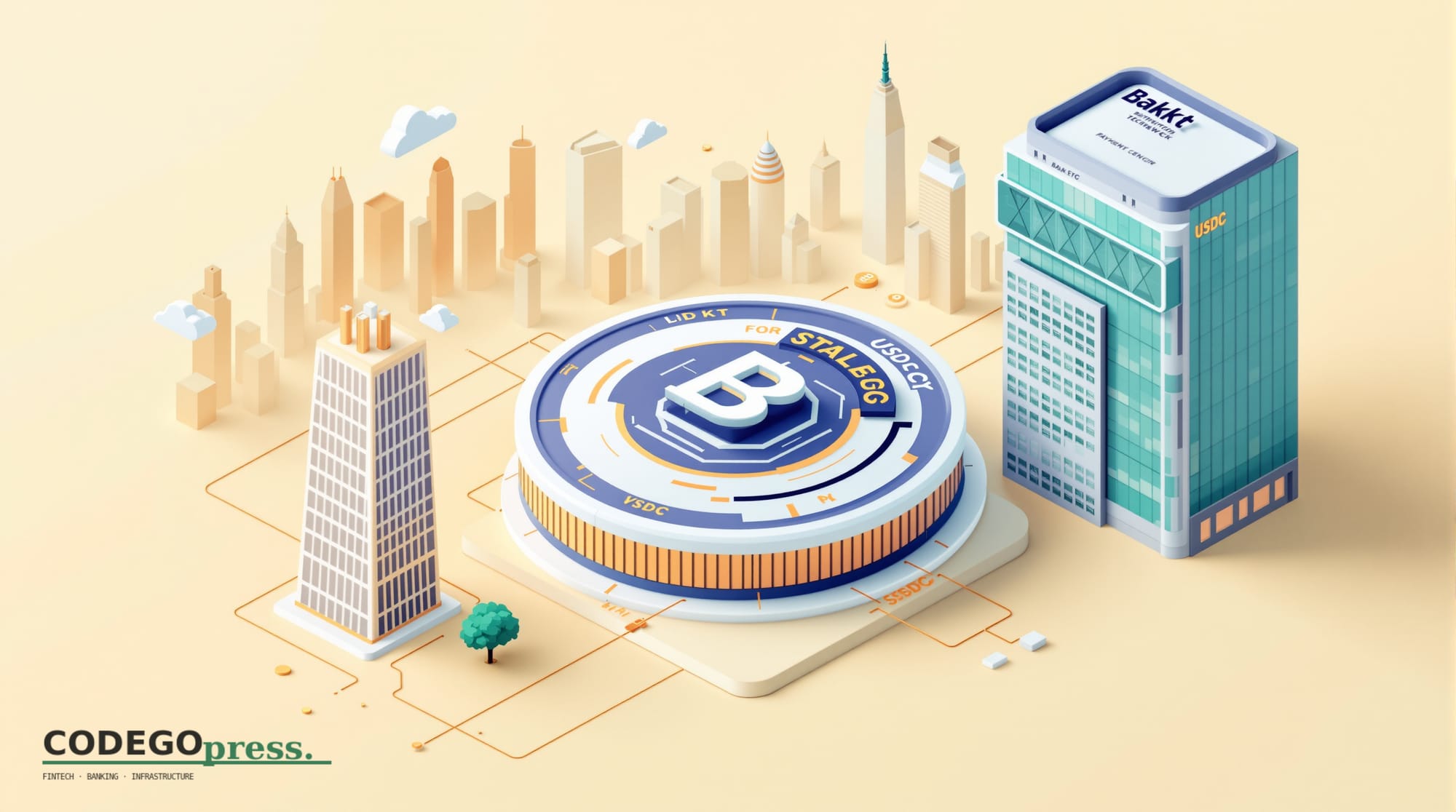
Bakkt has closed its acquisition of Distributed Technologies Research (DTR), formally consolidating stablecoin payment infrastructure under a single operating entity. The deal, announced in January 2026 and now completed, involved the issuance of 9.3 million shares and triggered Bakkt's corporate rebrand to Bakkt Inc.—a nomenclatural reset that underscores the company's departure from its legacy digital-assets exchange heritage toward genuine payment-rail infrastructure. For the broader fintech ecosystem, the move represents a critical inflection: stablecoin payments are no longer a speculative sideshow, but a regulated, institutional-grade settlement mechanism competing directly with traditional card networks and SWIFT corridors.
The acquisition is notable not for novelty, but for pragmatism. Bakkt entered 2025 as a crypto-native trading and custody platform—strategically sound, but operationally constrained to the digital-asset vertical. DTR, by contrast, had built proprietary stablecoin payment rails, compliant with Federal Reserve frameworks and designed to settle fiat-backed transactions at near-zero marginal cost. By merging, Bakkt acquired not a product line, but a regulatory posture: DTR's relationships with payment processors, its KYC/AML (know-your-customer/anti-money-laundering) integrations, and its status as a money-transmitter in key states. The rebrand to "Bakkt Inc." signals that the company no longer identifies as a crypto exchange playing at payments—it is now a payments infrastructure provider that happens to use blockchain settlement.
This distinction matters enormously for card issuers, Banking-as-a-Service platform operators, and embedded finance players. For two decades, the payment card duopoly—Visa and Mastercard—has absorbed and sterilised competitive threats by controlling the rails. Square, Stripe, and others optimised within those rails rather than around them. Bakkt's consolidation of stablecoin infrastructure signals a fundamentally different endgame: a blockchain-native settlement layer that bypasses both card networks and bank clearinghouses. For BaaS providers and fintech issuers currently dependent on interchange economics and card-network rules, the emergence of a credible alternative—one with institutional regulatory approval—is a structural threat disguised as a boutique acquisition.
The timing aligns with regulatory thaw. The Office of the Comptroller of the Currency has signalled openness to stablecoin settlement frameworks. The Securities and Exchange Commission, while vigilant on spot-price manipulation, has not blocked stablecoin rails outright. Federal Reserve officials have begun discussing—privately but unmistakably—how CBDC (central bank digital currency) design will coexist with private stablecoin settlement. Into that regulatory opening, Bakkt steps with DTR's compliance scaffolding already in place. The company can now license its settlement rails to card issuers, corporate treasuries, and payment gateways without the existential regulatory risk that plagued Circle and Paxos (both of which faced state-level license friction in 2024–2025).
Bakkt's move also reflects a strategic lesson learned during the 2022–2023 crypto winter: infrastructure outlasts speculation. When Bitcoin and Ethereum crashed, trading volumes evaporated. But payment infrastructure—the unglamorous work of moving actual fiat and tokenised deposits between counterparties—remained essential. DTR had survived the volatility precisely because its core offering was not price discovery, but settlement finality. By absorbing DTR, Bakkt acquires an annuity-like business model: recurring fees from every transaction routed through stablecoin rails, regardless of market sentiment. For institutional investors and public shareholders (should Bakkt pursue a future listing), that shift from volatility-dependent to volume-dependent revenue is transformative.
The broader implication cuts across the fintech stack. IBAN issuers, such as those relying on Codego's white-label IBAN infrastructure, are beginning to contemplate bridge-payment models: connecting traditional SEPA rails to stablecoin settlement for cross-border and instant-settlement segments. Bakkt's DTR integration accelerates that necessity. If stablecoin-to-IBAN conversion costs drop below SWIFT costs—and DTR's infrastructure suggests that inflection is approaching—corporate treasurers will demand dual-rail payables: ACH/SEPA for domestic stability, stablecoin for cross-border speed and margin relief. Payment processors and acquiring networks that have not begun stress-testing stablecoin settlement layers risk finding themselves relegated to commoditised domestic rails, with real margin compression upstream.
What Bakkt's completion of the DTR acquisition clarifies is that stablecoin payments have crossed from experimental to operational. The company now possesses the regulatory approval, compliance infrastructure, and payment-network relationships necessary to scale. Whether the market adopts stablecoin settlement at the pace incumbents fear remains uncertain—but the pathway is no longer theoretical. For banking infrastructure players, fintech issuers, and payment-network participants, the question is no longer whether stablecoin rails will exist, but whether they will build upon them, compete with them, or become stranded in slower, costlier legacy corridors. Bakkt's rebrand from crypto exchange to payment infrastructure provider is a confession and a prophecy: the future of settlement is blockchain-native, and the conversation has moved from "if" to "how fast" and "at whose margin."
Written by the Codego Press editor — independent banking and fintech journalism powered by Codego, European banking infrastructure provider since 2012.
Sources: Cointelegraph · 1 May 2026