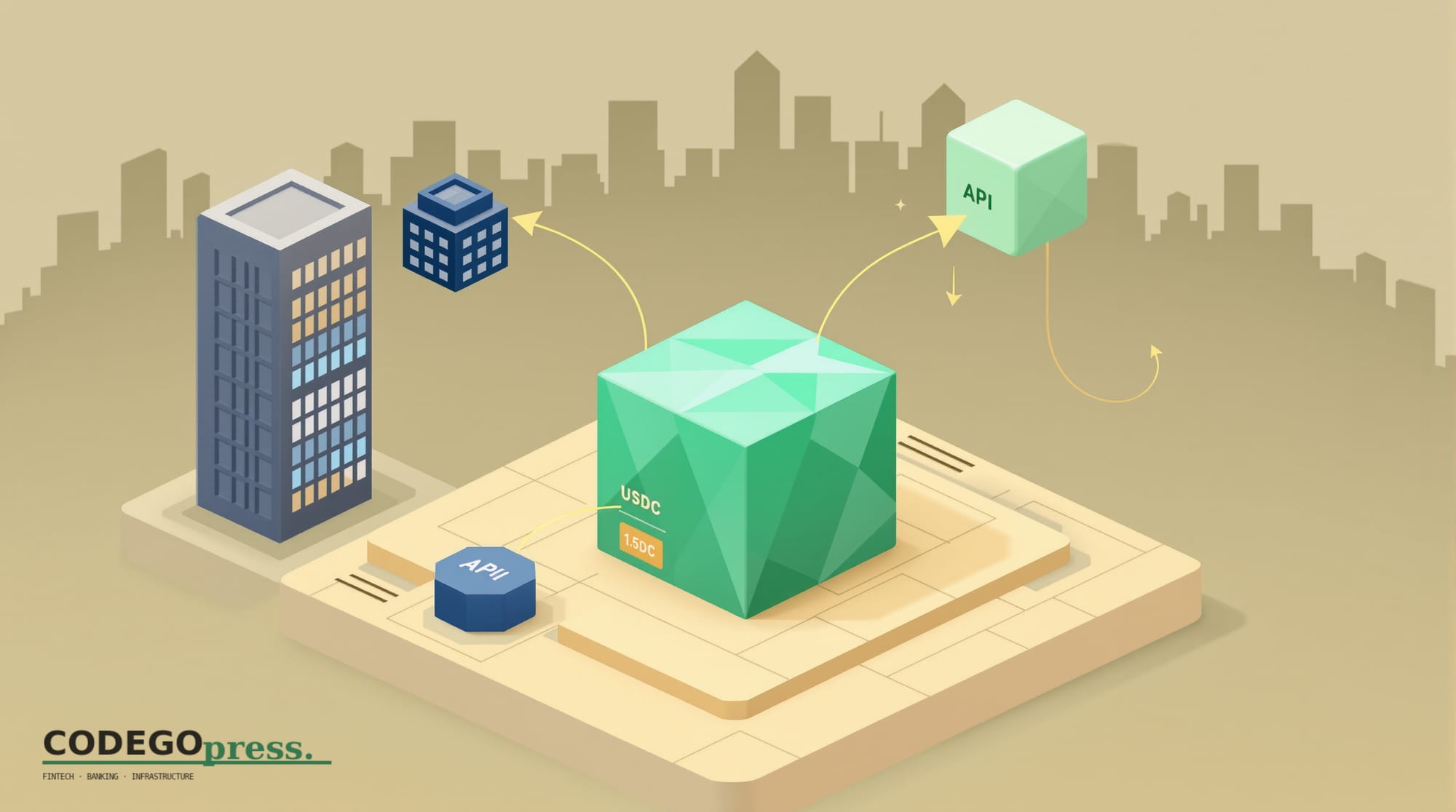
The machinery of commerce has always required intermediaries. Merchants needed banks. Banks needed clearing houses. Clearing houses needed regulators. Each layer added friction, cost, and delay—tolerable when humans remained the primary economic actors, but increasingly untenable as software assumes a larger share of transactional burden. Circle's activation of nanopayments infrastructure on mainnet this week represents a deliberate architect's choice: to build payment rails not optimized for the human wallet, but for the autonomous agent—the algorithmic middleman that may soon execute the majority of economic transactions on behalf of human interests.
The implications deserve scrutiny beyond the launch announcement. Circle's nanopayments layer, operating atop Circle Gateway and settling in USDC stablecoin, creates a specialized conduit for the kind of monetary flows that existing payment infrastructure—Visa rails, ACH batches, blockchain mempools—were never designed to handle efficiently. When software agents negotiate with other software agents, transacting in microsecond intervals and micropenny increments, traditional payment mechanisms become economically nonsensical. Visa charges basis points; nanopayments may involve basis basis points.
This is not merely technological refinement. This is economic infrastructure adaptation to a fundamental shift in who conducts commerce. The emerging agentic economy—where APIs speak to APIs, autonomous algorithms optimize on behalf of users, and machine-to-machine exchanges become the dominant transactional layer—requires payment primitives designed for that world. Humans still initiate; humans still benefit. But the execution layer increasingly operates in a realm where traditional payment categories (debit, credit, wire, ACH) impose unnecessary overhead. A nanosecond delay in settling a machine-to-machine transaction may cost more than the transaction's face value. Fractional cent precision becomes economically material when millions of agents negotiate simultaneously.
Circle's move reflects a broader recognition: stablecoins are not merely digital replicas of fiat currency. They are primitives for building new economic systems atop blockchain settlement. USDC, with its regulatory clarity and institutional backing, becomes the native currency of agent-to-agent commerce in a way that traditional money cannot easily become. It is programmable, auditable, and capable of near-instantaneous finality. These properties matter little for a human buying a coffee. They matter enormously when an AI assistant managing your portfolio makes a thousand micro-trades per second, each one requiring settlement assurance and transparent cost tracking.
The agentic economy is not speculative. It is nascent but empirically underway. Language models increasingly execute against APIs. Autonomous trading systems already dominate equities markets. Recommendation engines make purchasing decisions on behalf of users. As these systems proliferate and acquire greater capital authority, the plumbing carrying value between them becomes strategically critical. Circle is positioning itself as the operator of that plumbing—not the only operator, but an early institutional player with regulatory credentials and direct stablecoin issuance capability.
What makes this development noteworthy for financial infrastructure observers is not the technical feat—blockchain systems have supported micropayments theoretically for years. Rather, it is the deliberate market bet: that the next tranche of payment volume growth will originate not from traditional commerce but from machine-to-machine settlement. This requires not just capability but explicit architectural alignment. A payment system optimized for human commerce is not automatically optimized for agent commerce. The transaction patterns differ. The latency requirements differ. The custody models differ. The regulatory posture differs. Circle is betting that capturing this emerging niche early, before incumbent payment networks adapt, will prove strategically valuable.
The regulatory implications are underexplored. As machine-to-machine settlement accelerates, questions of transparency, auditability, and systemic risk become acute. Who monitors the aggregate flows? What prevents feedback loops in autonomous systems from creating destabilizing cascades? How do sanctions regimes and fraud detection adapt when counterparties are algorithms rather than individuals? These questions remain nascent because the volume remains small. But scale nanopayments sufficiently, and they become regulatory concerns rather than curiosities.
For fintech practitioners and banking infrastructure strategists, Circle's mainnet activation serves as a marker of institutional confidence in agent-based commerce as a material economic vector. It signals that stablecoins are crossing from speculative asset class into productive payment infrastructure for a class of users (software) that traditional finance never needed to serve. Whether nanopayments become the dominant rails for agent commerce, or whether other platforms capture that role, is uncertain. But the emergence of purposeful infrastructure for machine-to-machine settlement suggests that the financial system's next evolution will be measured not in human transactions per second, but in algorithmic exchanges per microsecond—and that the plumbing carrying those flows is being built now.
Written by the editorial team — independent journalism powered by Codego Press.
Sources: Crowdfund Insider · May 3, 2026