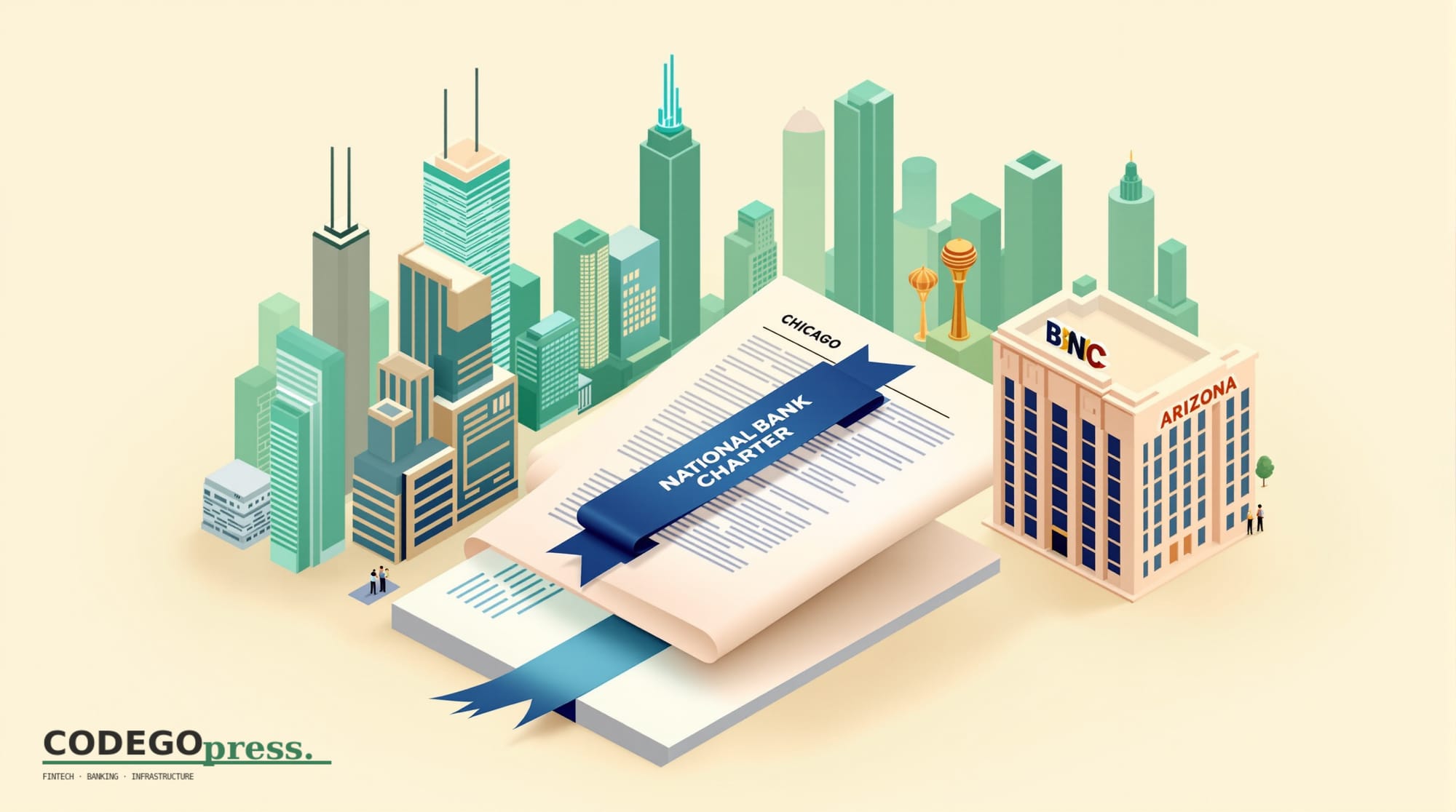
OppFi, the Chicago-based alternative lender that built a $5 billion business underwriting subprime credit online, is executing a strategic manoeuvre that has become fashionable in fintech circles: it is buying a bank charter outright. The $130 million acquisition of BNC National Bank, an Arizona-based depository institution, represents not innovation but a capitulation to regulatory reality. And it raises uncomfortable questions about the future of fintech independence in a world where banking infrastructure increasingly demands institutional credentials.
The transaction is transparent in its logic: OppFi operates a digital lending platform refined over years, but lacks the deposit-taking authority and systemic legitimacy that a national bank charter confers. BNC National Bank, by contrast, holds the prize—a U.S. Office of the Comptroller of the Currency charter, deposit insurance from the Federal Deposit Insurance Corporation, and access to Federal Reserve payment rails. By merging OppFi's lending technology with BNC's charter, the combined entity can offer not just loans but savings products, checking accounts, and the full suite of retail banking services—all under a single regulatory umbrella. It is a marriage of efficiency and legitimacy, and it is entirely legal.
What makes this transaction noteworthy is not its novelty—fintech firms have been acquiring bank charters since the late 2010s—but its timing and its message to the broader ecosystem. As late as 2020, fintech evangelists spoke of "disruption" and regulatory arbitrage: the idea that digital-native platforms could outcompete traditional banks by operating in licensed but less-regulated jurisdictions, or by partnering with chartered institutions while remaining non-bank entities themselves. Wise, Revolut, and others built global payment and currency businesses on the back of PSD2 licenses and sponsor bank partnerships. That model worked when regulators were still figuring out how to classify digital assets and when the compliance burden of full-banking was perceived as prohibitive.
Today, that calculus has inverted. Regulators—particularly in the European Central Bank zone and at the U.S. Federal Reserve—have tightened scrutiny of shadow banking and unregulated lenders. The European Banking Authority has issued guidelines that effectively narrow the window for non-bank financial institutions. Consumer protection demands have risen. Deposit insurance expectations have become non-negotiable for retail customers. In this environment, the cost of remaining a licensed-but-not-chartered fintech has risen faster than the cost of simply acquiring a charter. OppFi's move is a rational response to this pressure.
The strategy has implications for the Banking-as-a-Service (BaaS) and embedded finance landscape that fintech platforms have relied on. Companies like Codego and other BaaS providers have built their businesses on the premise that fintechs do not need to be banks themselves—they can partner with a licensed issuing or acquiring bank, plug into its infrastructure, and focus on customer experience and product innovation. This model remains viable for many use cases: card issuance, payment processing, lending to creditworthy customers. But for lenders operating in higher-risk or higher-volume segments—subprime, consumer installment loans, cross-border remittance—the friction of depending on a sponsor bank grows. Sponsor banks face their own regulatory pressure. They demand ever-higher fees for sponsoring riskier products. They impose underwriting standards that conflict with the fintech's business model. Eventually, acquiring your own charter becomes cheaper than negotiating with a sponsor.
OppFi's acquisition of BNC is thus not a sign of fintech strength but a sign of fintech maturation and pragmatism. The company is no longer a disruptor disrupting from the outside. It is becoming an incumbent acquiring the credentials of incumbency. This is healthy for the financial system—charter acquisition signals that fintech is moving from the periphery into the regulated core—but it is also a retrenchment. OppFi will now face the full compliance apparatus of the OCC, including regular examinations, capital requirements, liquidity stress tests, and consumer compliance audits. Its ability to experiment, pivot, and move fast will be constrained. In exchange, it gains stability, deposit funding, and an imprimatur of safety that justifies lower funding costs.
For regulators, the shift raises its own questions. A wave of fintech charter acquisitions could, paradoxically, increase systemic risk if the OCC approves charters without fully stress-testing the underlying business models for resilience in a downturn. Subprime lending, by definition, carries credit risk. That risk must be held somewhere—in capital, in loan loss reserves, or absorbed by depositors. Moving it into the banking system, rather than keeping it at arm's length in shadow finance, is probably cleaner from a systemic perspective. But it requires that regulators have genuine insight into OppFi's underwriting standards, loss rates, and customer demographics—and that they enforce standards rigorously. Regulatory capture, in which charter-holding fintechs gradually loosen compliance oversight through lobbying or revolving-door hiring, is a real risk.
What this means for the fintech ecosystem is twofold. First, the era of the pure-play fintech platform—remaining forever unlicensed or lightly licensed—is ending. Products and scale require legitimacy. Second, the value of traditional bank charters is rising, not falling. Fintechs that can acquire charters will; those that cannot will depend on increasingly expensive sponsor-bank partnerships or will remain boutique platforms serving niche segments. The middle ground—licensed but not chartered—will narrow. And third, the competitive advantage of fintech is narrowing from "regulatory arbitrage" to "better technology" and "lower customer acquisition cost." That is a healthier competition, but it is also a more mature one.
Written by the Codego Press editor — independent banking and fintech journalism powered by Codego, European banking infrastructure provider since 2012.
Sources: Banking Dive · 29 April 2026