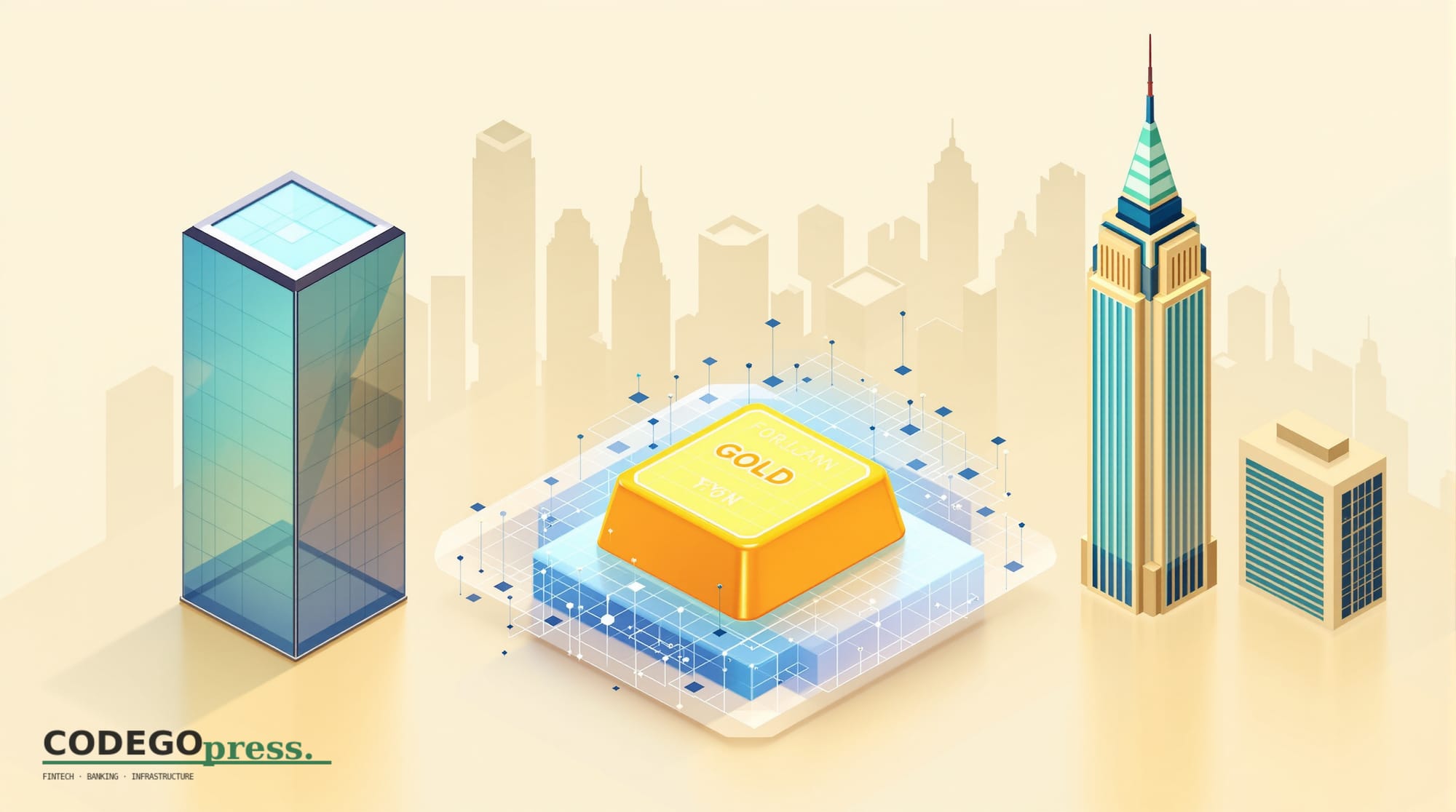
The tokenized commodities market has crossed a structural threshold. In the first quarter of 2026 alone, spot trading of blockchain-backed gold tokens reached $90.7 billion—exceeding the entire 2025 calendar year by $6.1 billion. This acceleration is not a speculative bubble or a niche cryptocurrency phenomenon. It represents a fundamental shift in how institutional and retail participants access safe-haven assets, and it carries immediate implications for banking infrastructure, payment networks, and regulatory frameworks across multiple jurisdictions.
For decades, gold trading operated within constrained windows—London Bullion Market Association (LBMA) trading hours, settled through clearing houses, hedged via futures contracts, or custodied in vaults. Twenty-four-hour blockchain-native gold markets eliminate all friction. A trader in Tokyo, São Paulo, or Lagos can now acquire fractional gold exposure, denominated in stablecoins, settled in minutes, and held in non-custodial wallets. No minimum lot size. No banking hours. No counterparty settlement risk in the traditional sense. The volume surge reflects not irrational euphoria, but rational arbitrage between legacy financial rails and decentralized infrastructure.
The real-world asset (RWA) narrative, once dismissed as speculative tokenization theater, has matured into a genuine asset class. Tokenized gold is the proof. Unlike synthetic derivatives or leverage-based trading, gold tokens represent direct ownership claims on physical bullion held in audited vaults. This distinction matters profoundly for banking regulation. A white-label crypto card platform issuing stablecoin-denominated payment cards now faces a novel competitive pressure: why should end-users hold fiat currency for store-of-value if they can custodize gold-backed tokens and spend them directly via blockchain-enabled payment rails? The answer compels banks and fintech platforms to rethink the deposit base and the velocity assumptions underlying traditional interest-margin models.
This growth also forces reassessment of the relationship between commodity markets and payment infrastructure. Gold tokens trade primarily on decentralized exchanges and specialized RWA platforms, but the economic gravity of $90 billion quarterly volume will inevitably pull traditional market infrastructure—brokers, custodians, clearing houses—into the token ecosystem. LBMA-regulated dealers are already exploring tokenization partnerships. When a Deutsche Bank or ING announces a tokenized gold settlement service, the boundary between traditional commodity finance and blockchain-native settlement will have dissolved entirely.
Regulators have begun to respond. The European Securities and Markets Authority (ESMA) and the Financial Conduct Authority (FCA) are circulating draft guidance on RWA tokenization, focusing on custody standards, redemption rights, and disclosure. The U.S. Securities and Exchange Commission (SEC) has signaled that tokenized commodities backed by physical reserves may qualify for exemption from certain derivatives regulations, provided issuers maintain transparent audit trails and redemption mechanisms. This regulatory clarity, though still incomplete, is widening the aperture for institutional participation.
From a banking-as-a-service standpoint, tokenized gold represents both threat and opportunity. Traditional deposit-gathering models—where banks profit from the spread between deposit rates and lending yields—face pressure as depositors seek yield through commodity tokenization. Conversely, Banking-as-a-Service platforms that integrate gold token custody, settlement, and on-ramp/off-ramp services can position themselves as digital asset infrastructure providers. A fintech operating a BaaS rail can offer a "gold-backed current account" without owning physical bullion—simply by tokenizing exposure and passing redemption requests to licensed custodians. The economics favor incumbents with existing KYC/AML infrastructure and regulatory licenses.
The volume milestone also signals maturation in stablecoin infrastructure. Gold tokens trade almost exclusively against USDC, Tether (USDT), or euro-backed tokens. The stability and liquidity of the stablecoin layer has become the invisible backbone of tokenized commodity markets. Any disruption to stablecoin issuers—regulatory action, custodial breach, or redemption friction—cascades directly into gold token trading. This concentration risk is worth monitoring, particularly as central banks move toward digital currency frameworks that may compete with or subsume private stablecoins.
What this means for the financial system is clear: blockchain-native infrastructure is no longer a sandbox for experimenting with crypto-native assets. It is now the preferred settlement layer for commodities that traditionally required clearinghouses, minimum lot sizes, and banking hours. The next phase will see traditional commodity bourses and investment banks either integrating token rails or ceding market share to decentralized platforms. Regulators will face pressure to harmonize custody standards, settlement finality, and redemption guarantees between tokenized and traditional gold markets. And fintech platforms offering embedded commodity exposure—through cards, payment rails, or BaaS stacks—will find themselves competing directly with broker-dealers for retail and institutional flows.
The $90.7 billion quarterly volume is not an anomaly. It is the sound of a $2.5 trillion commodity market beginning to migrate to blockchains. Banks and fintechs that treat tokenized RWAs as a peripheral curiosity will miss a structural pivot. Those that integrate gold token settlement into their infrastructure will capture disproportionate value in the next financial cycle.
Written by the Codego Press editor — independent banking and fintech journalism powered by Codego, European banking infrastructure provider since 2012.
Sources: BeInCrypto · 1 May 2026