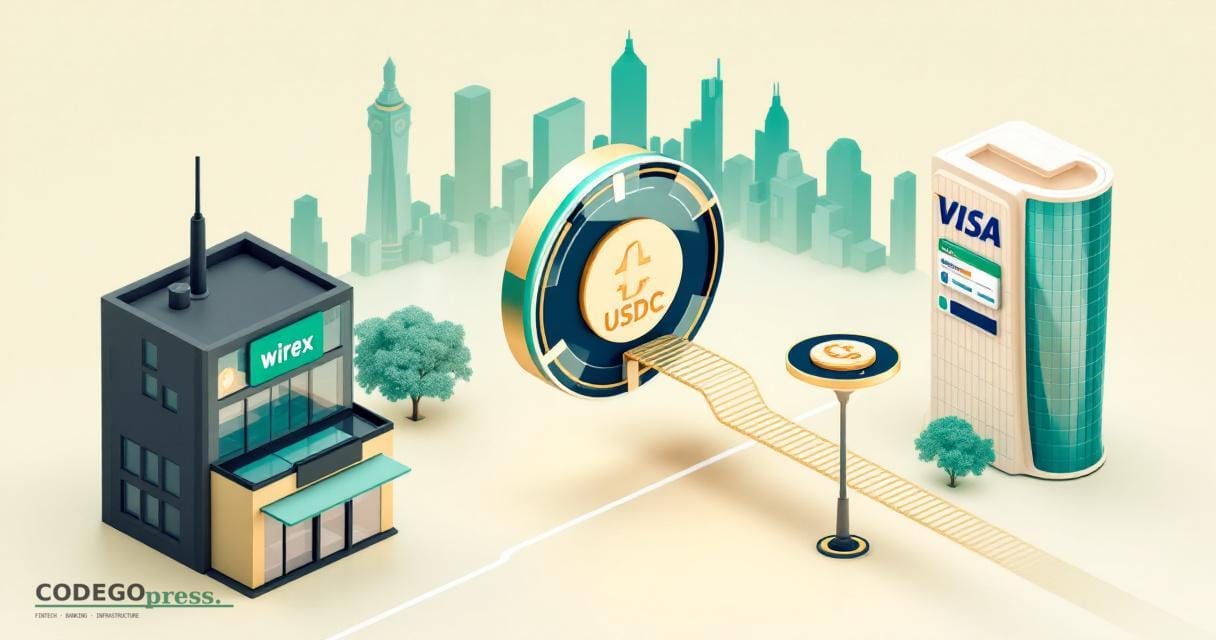
For years, the stablecoin payments industry laboured under a perception problem: experimentally viable, but structurally marginal. Wirex just shattered that narrative. By reaching $1 billion in annualised transaction volume in 131 days, the London-based Banking-as-a-Service (BaaS) provider has set a benchmark that demands serious recalibration of how fintech infrastructure investors and legacy payment processors view the migration of transaction flow onto blockchain-adjacent rails.
The achievement arrives at a inflection point. Stablecoin payments have long suffered from a "who needs it?" problem—a technical solution searching for a business case. Card networks like Visa and Mastercard have entrenched themselves so thoroughly in merchant and issuer infrastructure that proposing an alternative has seemed almost naive. Yet Wirex's trajectory suggests the calculus has shifted. The speed at which the platform onboarded volume—faster than most venture-backed fintechs achieve in three years—indicates that both merchants and issuers recognise genuine operational advantages in stablecoin rails: lower settlement friction, programmable payment logic, and absence of chargebacks in certain use cases.
What makes Wirex's ascent particularly instructive for the Codego readership is the model it validates: BaaS-as-substrate rather than BaaS-as-wrapper. Wirex is not licensing legacy payment rails and bolting fintech features onto them. It is positioning stablecoin infrastructure as a primary rail, enabling card issuers, acquirers, and embedded finance providers to plug into a blockchain-native settlement layer while still maintaining IBAN and traditional UI surfaces for end-users. That architectural choice matters. It sidesteps the regulatory ambiguity that has dogged crypto-native payment platforms and instead leverages the stability and reserve-backing of regulated stablecoins to operate in a zone of relative clarity.
The regulatory environment has cooperated. European Banking Authority guidance on stablecoins, alongside MiCA (Markets in Crypto-Assets Regulation) in the EU, has created a defined perimeter within which stablecoin payment services can operate. That clarity has accelerated institutional adoption in ways that the pre-regulatory crypto era never permitted. Wirex's volume growth, therefore, is not a speculative bubble; it is evidence of a new payment rail achieving critical mass in a legitimised operational environment.
For established card issuers and BaaS providers, Wirex's success poses a strategic question: is stablecoin infrastructure a complement to or a substitute for traditional card networks? The honest answer is neither, yet. Wirex's $1 billion annualised volume is real but remains a rounding error in global payment flows. Mastercard alone processes north of $6 trillion annually. But the trajectory matters more than the absolute. If Wirex doubles annually for the next three years—a conservative extrapolation given its current growth rate—it will command attention from institutional payment processors.
The deeper implication is infrastructural. Stablecoin rails introduce a new vector of competition not on brand or user experience, but on settlement speed and programmability. A BaaS provider that can offer its issuer clients instant settlement, atomic payment-and-invoice matching, and sub-second cross-border transfers has something that traditional ACH, SEPA, or SWIFT cannot easily replicate. Wirex's rapid onboarding of transaction volume suggests that enough BaaS customers and their end-merchants have recognised this advantage to merit operational integration.
Regulators will now watch closely. Financial Conduct Authority oversight of stablecoin payment infrastructure remains vigilant but not antagonistic. The question is whether stablecoin payment volume—particularly in cross-border B2B use cases—will concentrate into a small number of dominant platforms, creating systemic risk vectors that demand macroprudential intervention. Wirex's rapid scaling could itself accelerate such scrutiny.
What this means for the fintech sector is clearer than ever: stablecoin rails are no longer fringe infrastructure. They are becoming mainstream plumbing, integrated into card issuing, embedded finance, and BaaS platforms that serve millions of users. Wirex's record-breaking ascent is not a cryptocurrency story—it is a payments infrastructure story. And for legacy processors and fintech incumbents, it is a reminder that velocity of innovation, when coupled with genuine operational advantage, can compress market capture timelines by orders of magnitude. The next question is not whether stablecoin payments will matter, but how quickly they will displace marginal transaction flows from traditional rails.
Sources: The Fintech Times · 29 April 2026