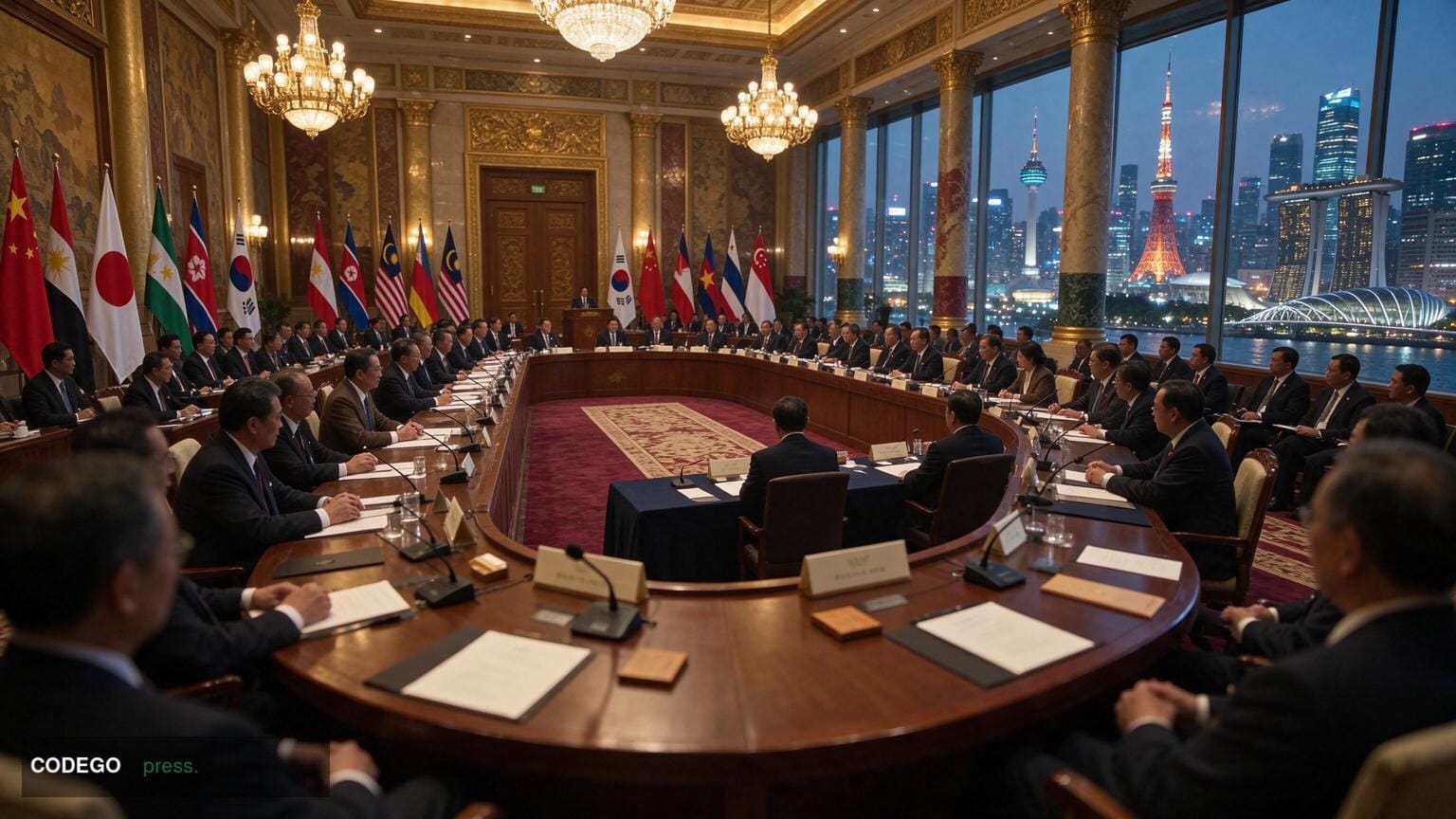
In a development with potentially far-reaching consequences for the architecture of Asian financial markets, finance and central bank deputies from the ASEAN+3 grouping — encompassing the ten-member Association of Southeast Asian Nations alongside China, Japan, and South Korea — have formally agreed to establish a specialized working group dedicated to two of the most consequential issues in modern financial policy: the improvement of cross-border digital payment linkages and the harmonization of digital asset regulation across the bloc. The decision marks one of the most ambitious multilateral regulatory coordination efforts Asia has yet attempted in the digital finance domain.
The ASEAN+3 framework, long recognized as a cornerstone of regional financial cooperation since its formalization in the wake of the 1997 Asian financial crisis, is now turning its institutional weight toward the challenges posed by the rapid proliferation of cryptocurrencies, stablecoins, and real-time cross-border payment infrastructure. By bringing central bank deputies — not merely finance ministry officials — into the founding structure of this working group, the initiative signals that monetary authorities, not just fiscal policymakers, are treating digital asset coordination as a core supervisory priority.
The scale of ambition embedded in this agreement should not be understated. The ASEAN+3 bloc encompasses some of the world's most dynamic digital finance markets. China has pursued one of the world's most advanced central bank digital currency programs with its digital yuan, while Japan has developed a mature and closely regulated cryptocurrency market framework following years of legislative refinement after landmark exchange failures. South Korea, meanwhile, has emerged as one of the most active retail cryptocurrency markets globally, with its own Virtual Asset Service Provider framework now fully operational. The Southeast Asian member states present an equally diverse regulatory tapestry, ranging from Singapore's sophisticated licensing regime to nascent frameworks across emerging economies in the bloc.
Cross-border digital payments represent perhaps the most commercially urgent dimension of the working group's mandate. Despite years of bilateral and multilateral efforts, payment fragmentation across Asian corridors remains a persistent inefficiency. Transaction costs, settlement delays, and regulatory asymmetries continue to impose friction on the region's immense intraregional trade flows. The working group's focus on digital payment linkages suggests an ambition to build upon existing bilateral real-time payment connection experiments — such as those linking Singapore, Thailand, Malaysia, and others — and elevate them into a more systematic, bloc-wide architecture.
The digital asset regulation dimension of the mandate carries its own distinct complexity. Coordinating crypto regulatory approaches across thirteen jurisdictions with fundamentally different legal traditions, financial system structures, and political economies is an undertaking with few precedents in global regulatory history. The European Union's Markets in Crypto-Assets (MiCA) regulation offers one reference point, but the ASEAN+3 context differs markedly: there is no supranational legislative authority, meaning any coordination must rely on voluntary alignment, mutual recognition agreements, or soft-law convergence mechanisms. The working group's effectiveness will likely depend on how much binding discipline its participants are prepared to accept.
From a geopolitical perspective, the involvement of China alongside Japan and South Korea in a shared digital finance regulatory forum carries significance beyond the technical. These three Northeast Asian economies have historically found it difficult to build durable institutional frameworks outside broader multilateral umbrellas, given unresolved historical and territorial tensions. The fact that digital finance regulation — a domain where all three face shared pressures from capital flight risks, illicit finance concerns, and the competitive rise of decentralized platforms — has provided common ground is itself a noteworthy diplomatic development.
Industry participants across fintech and banking sectors operating in the region will be watching the working group's composition and initial workplan closely. Whether the body adopts a narrow technical remit focused on payment interoperability standards, or pursues the broader ambition of genuine regulatory harmonization on digital assets, will determine its practical relevance. The Bank for International Settlements and its Innovation Hub have been active facilitators of cross-border payment experiments across Asian central banks, and it would be reasonable to expect their technical frameworks to inform the new group's deliberations.
What This Means for the Region's Financial Architecture
The establishment of an ASEAN+3 working group on digital payments and crypto regulation is best understood not as a finished policy outcome but as the opening of a structurally significant institutional channel. The mere existence of a formal forum in which thirteen of Asia's most economically consequential finance ministries and central banks share intelligence, compare regulatory approaches, and work toward payment interoperability represents a material upgrade in the region's collective capacity to govern digital finance. For payments firms, digital asset platforms, and financial institutions operating across Asian corridors, the emergence of this body creates both a new compliance horizon to monitor and — if the group achieves genuine convergence — the prospect of a meaningfully more efficient regional operating environment. The months ahead will reveal whether this agreement produces durable institutional architecture or remains an aspirational communiqué. Either way, the signal sent by its announcement is unambiguous: Asia's financial policymakers have concluded that digital assets and cross-border payments are too systemically important to be left to uncoordinated national action alone.
Written by the editorial team — independent journalism powered by Codego Press.