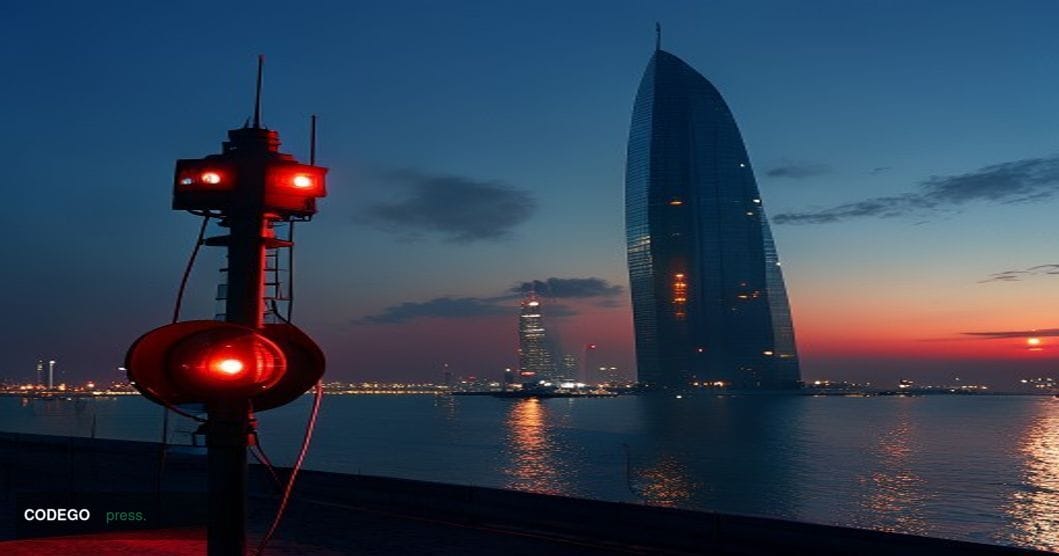
Bahrain activated air raid sirens across the island kingdom on Sunday following a sharply heightened alert level tied to escalating tensions with Iran, a development that sent an immediate signal through regional security circles and began reverberating across global financial markets. The activation marks one of the most overt civil-defense measures the Gulf state has deployed in recent memory, and it arrives at a moment when the broader Middle East security architecture is under severe strain.
A Gulf in Alert Mode
Bahrain occupies a position of outsized strategic significance relative to its modest geography. The island nation hosts the United States Naval Forces Central Command — the Fifth Fleet — making it not merely a Gulf Cooperation Council member but a linchpin of Western military posture in the region. When Bahraini authorities activate air raid infrastructure, the message is not purely domestic. It is a signal readable by every government, every trading desk, and every risk committee with exposure to the Gulf. Sunday's activation was precisely that kind of signal.
The alert follows a pattern of escalating friction between Iran and Gulf Arab states that has intensified through 2026. Tehran's posture across multiple fronts — from its nuclear program to proxy network activity — has kept regional threat assessments elevated. Bahrain, which shares a tense history with Iran rooted in both territorial disputes and sectarian dynamics, finds itself among the most exposed of the Gulf states to any deterioration in that relationship. The sirens heard across Manama on Sunday were the audible expression of a threat calculus that policymakers have been quietly managing for months.
Market Exposure and the Oil Equation
The financial implications of Gulf instability are well-documented and consistently underestimated until a crisis materializes. The Strait of Hormuz, which sits at the neck of the Persian Gulf, channels approximately one-fifth of global oil supply. Any military confrontation between Iran and Gulf states — or between Iran and Western powers operating from Gulf bases — carries the immediate risk of supply disruption on a scale that energy markets have not absorbed in decades. Crude oil benchmarks are highly sensitive to even the perception of Hormuz risk, and Sunday's developments in Bahrain are precisely the kind of event that hardens that perception into price action.
Beyond crude oil, the Gulf region has become an increasingly significant node in global capital markets. Sovereign wealth funds headquartered in the region — including those of Saudi Arabia, the United Arab Emirates, Kuwait, and Qatar — collectively manage assets measured in the trillions of dollars. A sustained security crisis would not only affect their domestic investment environments but could prompt defensive repositioning across global equity, bond, and alternative asset classes. The spillover effects would be neither contained nor linear.
Digital Asset Markets: A Parallel Stress Test
The cryptocurrency and digital asset ecosystem, while sometimes portrayed as insulated from geopolitical turbulence, has demonstrated in prior Gulf crises that it is not immune. Risk-off sentiment triggered by military escalation tends to produce sharp volatility across asset classes, including digital assets, as leveraged positions are unwound and liquidity seeks safety. Bahrain itself has positioned itself as a progressive digital asset regulatory jurisdiction in recent years, with the Central Bank of Bahrain licensing several crypto exchanges and actively developing its fintech regulatory framework. A prolonged security emergency would cast uncertainty over that regulatory momentum and dampen the investment appetite that has been building in the kingdom's financial technology sector.
The Gulf's broader digital finance ambitions — including central bank digital currency pilots and cross-border payment infrastructure development being pursued across the region — are contingent on a stable operating environment. Geopolitical shock does not merely disrupt physical infrastructure; it disrupts the institutional confidence required for long-horizon financial innovation projects to attract capital and regulatory commitment.
What This Means for Markets and Institutions
The activation of air raid sirens in Bahrain is not, on its own, evidence of imminent military conflict. Civil-defense systems are designed to communicate heightened readiness, and governments activate them in anticipation of threats as much as in response to confirmed attacks. However, the threshold for such a public measure is high, and the decision to cross it reflects an intelligence and threat assessment environment that regional and global stakeholders must take seriously.
For financial institutions with Gulf exposure — whether through sovereign debt holdings, energy derivatives, project finance commitments, or digital asset operations — the events of July 12, 2026, represent a clear instruction to review and stress-test geopolitical risk assumptions. The Gulf has long been treated as a manageable risk environment punctuated by periodic spikes; the current trajectory suggests that framing may require revision. Risk premiums on Gulf-linked assets, already under pressure, face further recalibration if the security situation continues to deteriorate. Markets that ignored the warning embedded in Sunday's sirens will do so at their own cost.
Written by the editorial team — independent journalism powered by Codego Press.