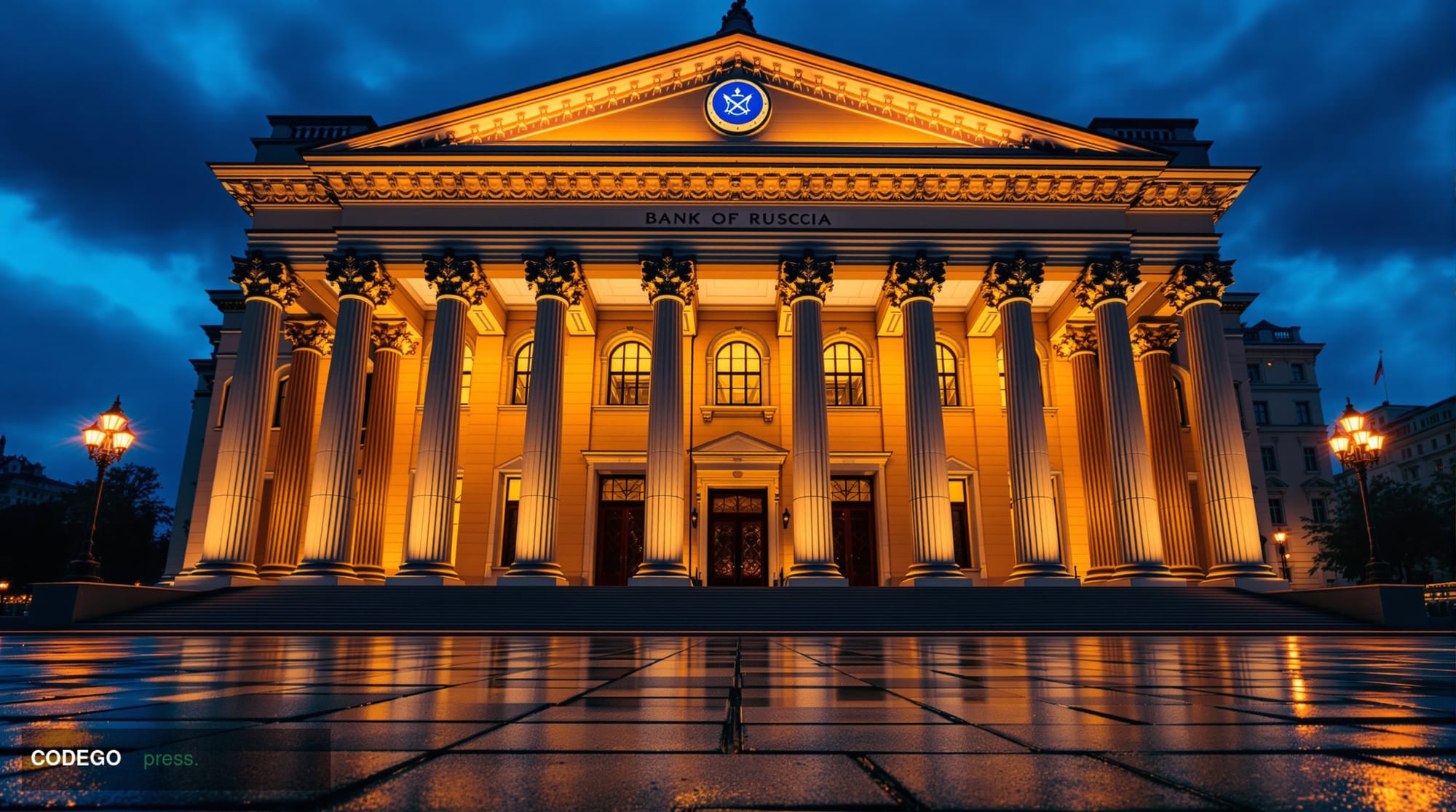
Russia's central bank moved to dramatically narrow the universe of permissible cryptocurrency assets for ordinary investors on Tuesday, August 11, 2026, when the Bank of Russia published proposed rules that would restrict retail participants to trading just three digital assets: Bitcoin, Ether, and Tether's USDT stablecoin. The proposal also imposes a hard annual ceiling of 300,000 rubles — roughly $3,600 at current exchange rates — on purchases of each of those assets, signaling Moscow's intent to tightly corral retail exposure to digital currency markets even as it permits their existence.
A Narrow Gate, Not an Open Door
The framing of this regulatory proposal is as significant as its substance. By selecting precisely three assets — a proof-of-work store of value, a programmable smart-contract platform, and a dollar-pegged stablecoin — the Bank of Russia is not endorsing a broad crypto economy. It is drawing a deliberately tight perimeter around the instruments it considers sufficiently liquid, globally recognized, and, crucially, monitorable. Every other token, altcoin, or decentralized finance protocol that has proliferated across global markets in recent years would, under this framework, be off-limits entirely for Russian retail participants.
The 300,000-ruble annual limit per currency is instructive on its own terms. At approximately $3,600 per asset class, the ceiling sits low enough to prevent meaningful capital accumulation through crypto channels while still permitting a degree of retail participation that the authorities can market as tolerance. A Russian investor could in theory deploy up to 900,000 rubles — around $10,800 — across all three permitted assets in a given year, but that aggregate figure still represents a modest sum by the standards of active retail investors in liquid markets.
Context: Sanctions, Capital Controls, and Digital Asset Strategy
The proposal does not emerge in a vacuum. Since the imposition of sweeping Western sanctions following Russia's 2022 invasion of Ukraine, the Russian financial system has operated under extraordinary strain, with large segments of the population cut off from conventional cross-border financial infrastructure. Cryptocurrency, particularly dollar-pegged stablecoins such as USDT, has served in practice as an unofficial pressure valve — enabling Russians to hold dollar-denominated value outside the traditional banking system. The Bank of Russia's move to formally permit USDT while capping its purchase volume can be read as an attempt to acknowledge that reality while simultaneously preventing large-scale dollarization through the crypto channel.
Moscow's relationship with digital assets has long been characterized by ambivalence. For years the Bank of Russia advocated for outright bans on retail crypto trading, while other arms of the Russian state — including the Ministry of Finance — pushed for a regulated, taxable framework. The August 2026 proposal represents a negotiated middle ground: permission, but permission circumscribed by limits stringent enough to restrain the market's scale.
Implications for the Global Stablecoin Debate
The inclusion of Tether's USDT on Russia's approved list carries implications that extend well beyond Russia's borders. USDT, issued by Tether, remains the world's largest stablecoin by market capitalization and has faced persistent scrutiny from Western regulators over reserve transparency and its potential role in sanctions evasion. That Russia's central bank would explicitly enshrine USDT as one of only three permissible retail crypto assets will likely intensify the pressure on Tether and Western policymakers alike. For regulators in Washington and Brussels who have spent years debating how to tighten oversight of dollar-pegged stablecoins, Russia's formal embrace of USDT as a sanctioned-economy instrument adds an awkward geopolitical dimension to what was already a complex regulatory conversation.
What This Means for Russian Retail Investors
For ordinary Russian citizens who have navigated an increasingly isolated financial system, the proposed rules represent a double-edged development. On one hand, they offer a degree of legal clarity that has been conspicuously absent: retail investors would know precisely which assets they may hold and what annual volumes are permissible, reducing the legal ambiguity that has discouraged some from participating at all. On the other, the 300,000-ruble-per-currency annual cap is restrictive enough that it would barely serve as a hedge against the ruble's historical volatility, let alone a meaningful investment position. Those who have already accumulated larger crypto holdings through informal channels will be watching closely to see how the Bank of Russia proposes to treat existing positions under any transitional provisions.
As a proposed rule rather than enacted legislation, the framework remains subject to revision. The Bank of Russia's history of iterating on digital asset policy — often substantially between proposal and implementation — means that the final limits, the approved asset list, and the enforcement mechanisms could all shift before any rules take effect. What is already clear, however, is that Russia's direction of travel is toward a tightly controlled, state-supervised crypto market rather than the open, decentralized ecosystem that the underlying technology was designed to enable.
Written by the editorial team — independent journalism powered by Codego Press.