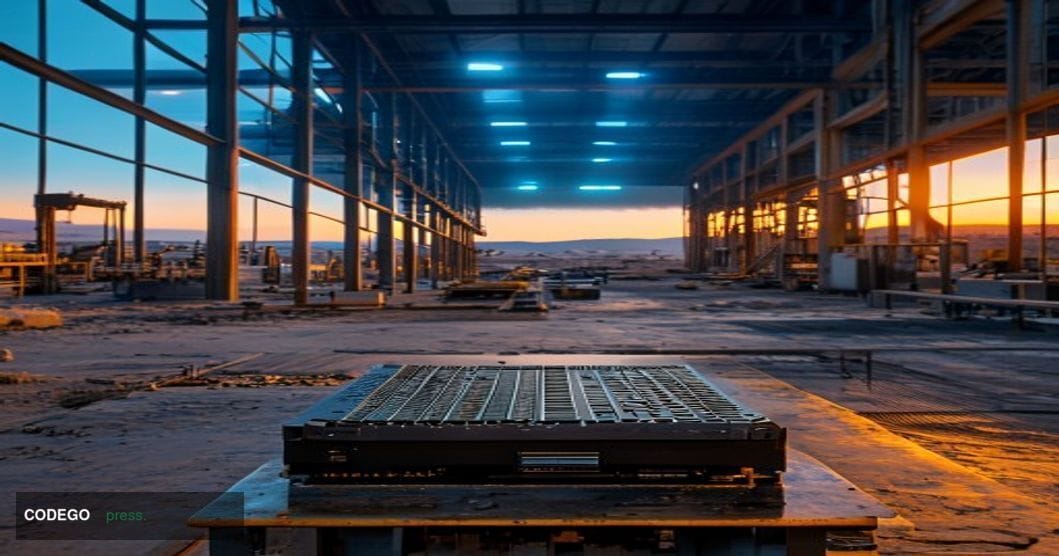
Shares of Bitdeer surged 14% after the cryptocurrency mining company announced it will invest $36 million to construct a dedicated manufacturing facility in Nevada, purpose-built to produce its proprietary SEALMINER line of Bitcoin mining machines. The announcement marks a significant strategic pivot toward domestic hardware production, positioning Bitdeer at the intersection of two powerful market forces: surging institutional demand for Bitcoin mining infrastructure and a broader industrial push to repatriate semiconductor and hardware manufacturing to American soil.
A $36 Million Bet on American Manufacturing
The Nevada facility represents one of the more substantial capital commitments in the Bitcoin mining hardware space this year. At $36 million, the investment signals that Bitdeer is not merely dabbling in vertically integrated production — it is making a structural commitment to owning the full supply chain, from chip design through to finished mining rigs assembled on United States territory. For a company whose SEALMINER brand has been gaining recognition as a competitive alternative to dominant Asian manufacturers, the move to produce domestically carries both commercial and geopolitical significance.
The timing of the announcement is far from incidental. Trade tensions, tariff uncertainty, and ongoing supply chain disruptions have made the dependence on overseas hardware production an acute vulnerability for Bitcoin miners operating primarily in North America. By establishing a manufacturing base in Nevada, Bitdeer insulates itself — and potentially its customers — from the logistical and cost volatility that has plagued the sector. Nevada's favorable regulatory environment for energy-intensive industries, combined with competitive real estate and an established industrial workforce corridor, makes it a pragmatic choice for a facility of this nature.
SEALMINER and the Hardware Arms Race
The SEALMINER product line sits at the core of this expansion strategy. Bitcoin mining hardware is one of the most competitive and technically demanding segments of the broader digital asset industry, where efficiency — measured in terahashes per second per watt of electricity consumed — determines profitability margins on a per-machine basis. Companies that can design, manufacture, and rapidly iterate on their own application-specific integrated circuit (ASIC) miners enjoy a compounding competitive advantage: they control costs, delivery timelines, and technology roadmaps in ways that pure-play miners relying on third-party hardware cannot.
Bitdeer's decision to scale SEALMINER production through a dedicated domestic facility suggests confidence in both the technical maturity of its hardware and the durability of customer demand. Bringing manufacturing stateside also removes the months-long shipping lead times that have historically constrained mining operators from rapidly scaling capacity in response to favorable Bitcoin price environments. In a sector where network difficulty adjusts every two weeks and profitability windows can open and close quickly, that operational agility has tangible financial value.
Market Reaction and Investor Sentiment
A 14% single-session stock rally is a meaningful signal in any market context. For a company operating in the volatile mining hardware vertical, it suggests investors interpreted the Nevada announcement not merely as a capital expenditure but as a forward-looking indicator of competitive positioning and revenue diversification. Hardware sales generate a materially different revenue profile than self-mining operations — they offer higher margin potential during bull markets when demand for mining equipment spikes, and they reduce Bitdeer's direct exposure to Bitcoin price fluctuations compared to a pure-mining business model.
The market's enthusiasm also likely reflects broader sector tailwinds. Bitcoin's maturation as an institutional asset class has driven sustained investment in mining infrastructure, and the passage of clearer regulatory frameworks in the United States has encouraged longer-term capital planning among operators. Companies capable of supplying hardware domestically stand to benefit disproportionately as North American miners seek supply chain certainty.
What This Means for the Industry
Bitdeer's $36 million Nevada facility is more than a single corporate announcement — it is an early signal of a potential structural shift in where Bitcoin mining hardware gets made. For years, the ASIC manufacturing industry has been dominated by manufacturers based in Asia, principally in China and, to a growing degree, in Southeast Asia. The emergence of a credible domestic United States manufacturer with a named product line like SEALMINER challenges that geography, particularly as American policy increasingly incentivizes strategic technology manufacturing on home soil.
If the Nevada facility delivers on its production targets, Bitdeer could find itself occupying a uniquely advantageous position: a vertically integrated mining company with domestic hardware capabilities at a moment when the market places a premium on exactly that combination. The 14% share jump suggests the investment community is already pricing in that possibility. Whether the operational execution matches the strategic ambition will be the defining question as the facility moves from announcement to production.
Written by the editorial team — independent journalism powered by Codego Press.