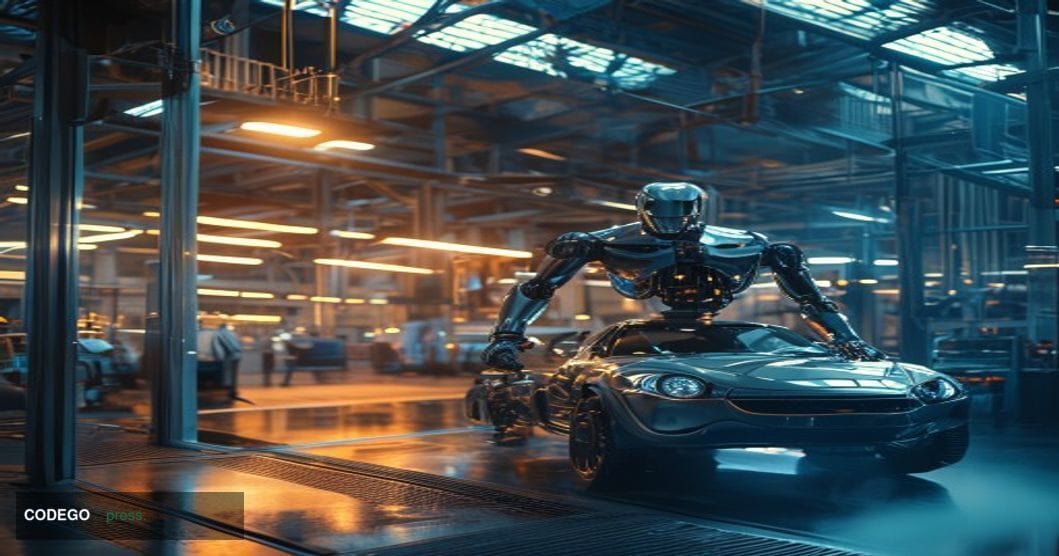
BMW has taken a consequential step toward redefining the future of automotive manufacturing by deploying next-generation humanoid robots on the production floor of its South Carolina facility — a move that carries implications reaching far beyond a single assembly line. At a moment when global industry leaders are scrambling to automate intelligently rather than merely mechanically, BMW's embrace of humanoid robotics signals that the automotive sector is entering a genuinely new industrial era.
The South Carolina plant, long considered one of BMW's flagship North American manufacturing hubs, has become the latest proving ground for technology that until recently existed primarily in laboratory demonstrations and venture-capital pitch decks. By integrating humanoid robots — machines designed to navigate, manipulate, and operate within environments built for human bodies — into an active, high-throughput production environment, BMW is stress-testing a concept that could fundamentally alter how factories are designed, staffed, and financed.
Why Humanoid Robots, and Why Now
The distinction between conventional industrial robots and humanoid robots is not merely aesthetic. Traditional robotic arms excel at repetitive, fixed-position tasks, but they require expensive custom tooling and purpose-built workstations. Humanoid robots, by contrast, are engineered to operate within the same spatial and ergonomic constraints as human workers — reaching overhead, navigating narrow corridors, and adapting to variable tasks without wholesale reconfiguration of the surrounding infrastructure. For a manufacturer like BMW, which produces a diverse portfolio of models on shared platforms, that flexibility is not a marginal advantage; it is a strategic premium.
The efficiency gains at stake are substantial. Manufacturing ergonomics — the science of designing work processes to minimize human physical strain — has long been a cost center for automotive producers, driving expenditure on workplace injury compensation, lost productivity, and line redesigns. By delegating physically demanding or repetitive ergonomic-risk tasks to humanoid robots, BMW stands to reduce those costs materially while simultaneously improving throughput consistency. The company's deployment in South Carolina is explicitly framed around both efficiency and ergonomics, suggesting a dual mandate: produce more, and protect the human workforce that remains.
The Broader Industrial Stakes
BMW's move does not exist in isolation. The global race to operationalize humanoid robotics in real manufacturing settings has intensified dramatically over the past two years, with companies including Tesla, Figure AI, and Agility Robotics all pursuing commercial-scale deployments. What distinguishes BMW's South Carolina initiative is the pedigree of the environment: a high-complexity, high-volume automotive plant is among the most demanding operational contexts any autonomous system can face. Success here carries an industry-wide credibility that a warehouse pilot or controlled laboratory trial simply cannot replicate.
The implications for global industry standards are significant. If BMW's deployment demonstrates measurable gains in production efficiency and worker ergonomic outcomes, it will intensify pressure on rival automakers — and manufacturers across adjacent sectors — to accelerate their own humanoid robotics programs. Regulatory bodies overseeing workplace safety, alongside international standards organizations, will likely be compelled to develop new frameworks governing human-robot collaboration on active production lines. The South Carolina factory, in this sense, is not merely a manufacturing site; it is a standard-setting laboratory whose outputs will reverberate through boardrooms and regulatory chambers on multiple continents.
Financial and Investment Dimensions
From a capital-markets perspective, the deployment reinforces a broader investment thesis that has been driving valuations in the industrial robotics and artificial intelligence sectors. Venture capital and private equity flows into humanoid robotics have accelerated sharply, and each credible large-scale industrial deployment — particularly by a blue-chip manufacturer of BMW's stature — serves as a proof-of-concept that de-risks the sector for institutional investors. The announcement will inevitably focus analyst attention on the cost economics of humanoid deployment at scale: amortization of hardware investment against labor cost savings, maintenance expenditure, and the training overhead associated with programming machines to perform nuanced physical tasks.
BMW has not disclosed specific financial parameters around the South Carolina rollout — investment figures, unit counts, or projected productivity targets remain undisclosed at this stage. That information gap is itself notable. It suggests either that the program is still in a sufficiently early phase that definitive metrics are not yet available, or that competitive sensitivity has led the company to withhold details that rivals could exploit. Either way, the market will watch subsequent earnings disclosures and manufacturing output data from the South Carolina facility with heightened interest.
What This Means for Manufacturing's Future
BMW's humanoid robot deployment in South Carolina is best understood not as a finished achievement but as an opening move in what promises to be a multi-decade transformation of industrial production. The efficiency and ergonomic arguments are compelling in isolation, but the deeper significance lies in normalization: a globally recognized premium automaker has placed next-generation humanoid machines on a live production floor and declared it a strategic priority. That act of institutional confidence will lower the psychological and procurement barriers for manufacturers across industries who have been watching from the sidelines.
For financial professionals, the event is a prompt to reassess exposure to both traditional industrial automation incumbents and the newer cohort of humanoid robotics developers. For policymakers, it is a signal that workforce transition planning can no longer treat advanced humanoid robotics as a distant theoretical concern. And for the global manufacturing industry, BMW's South Carolina plant has just become a site worth watching very closely indeed.
Written by the editorial team — independent journalism powered by Codego Press.