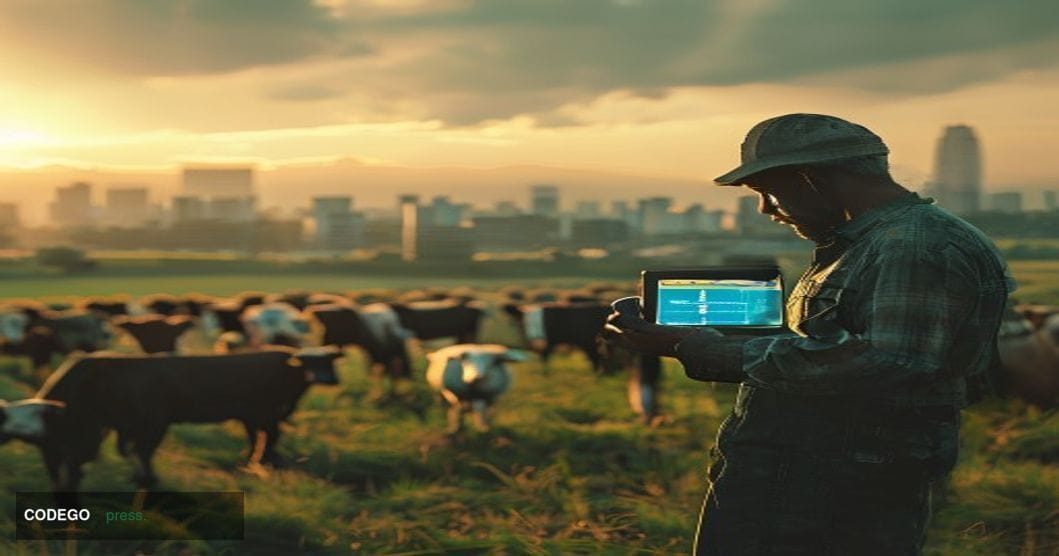
For generations, Brazilian dairy farmers have financed their operations through a patchwork of rural credit lines, government subsidies, and personal relationships with regional lenders. That system is now under severe strain. As the dairy sector's credit crisis deepens, a pioneering blockchain-based solution has emerged — one that turns a farmer's herd of cows into a digitally verifiable, exchange-listed asset capable of unlocking formal capital markets financing. The first tokenized livestock deal on Brazil's stock exchange has now been completed, and industry observers say it could fundamentally reshape how one of the world's largest agricultural economies thinks about rural credit.
A Credit Crisis With Deep Roots
Brazil's dairy sector has long operated at the margins of the country's formal financial system. Small and medium-scale dairy farmers, who account for the majority of national milk production, frequently lack the collateral documentation that commercial banks require to extend credit. Land titles are often disputed or informally held, equipment is aging, and income is highly seasonal. The result is a structural credit gap that leaves farmers unable to invest in herd quality, feed efficiency, or infrastructure — and therefore unable to compete as input costs rise. The crisis has not been a sudden shock but a slow, grinding contraction of available financing that has forced many producers to reduce herd sizes or exit the sector entirely.
Tokenizing the Herd: How It Works
The tokenization model addresses this gap by converting physical cattle into blockchain-registered digital tokens, each representing ownership or a secured interest in one or more animals within a verified herd. By recording these assets on a distributed ledger and listing them on Brazil's stock exchange infrastructure, lenders gain a level of transparency and enforceability over collateral that a handwritten inventory document or a rural registration certificate could never provide. The token carries verifiable data about the animal — weight, health records, breeding lineage, and location — that can be audited in near real time. For a lender, this transforms a cow from an opaque, illiquid, and geographically remote asset into a structured, monitored financial instrument.
The significance of executing this transaction through the stock exchange cannot be overstated. Exchange listing imposes standardization, regulatory oversight, and secondary market potential that bilateral agricultural lending arrangements entirely lack. It means that tokenized cattle positions could, in principle, be traded, hedged, or used as collateral in more complex structured finance arrangements — opening the door for institutional capital that would never participate in a direct farm loan.
Why Dairy Farmers Specifically
The dairy subsector was not chosen arbitrarily. Milk production in Brazil is characterized by relatively predictable cash flow cycles tied to collection schedules with large dairy processors, which provides an underlying revenue stream that can support loan repayment structures. Dairy cattle also have well-established market valuation benchmarks, making the pricing of tokenized assets more defensible to credit committees. And because the credit crisis has hit dairy producers particularly hard — squeezed between rising feed and energy costs on one side and volatile farmgate milk prices on the other — the urgency to find alternative financing channels is acute. Tokenization offers a mechanism by which a farmer's existing productive assets can be mobilized without requiring them to sell the herd or surrender operational control.
Blockchain as Rural Infrastructure
What makes this development notable beyond its novelty is what it implies about the role of blockchain technology in emerging-market financial inclusion. Brazil is already one of the most active jurisdictions globally for financial technology experimentation, with its Banco Central do Brasil having pioneered the Pix instant payment system and actively exploring a central bank digital currency. The tokenization of agricultural assets fits into a broader national narrative about using technology to extend the reach of formal financial markets into sectors and geographies that legacy infrastructure cannot efficiently serve. In a country where agriculture represents a substantial share of gross domestic product and exports, the stakes of getting rural finance right are macroeconomic, not merely sectoral.
The involvement of the stock exchange as the settlement and registration venue also suggests that Brazilian regulators and exchange operators are willing to accommodate genuinely novel asset classes, provided that appropriate disclosure and custody standards are met. This regulatory pragmatism is itself a form of competitive advantage that positions Brazil ahead of many peer economies in the race to translate blockchain's theoretical promise into operational financial infrastructure.
What This Means for Agricultural Finance
The completion of Brazil's first tokenized livestock transaction on an exchange should be understood as a proof of concept with significant replication potential. If the credit performance of early deals holds — if farmers repay, if lenders recover collateral efficiently when needed, and if the operational complexity of managing tokenized herds proves manageable — the model will attract imitators. Other livestock categories, crop inventories, and equipment pools could follow the same template. Regional development banks, agribusiness lenders, and international impact investors focused on food security and smallholder finance are all natural future participants in a mature tokenized agricultural credit market.
For dairy farmers struggling to access the working capital they need to remain viable, the immediate impact is more personal: a blockchain token attached to their herd may prove to be the most powerful financial tool they have ever held. That an exchange-listed digital asset now offers a lifeline where traditional banking has failed is both a commentary on the inadequacy of legacy rural finance and a compelling demonstration of what tokenization, applied with purpose and precision, can actually accomplish in the real world.
Written by the editorial team — independent journalism powered by Codego Press.