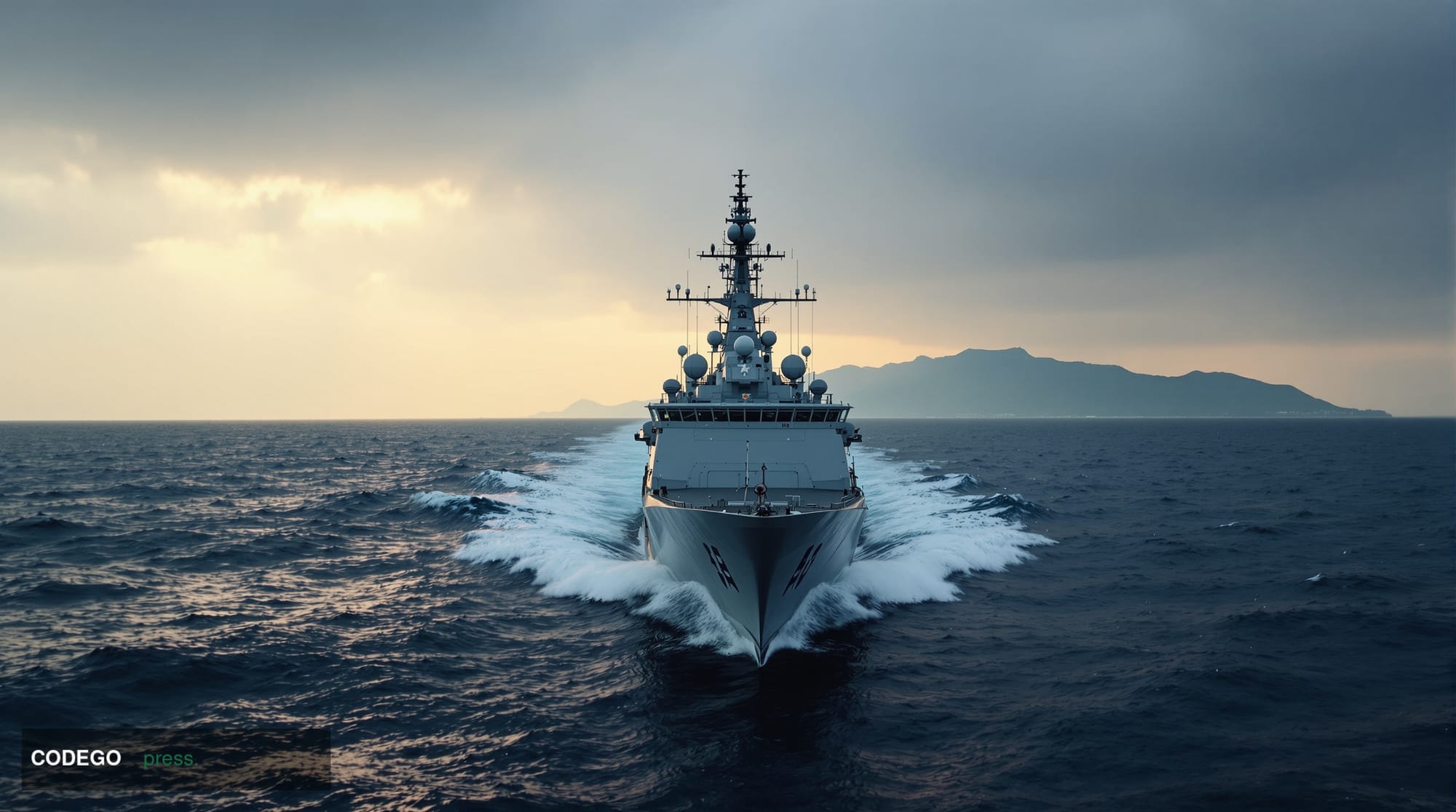
China's deployment of coast guard vessels to waters east of Taiwan marks a significant and deliberate geographic escalation, shifting patrol activity beyond the Taiwan Strait and into the Pacific approaches that ring the island's less-monitored eastern flank. The move has immediately registered across financial markets, where analysts and risk desks are reassessing the probability of military confrontation in one of the world's most economically consequential flashpoints.
The strategic significance of operating east of Taiwan cannot be overstated. The Taiwan Strait's western channel has long been the primary theatre of cross-strait posturing, but patrol activity on the Pacific-facing eastern side effectively completes a maritime encirclement posture — one that military analysts have previously described as a prerequisite rehearsal for any serious blockade scenario. That China Coast Guard vessels rather than People's Liberation Army Navy warships are being used offers Beijing a measure of legal and diplomatic deniability, while still projecting a forward presence that Taipei and Washington are unlikely to ignore.
From a market perspective, the timing carries its own weight. Geopolitical risk premiums, which had receded modestly across Asian equity and currency markets earlier in 2026, are once again being priced with greater urgency. Investors with exposure to Taiwan's semiconductor supply chain — anchored by firms whose fabrication capacity underpins a vast share of global technology output — are particularly sensitive to any signal that the operational tempo around the island is accelerating. A disruption to that supply chain, even a temporary one driven by insurance and shipping route concerns rather than direct conflict, would transmit shock through every major technology-dependent economy.
The broader regional context amplifies the concern. Tensions in the Association of Southeast Asian Nations corridor have remained elevated through much of 2025 and into 2026, with overlapping disputes in the South China Sea providing a continuous backdrop of low-level friction. Beijing's decision to extend its coast guard footprint to the eastern Pacific approaches of Taiwan does not exist in isolation — it is the latest data point in a pattern of incremental boundary-testing that has characterized Chinese strategic behavior in the region for over a decade.
For financial institutions and corporate treasury functions managing Asia-Pacific exposure, the east-of-Taiwan patrol introduces a new variable into scenario planning. The eastern coastline has traditionally been considered the island's more secure maritime corridor, used for logistics, energy imports via tanker, and submarine cable infrastructure that carries a substantial portion of the region's internet traffic. Coast guard activity in that zone, even if currently limited to presence patrols, raises the operational risk calculus for shipping insurers, logistics operators, and telecommunications firms with infrastructure passing through those waters.
Currency markets are watching the Central Bank of the Republic of China (Taiwan) for any sign of defensive intervention or capital flow management. A sustained elevation in perceived conflict risk historically correlates with outflows from the New Taiwan dollar and increased demand for safe-haven assets including the Japanese yen, gold, and — in recent cycles — certain digital asset classes perceived as jurisdictionally neutral stores of value. Whether those correlations hold in a more acute escalation scenario remains a subject of active debate among macro strategists.
Washington's response, or the absence of one, will itself be a market signal. The U.S. Department of State and the Pentagon have consistently described the Taiwan Strait as an international waterway, but the eastern Pacific approaches carry different legal characterizations that could complicate a swift diplomatic counter-narrative. How the United States and its regional allies — particularly Japan and the Philippines — frame their response will shape whether this episode is absorbed as routine coercive signaling or treated as a qualitative shift in China's operational posture.
What This Means for Markets and Risk Managers
The China coast guard's move east of Taiwan represents more than a military or diplomatic development — it is a direct input into the risk models that govern capital allocation across the Indo-Pacific. Sovereign risk desks will be updating Taiwan-linked scenario weights. Shipping and trade finance underwriters will be revisiting eastern Taiwan route assumptions. Technology supply chain managers will be stress-testing their concentration in Taiwan-based manufacturing against a wider range of disruption scenarios than they modeled even six months ago. The patrol may prove to be a contained episode of coercive diplomacy that de-escalates quietly. But the fact that markets are no longer treating that as the base case is itself a material shift in the regional risk environment — one that financial decision-makers cannot afford to discount.
Written by the editorial team — independent journalism powered by Codego Press.