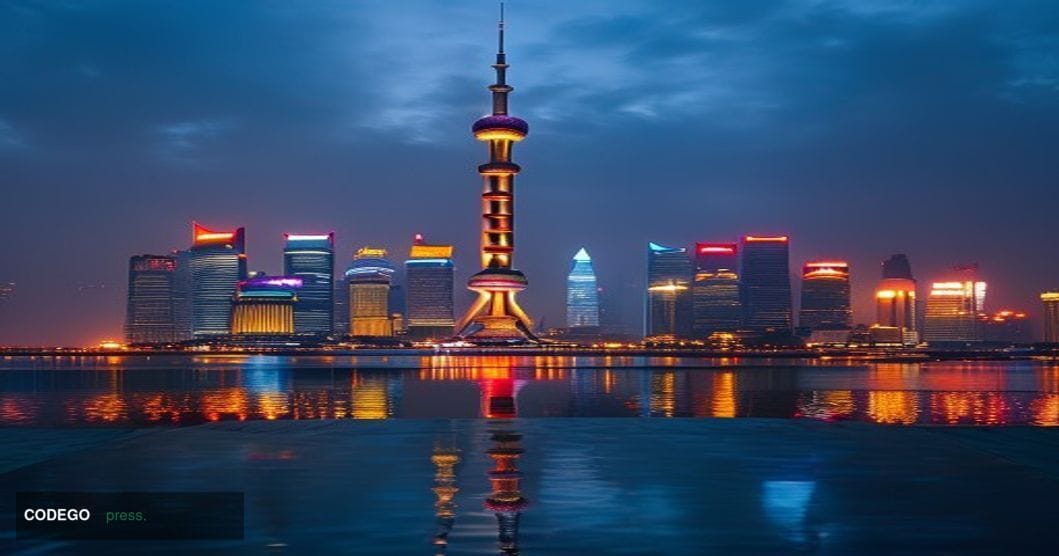
At the 2026 Lujiazui Forum in Shanghai, one of China's most closely watched annual gatherings of financial policymakers and market participants, People's Bank of China Deputy Governor Zhu Hexin delivered a keynote address that placed the question of global capital flow dynamics — and China's deliberate response to them — squarely at the centre of the international financial policy conversation. The speech, subsequently published by the Bank for International Settlements on 1 July 2026, signals that Beijing's commitment to high-level financial opening is not merely rhetorical but is being actively framed within the context of a materially shifting global investment landscape.
A Pivotal Moment for Cross-Border Capital
The timing of Zhu Hexin's address is itself significant. Global capital flows have undergone substantial structural realignment over the past several years, driven by divergent monetary policy cycles among major economies, geopolitical fragmentation, and the accelerating reconfiguration of supply chains. Against this backdrop, China's posture toward inbound and outbound investment — long a subject of considerable scrutiny by international investors and multilateral institutions alike — carries outsized implications for the stability and direction of emerging market capital flows broadly. Zhu Hexin, who also serves as Administrator of the State Administration of Foreign Exchange (SAFE), occupies a uniquely authoritative position to speak to both the regulatory and monetary dimensions of this challenge.
High-Level Opening as Strategic Doctrine
The phrase "high-level opening-up" deployed by Chinese policymakers is not incidental language. It represents a deliberate calibration: an acknowledgment that deeper integration with global capital markets is a strategic imperative, while simultaneously signalling that such integration will proceed on China's own institutional terms, with careful attention to financial stability and sovereign regulatory capacity. Zhu Hexin's keynote framed this opening within the new landscape of global capital movements, suggesting that China sees the current period of international financial uncertainty not as a reason for retrenchment, but as an opportunity to reposition the country as a predictable, rule-governed destination for long-term capital.
This framing matters for international financial institutions, asset managers, and multinational corporations that have been navigating an increasingly complex calculus around China exposure. The consistent articulation of opening-up at forums like Lujiazui — and the BIS's decision to publish and disseminate the speech to its global institutional readership — serves a dual function: it is both a domestic policy statement and an international investor relations exercise of the highest order.
The Lujiazui Forum as a Platform of Consequence
The Lujiazui Forum has grown into one of Asia's most consequential annual financial convocations, regularly attracting senior officials from China's central bank, securities regulators, banking supervisors, and international counterparts. Holding the forum in Shanghai — China's preeminent international financial centre — reinforces the symbolic geography of the opening-up message. Lujiazui, the financial district on the eastern bank of the Huangpu River, is home to the headquarters of major state-owned banks, global financial institutions, and China's principal futures and equity exchanges. A keynote speech in this setting carries the institutional weight of place as much as of argument.
The BIS's role in amplifying the speech through its review series further underscores the multilateral resonance of China's policy communications. The Basel-based institution serves as the bank for central banks, and its decision to include Zhu Hexin's address in its published speeches reflects the degree to which Chinese monetary and foreign exchange policy is now considered integral to the global financial stability conversation — not peripheral to it.
What This Means for Global Finance
For market participants and policymakers monitoring China's financial integration trajectory, Zhu Hexin's keynote at the 2026 Lujiazui Forum carries several actionable implications. First, it reaffirms that senior Chinese monetary authorities are actively engaging with the international community on the terms and pace of capital account liberalisation, even as geopolitical headwinds persist. Second, the explicit linkage between global capital flow shifts and China's opening-up agenda suggests that Beijing is monitoring external financial conditions closely and is prepared to adapt its policy posture in response to evolving international dynamics. Third, the forum and its keynote collectively signal that China intends to use institutional diplomacy — speeches, multilateral forums, BIS publications — as a complement to regulatory and market-structure reforms in building the credibility necessary to attract sustained foreign participation in its capital markets.
For global banks, asset managers, and cross-border payment infrastructure providers operating in or seeking access to Chinese markets, the policy direction articulated at Lujiazui 2026 warrants serious attention. The language of high-level opening-up, when voiced by a Deputy Governor who simultaneously controls China's foreign exchange regulatory architecture, is as close to a formal policy commitment as the international financial community is likely to receive outside of official regulatory announcements. The question that remains — and that subsequent policy action will answer — is the speed and depth at which that opening materialises in practice.
Written by the editorial team — independent journalism powered by Codego Press.