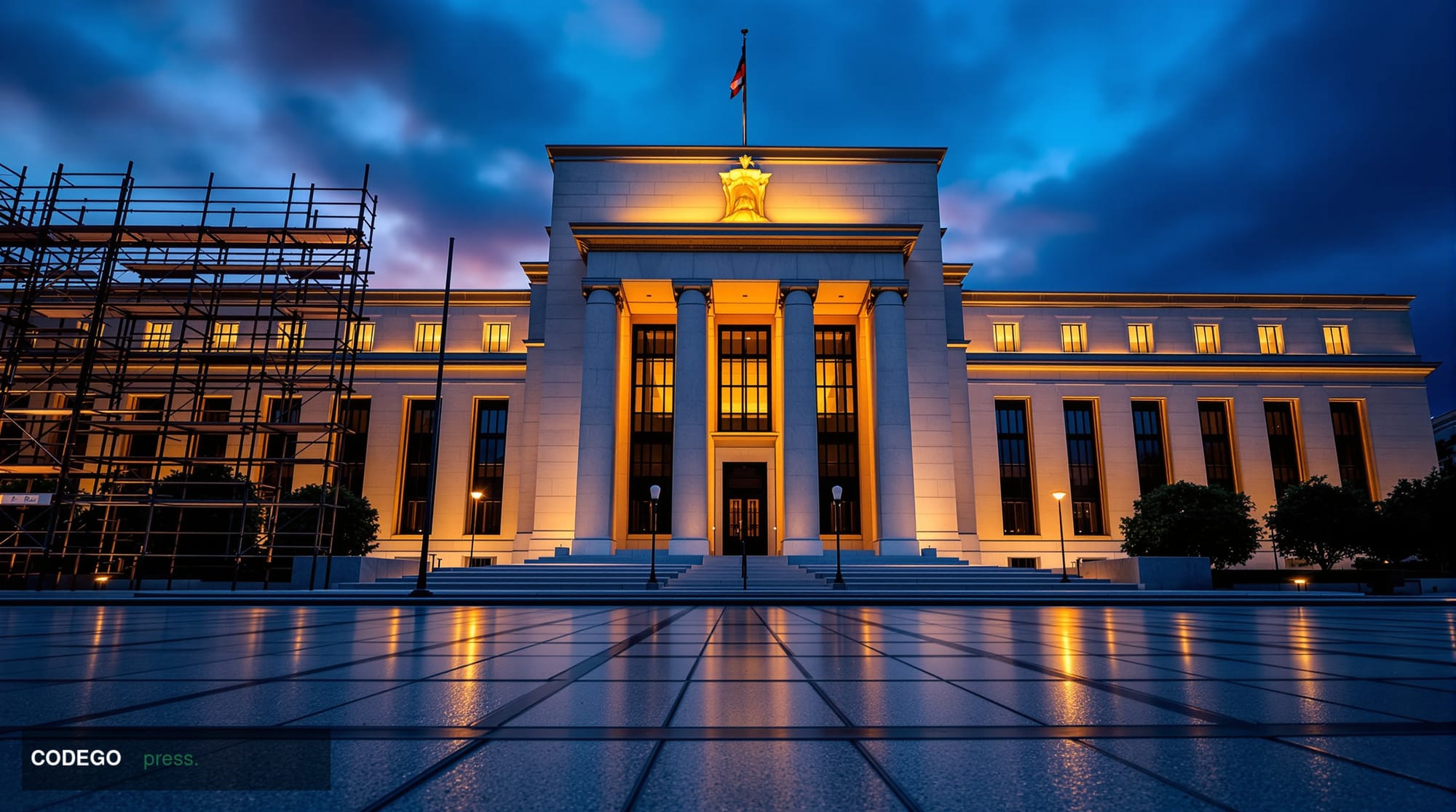
The U.S. Department of Justice has formally declined to reopen its investigation into Federal Reserve Chair Jerome Powell, even as the nation's top law enforcement official conceded that significant questions remain unanswered about how the central bank's renovation project spiraled into an extraordinarily costly undertaking. The decision, announced by Attorney General Todd Blanche in an interview on Bloomberg TV, effectively draws a legal line under a controversy that has shadowed Powell's tenure and invited scrutiny from across the political spectrum.
A Closed Case With Open Questions
Blanche's choice of words was striking in its candor. Acknowledging that there is "more work to do to understand" how the Federal Reserve's renovation project became so expensive, the Attorney General nonetheless confirmed that the Justice Department would not resume its related inquiry into Powell. That combination — admitting incomplete understanding while simultaneously closing the investigative door — raises important questions about the institutional calculus that governs decisions at the intersection of law enforcement, monetary policy independence, and political accountability.
The renovation project at the center of the controversy has attracted attention precisely because of the opacity surrounding its cost escalation. Public institutions undertaking large-scale construction and refurbishment work are expected to maintain rigorous cost controls and transparent oversight. When those costs balloon without clear public explanation, the credibility of the institution itself comes under pressure — regardless of whether any criminal or regulatory threshold has been crossed. The DOJ's reluctance to reopen the probe does not, by itself, answer the underlying questions about fiscal stewardship at one of the world's most consequential financial institutions.
Powell's Position and the Fed's Independence
The decision not to pursue Powell further will likely be interpreted through the lens of Federal Reserve independence, a principle that has been fiercely debated in recent years. The Fed's mandate — to manage monetary policy free from direct political interference — has historically extended to a general expectation that its leadership would not face politically motivated legal pressure. Critics of the original probe had argued precisely this point: that initiating an investigation tied to a renovation project risked weaponizing the legal apparatus against a central bank official whose policy decisions had generated significant political friction.
Supporters of the inquiry, by contrast, maintained that no institution should be immune from scrutiny when public funds are involved and costs appear to have exceeded reasonable projections without adequate accounting. From this perspective, Blanche's admission that full understanding of the cost escalation remains elusive is itself a form of institutional acknowledgment that the matter is not simply resolved by closing a legal file.
Blanche's Calculus and the DOJ's Credibility
For Attorney General Blanche, the announcement represents a carefully balanced posture. By publicly recognizing that questions persist while simultaneously declining to reopen the probe, he avoids the appearance of a politically driven pursuit of Powell while also refusing to offer the Federal Reserve a clean bill of health. It is a position that preserves prosecutorial discretion without fully exonerating the central bank's handling of the renovation matter. Whether that balance satisfies either camp — those who view the investigation as overreach, or those who demanded greater accountability — is doubtful.
The DOJ's credibility on matters touching the Federal Reserve is itself a sensitive subject. Any perception that law enforcement is either too aggressive or too deferential toward a monetary authority of the Fed's stature can erode public confidence in the independence of both institutions. Blanche's approach attempts to thread that needle, though the acknowledgment of remaining uncertainty means the episode is unlikely to fade entirely from public discourse.
What This Means
For markets and financial institutions watching this episode, the immediate takeaway is one of stability: Jerome Powell faces no active legal jeopardy from the Justice Department, and the Federal Reserve's ability to conduct monetary policy without the distraction of a parallel criminal investigation is preserved. That is a meaningful outcome for those who prioritize institutional continuity and policy predictability above all else.
Yet the longer-term institutional lesson is harder to dismiss. The Federal Reserve, like any public body overseeing significant expenditures of public resources, cannot expect that cost overruns on major projects will simply be absorbed into the background noise of Washington's political environment. As Blanche himself implied, understanding how the renovation became so costly remains unfinished business. For an institution whose entire operational legitimacy rests on the perception of careful, disciplined stewardship — whether of the money supply or of its own facilities — that unfinished business carries reputational weight that no legal closure can entirely erase. Transparency, not merely legal exoneration, is the standard that the Fed's long-term credibility requires.
Written by the editorial team — independent journalism powered by Codego Press.