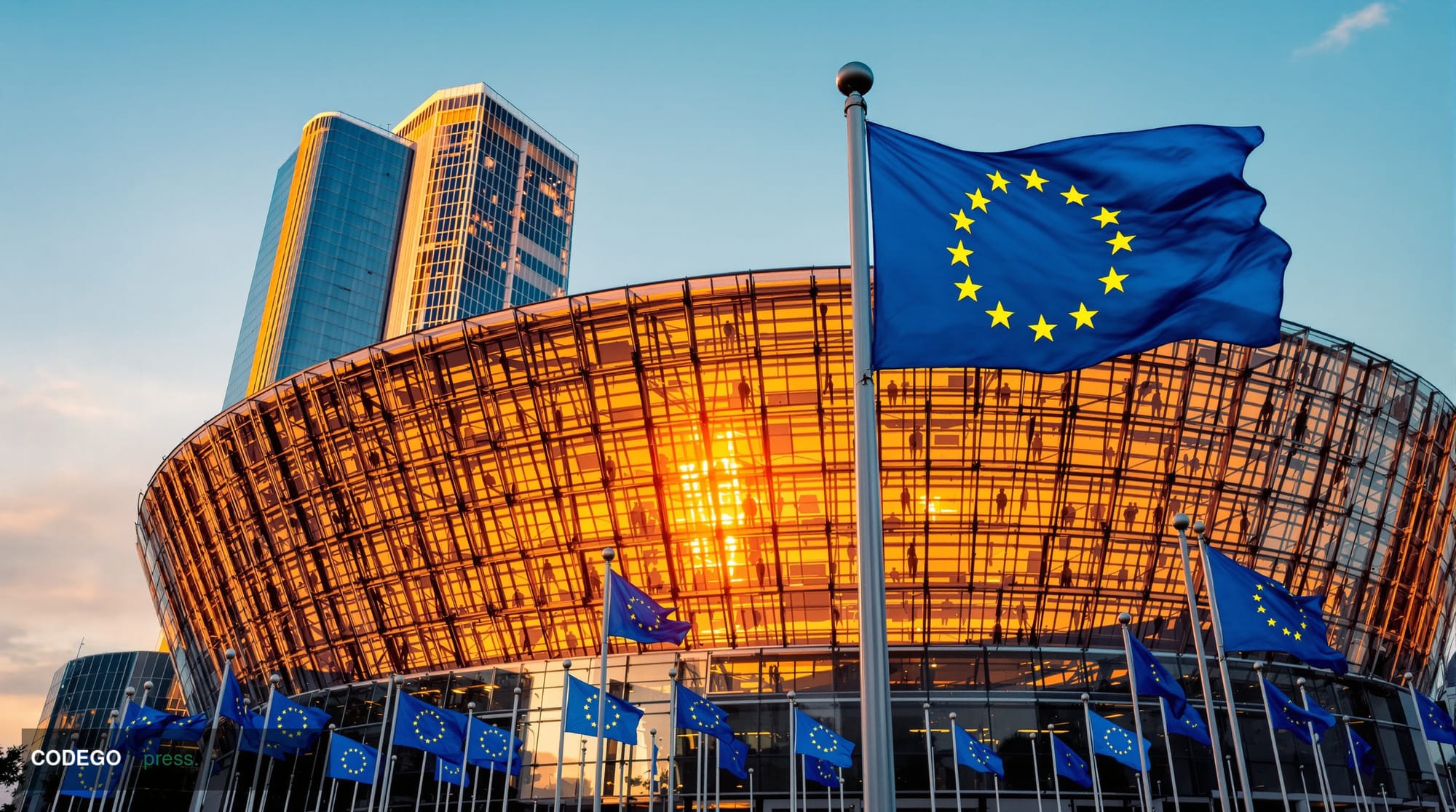
The European Union has moved decisively to close one of the most consequential remaining loopholes in its economic war against Russia, expanding its sanctions architecture to explicitly target cryptocurrency platforms. The measure signals a fundamental shift in how Western institutions conceptualise financial warfare — one that acknowledges digital assets are no longer a peripheral concern but a systemic channel capable of absorbing and redirecting the economic pressure that conventional banking restrictions are designed to impose.
Since the onset of large-scale sanctions packages following Russia's invasion of Ukraine, a persistent question has hung over Brussels and allied capitals: to what degree were crypto markets functioning as a pressure valve, allowing sanctioned Russian entities, oligarchs, and state-linked institutions to circumvent the restrictions placed on their access to dollar- and euro-denominated financial infrastructure? The EU's latest expansion of its sanctions regime suggests regulators have concluded that the answer is: significantly enough to demand direct action.
The practical implications of targeting crypto platforms are considerably more complex than applying sanctions to a correspondent bank or freezing a securities account. Cryptocurrency infrastructure spans jurisdictions in ways that traditional finance does not. Exchanges, wallet providers, liquidity pools, and decentralised protocols may be incorporated in one country, operated from another, and accessed by users across dozens more. Compelling compliance requires not only the legal designation of specific platforms but a credible enforcement mechanism — and that is where the EU's expanded framework will face its most rigorous test.
For platforms operating within the EU or servicing European customers, the regulatory leverage is relatively straightforward. The bloc's Markets in Crypto-Assets regulation, known as MiCA, has already established a licensing and compliance framework that ties crypto asset service providers to enforceable obligations. Sanctions compliance layers on top of that framework with serious consequences: any platform found to have facilitated transactions for designated Russian individuals or entities faces not only fines but potential revocation of its operating licence across all twenty-seven member states. That is a compelling deterrent for any exchange with meaningful European business.
The more difficult enforcement frontier lies beyond EU borders. Russian actors seeking to exploit crypto channels are unlikely to route activity through Brussels-licensed exchanges. The concern, shared by analysts and Western intelligence agencies alike, centres on platforms domiciled in jurisdictions with limited sanctions cooperation — parts of Southeast Asia, the Middle East, and Central Asia have all been identified in previous reporting as potential nodes in Russia-linked crypto flows. The EU's expanded measures will put direct pressure on those intermediaries, but converting designation into disruption requires either secondary sanctions pressure on third-country platforms or international coordination that has historically proven difficult to achieve at speed.
What is unambiguous is the direction of travel. The expansion of EU sanctions to cover crypto platforms represents the latest chapter in a broader regulatory convergence: the period in which digital assets occupied a grey zone — acknowledged as innovative but treated as largely outside the perimeter of geopolitical financial tools — is drawing to a close. Financial Action Task Force guidance on virtual assets, MiCA's compliance mandates, and now direct sanctions targeting collectively constitute a wall of regulatory pressure that is fundamentally reshaping the risk calculus for every crypto platform with any nexus to Western markets.
For Russia, the intensification of economic isolation through this channel is strategically significant. Official access to SWIFT messaging, euro and dollar clearing, and Western capital markets has already been severely curtailed. If crypto platforms — which Russian entities have reportedly used for everything from commodity trade financing to individual capital flight — are brought meaningfully within the sanctions perimeter, the remaining corridors for financial manoeuvre narrow further. The economic consequences compound over time: each closed channel raises the cost of doing business internationally, reduces the efficiency of whatever workarounds remain, and signals to neutral third parties that the risk of secondary exposure is rising.
What This Means for the Industry
For the global crypto industry, the EU's move carries a message that extends well beyond Russia policy. Regulators in Brussels have now demonstrated willingness to weaponise access to European markets as a sanctions enforcement tool — a capability that, once established, will not be retired when the Russia conflict eventually de-escalates. Crypto platforms that have treated geopolitical compliance as a secondary concern to liquidity and product development must now reassess that prioritisation. The cost of being designated, or even credibly suspected of facilitating sanctions evasion, is existential for any platform seeking a durable presence in regulated Western markets. Compliance infrastructure, sanctions screening technology, and robust Know Your Customer and Anti-Money Laundering frameworks are no longer optional enhancements — they are the price of admission to the financial mainstream that most serious crypto businesses aspire to reach. The EU has made that calculation explicit, and the industry would be unwise to assume the message is not intended for them.
Written by the editorial team — independent journalism powered by Codego Press.