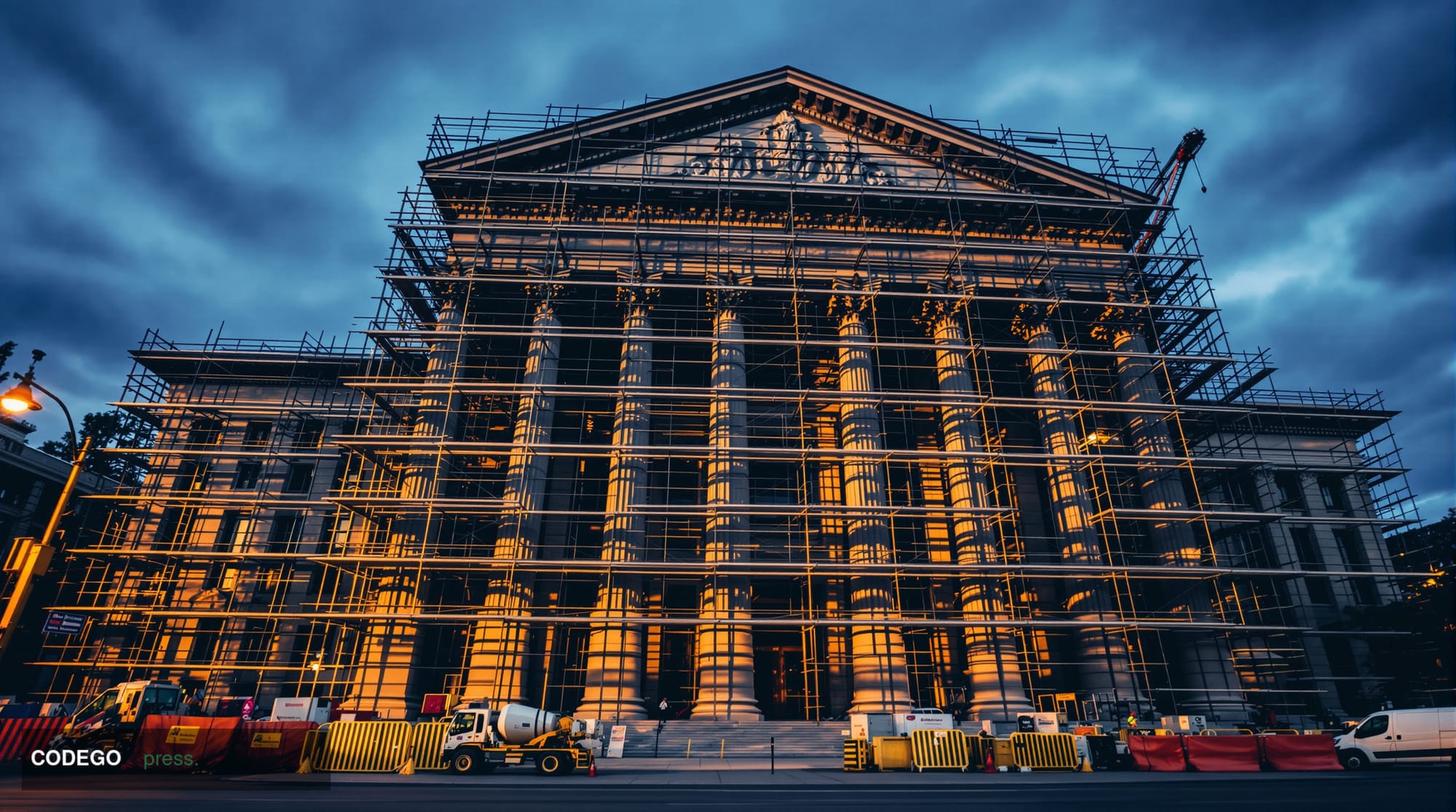
The Federal Reserve Board finds itself at the center of an uncomfortable institutional reckoning: its own internal watchdog has concluded that a $2.5 billion headquarters renovation project has been marred by significant mismanagement — even as investigators stopped short of finding any criminal wrongdoing. The findings, issued by the Office of the Inspector General (OIG), expose a troubling gap between the stewardship standards expected of the world's most influential central bank and the operational discipline it has applied to one of the largest public construction projects in Washington's recent memory.
A Project Years in the Making — and Already Under Scrutiny
The renovation effort, now several years underway, was always destined to attract attention given its eye-catching price tag. At $2.5 billion, it ranks among the most expensive government building projects in the United States, and the OIG's decision to open a formal review reflects the scale of concern that has accumulated as costs and timelines have evolved. What the investigation ultimately delivered was not the criminal referral that some observers may have anticipated, but rather a detailed indictment of process failures: poor oversight mechanisms, insufficient cost controls, and a management structure that allowed financial exposure to grow unchecked over an extended period.
The distinction between mismanagement and criminality matters enormously in institutional terms, but it does not absolve the Federal Reserve Board of accountability. Mismanagement at this scale — on a project costing taxpayers and the institution billions of dollars — represents a serious governance failure in its own right. Central banks, by their very nature, are custodians of public trust. When that trust is strained not by malfeasance but by organizational incompetence, the reputational damage can be equally corrosive.
The OIG's Core Recommendation: Price Certainty
The most actionable finding to emerge from the OIG's review is its recommendation that the Federal Reserve Board immediately establish a guaranteed maximum price for the renovation project. This mechanism, widely used in large-scale commercial and public construction, caps a contractor's total reimbursable costs and establishes a ceiling above which the project owner — in this case, the Federal Reserve — bears no further financial obligation for cost overruns attributable to the contractor's execution. The absence of such a structure, in a project that has already stretched across several years, is itself a telling indicator of where the mismanagement originated.
A guaranteed maximum price arrangement would introduce the kind of financial discipline and contractual accountability that should have been embedded in the project's governance framework from the outset. Its absence has left the Federal Reserve exposed to open-ended cost escalation at a time when the institution's independence and operational credibility are subjects of intense scrutiny from legislators and financial markets alike. The OIG's recommendation is sound, but its lateness in the project lifecycle means the Fed will now be attempting to impose pricing discipline on a multi-billion-dollar undertaking that has already built up years of unconstrained expenditure momentum.
Institutional Credibility in the Balance
The irony of this situation is difficult to overstate. The Federal Reserve is the institution charged with maintaining financial stability across the United States economy, setting the monetary policy framework that governs interest rates and inflation expectations, and supervising some of the largest and most complex financial institutions in the world. It routinely demands rigorous risk management, robust internal controls, and sound governance from the banks it oversees. The OIG's findings suggest that, when it comes to managing its own internal capital project, the Fed fell short of the very standards it enforces on others.
This is not merely an administrative curiosity. The Federal Reserve's credibility rests in significant part on its perceived competence and institutional integrity. Congressional critics who have long sought greater oversight of the central bank's operations will find ample material in this report to advance arguments for expanded legislative scrutiny. Whether or not those arguments gain traction, the OIG's findings will remain on the record as a documented instance of the Fed's internal management failing to meet the bar its own reputation demands.
What This Means for the Path Forward
For the Federal Reserve Board, the immediate priority must be acting on the OIG's recommendation to establish a guaranteed maximum price without further delay. Every month that passes without that contractual ceiling in place represents continued financial exposure on a project already defined by its lack of cost discipline. Beyond the mechanics of the renovation itself, the Fed's leadership faces a broader communication challenge: demonstrating to legislators, financial institutions, and the public that the governance failures identified in the OIG review have been understood, addressed, and will not be repeated.
The finding of mismanagement rather than criminality is, in one narrow sense, a relief — it means no individuals face legal jeopardy as a result of the review. But it would be a serious error to interpret that finding as a clean bill of health. An institution that manages trillions of dollars in monetary policy operations and holds supervisory authority over the American banking system must be held to the highest possible standard of internal governance. A $2.5 billion renovation project that generates an OIG mismanagement finding, several years into its execution, is a standard that was plainly not met.
Written by the editorial team — independent journalism powered by Codego Press.