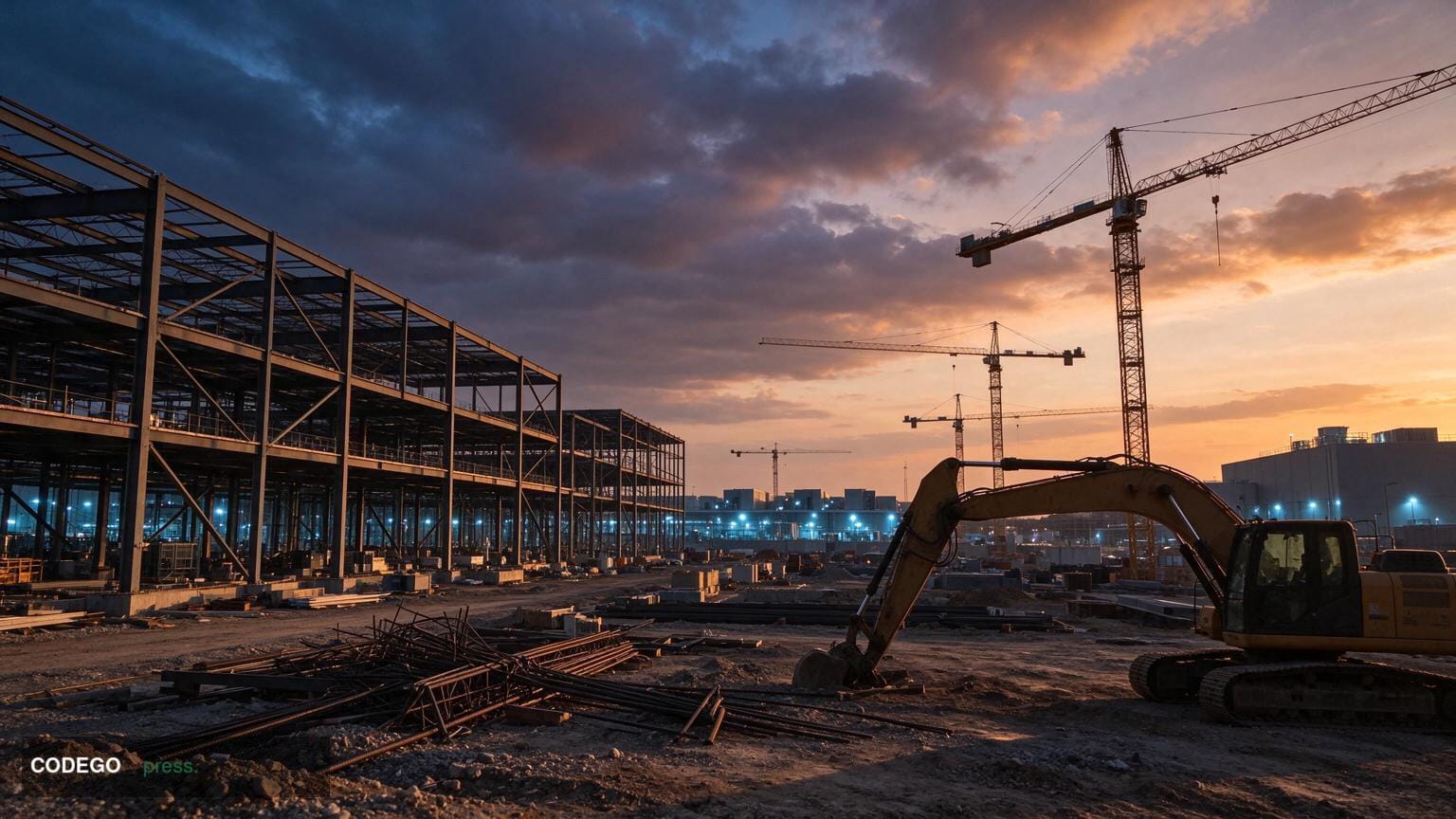
The Federal Reserve has raised a significant alarm over what may be one of the most consequential infrastructure financing stories of this decade: more than $1 trillion in artificial intelligence data center leases that have been signed but have not yet broken ground. The warning, directed squarely at the intersection of commercial real estate finance and the technology sector's AI buildout, underscores the degree to which the financial system has quietly accumulated exposure to a bet that AI revenue growth will materialize on a scale sufficient to justify some of the most ambitious infrastructure commitments in modern economic history.
The scale of the figure alone demands attention. One trillion dollars in unstarted lease commitments is not an abstraction — it represents binding contractual obligations between technology companies and landlords, backed in turn by financing provided or facilitated by the banking sector. These are not speculative proposals or letters of intent. They are executed agreements for data center capacity that, as of the Fed's assessment, has yet to be built, let alone operational. The gap between paper commitment and physical reality is precisely what regulators appear to find troubling.
The Mechanics of the Exposure
To understand why this matters for financial stability, it is worth tracing the chain of risk. Hyperscale technology companies and AI-focused firms have been racing to secure data center capacity to support the voracious computational demands of large language models and related infrastructure. Rather than building their own facilities outright, many have opted to lease from specialist data center operators under long-term agreements — arrangements that provide predictable capacity while shifting construction and operational responsibility to the landlord. Those landlords, in turn, require capital to finance construction, capital that flows through banks and credit markets. The result is a risk chain that links AI adoption forecasts at one end to bank balance sheets at the other.
The Fed's concern is rooted in what happens if the intermediate steps fail. If AI revenue growth — the anticipated income that justifies the technology companies' willingness to sign decade-long lease agreements — disappoints materially, tenants may seek to renegotiate, exit, or restructure their commitments. That stress would flow upstream to data center operators whose construction financing is premised on those lease cash flows, and from there to the banks carrying the underlying debt. With over $1 trillion in commitments not yet even at the construction stage, any reversal in AI monetization trajectories could trigger a cascade that regulators are evidently not prepared to treat as a tail risk.
Bank Exposure and the AI Revenue Assumption
The Fed's identification of significant bank exposure in this context is a pointed signal to financial institutions to scrutinize their underwriting assumptions. Banks that have extended construction loans, revolving credit facilities, or term financing to data center developers are, in effect, underwriting a projection about the future economics of artificial intelligence. That projection may well prove correct — AI has demonstrated genuine and growing commercial utility — but the unprecedented speed at which these commitments have accumulated means that due diligence cycles have been compressed and that the aggregate position across the banking system has grown faster than supervisory frameworks have adapted.
This is not the first time regulators have watched a technology-driven infrastructure boom attract leveraged capital at scale before the demand thesis was fully proven. The parallels to earlier cycles of overbuilding — where capital rushed into physical infrastructure ahead of sustainable demand — are not lost on experienced credit analysts. The specific wrinkle here is that AI remains a technology in rapid flux: the revenue models, the competitive dynamics, and even the dominant computational architectures are all still evolving. Locking in $1 trillion of capacity before those questions settle introduces a form of optionality mismatch that regulators are right to flag.
Systemic Implications and the Road Ahead
The Federal Reserve's decision to publicly flag this exposure is itself a form of macroprudential intervention. By surfacing the aggregate figure and naming the financial stability concern explicitly, the Fed is sending a clear signal to bank supervisors, credit committees, and institutional investors that this category of risk deserves heightened scrutiny in stress-testing frameworks and capital planning. Banks with material concentrations in data center financing should expect questions from examiners about their assumptions on lease performance, tenant creditworthiness under adverse AI-revenue scenarios, and their liquidity positions if construction timelines extend or draw requests accelerate simultaneously across the portfolio.
For the broader fintech and digital banking ecosystem, this episode is a reminder that the AI infrastructure buildout is not a risk-free backdrop to the sector's own AI ambitions. Financial institutions deploying capital into AI tools, AI-powered credit models, and AI-driven customer engagement are downstream of the same infrastructure stack that is now under regulatory scrutiny. A disruption in data center financing markets would have velocity effects through cloud pricing, model availability, and technology vendor stability that extend well beyond the balance sheets of the construction lenders themselves.
What the Fed's warning makes unmistakably clear is that the financial system has extended an enormous, still-unmaterialized bet on the trajectory of artificial intelligence — and that the time for treating that bet as invisible on supervisory radar has passed. How banks, regulators, and the technology sector manage the gap between $1 trillion in signed paper and the operational infrastructure it is meant to represent will be one of the defining credit stories of the years ahead.
Written by the editorial team — independent journalism powered by Codego Press.