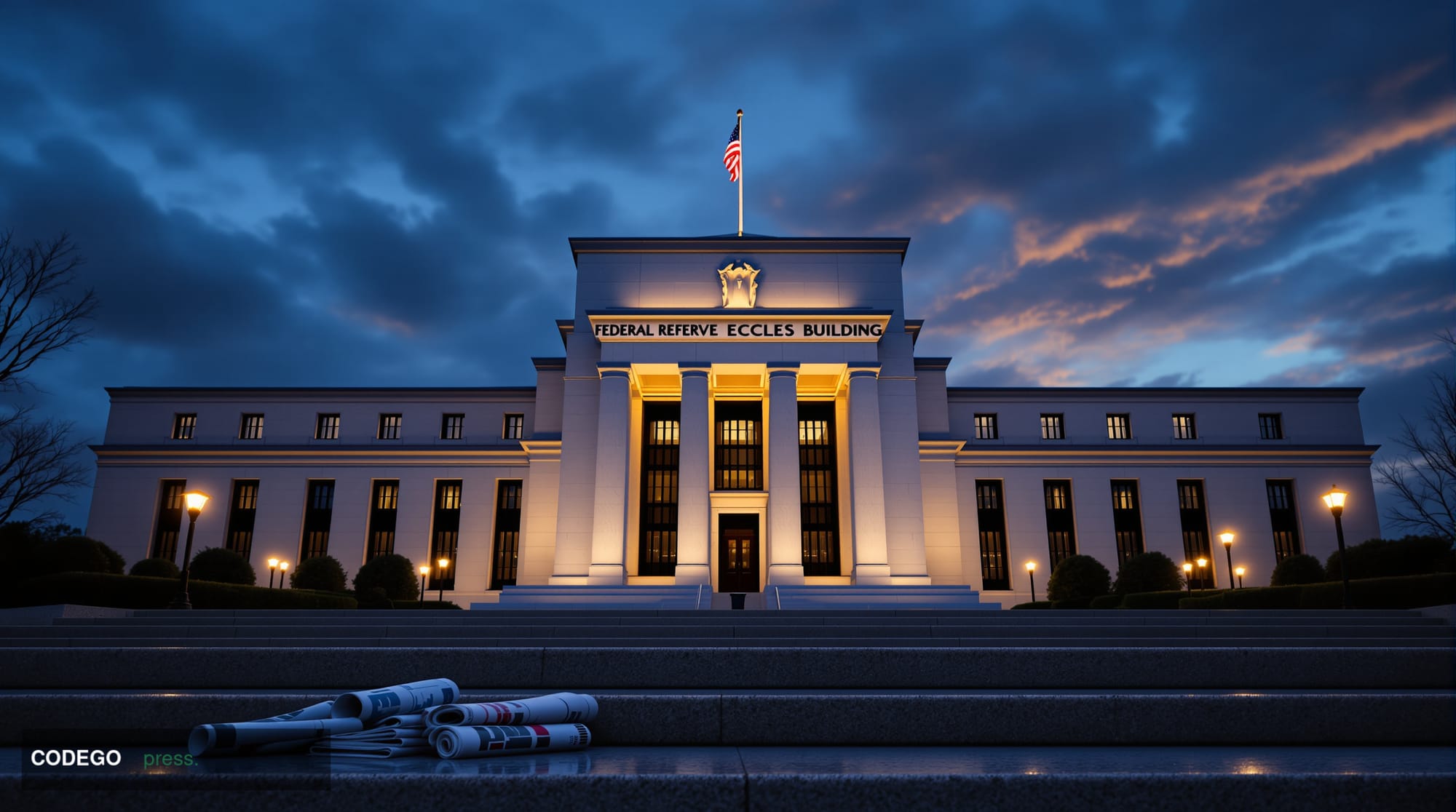
The Federal Reserve's Federal Open Market Committee (FOMC) delivered another monetary policy tightening on Wednesday, voting unanimously to lift its benchmark interest rate by 25 basis points — a move that, despite being telegraphed well in advance, rattled equity markets and pushed bond yields higher across the curve. The decision underscores the central bank's continued commitment to restraining economic conditions even as the cumulative weight of successive rate increases bears down on risk assets and borrowing costs alike.
A Unanimous Front, A Nervous Market
The unanimity of the FOMC vote carries its own signal. When every member of the committee aligns behind a single course of action, it projects institutional conviction — a deliberate message to markets and the broader public that policymakers are not hedging on the direction of travel. In previous tightening cycles, dissents from individual members have sometimes served as an early warning of an impending pivot. Wednesday's clean sweep offered no such comfort to investors hoping for cracks in the consensus.
And yet the market reaction was notably negative. Despite the fact that a 25 basis point increase had been the dominant expectation heading into the meeting — priced in by futures markets and discussed exhaustively in analyst notes for weeks — most major indices closed in the red by the end of the session. This phenomenon, sometimes described as "sell the fact" after a prolonged "buy the rumour" run-up, reveals something important about the current state of investor psychology: even certainty, when it arrives draped in tighter monetary policy, is capable of souring sentiment.
Why Expected Hikes Still Hurt
The paradox of a widely anticipated rate hike still triggering a market selloff deserves careful examination. In efficient market theory, known information should already be embedded in asset prices before a decision is formally announced. That principle holds — to a degree. But what markets price in is not simply the immediate decision; they are also continuously re-evaluating the forward path: how long rates stay elevated, what economic data follows, and whether the FOMC's own projections shift in tone or emphasis around the edges.
When the Fed raises rates unanimously and bond yields respond by climbing further, the implicit message absorbed by equity markets is that the cost of capital remains on an upward trajectory with no near-term relief in sight. Higher yields compress the present-value calculations used to justify elevated equity valuations, particularly in growth-oriented and technology sectors that tend to be most sensitive to discount-rate movements. A broad cross-sector decline, as occurred Wednesday, suggests this repricing pressure is not confined to any single corner of the market.
Bond Yields: The Other Side of the Ledger
The concurrent rise in yields on the day of the announcement reflects a recalibration of fixed-income expectations. When the FOMC raises its benchmark rate and signals no imminent reversal, holders of existing bonds face mark-to-market pressure, while newly issued debt must offer higher coupons to attract buyers. This dynamic — yields rising as bond prices fall — is the mechanical backbone of what the Fed's tightening cycle has produced across fixed-income markets over the course of this campaign.
For banks, insurance companies, pension funds, and any institution running large fixed-income portfolios, the yield movement carries a dual character. On one hand, new issuances become more attractive on a forward-looking basis. On the other, unrealized losses on legacy holdings continue to accumulate, a dynamic that regulators and risk managers across the financial sector have been monitoring with increasing vigilance. The stress this places on balance sheets — particularly for regional and mid-sized banks — remains one of the more underappreciated systemic risks of a prolonged high-rate environment.
What the Unanimous Vote Signals Going Forward
Beyond the immediate market reaction, the FOMC's united front has meaningful implications for the trajectory of monetary policy in the months ahead. A unanimous decision removes ambiguity about internal disagreement but does not, by itself, foreclose future flexibility. The committee retains its meeting-by-meeting posture, remaining dependent on incoming economic data — particularly inflation readings, labor market conditions, and consumer spending trends — before committing to subsequent moves in either direction.
For fintech lenders, neobanks, and embedded-finance platforms operating in rate-sensitive segments of the economy, the persistence of elevated borrowing costs continues to reshape product economics. Credit underwriting standards, loan loss provisioning, and the cost of wholesale funding are all recalibrated in an environment where the Fed's benchmark holds at elevated levels. Platforms that expanded aggressively during the near-zero rate era face the stiffest structural headwinds, while those that built durable unit economics and conservative balance sheets are better positioned to weather the current regime.
What This Means
Wednesday's 25 basis point increase, unanimous in its passage and negative in its market reception, is more than a single data point in the Fed's tightening cycle — it is a reaffirmation that the central bank is prepared to absorb the political and economic discomfort of higher rates in pursuit of its inflation mandate. For investors, lenders, and financial institutions alike, the key question is no longer whether the Fed will move, but how long it is willing to hold. Until that calculus shifts, equity volatility and yield pressure are the price of admission in this market environment.
Written by the editorial team — independent journalism powered by Codego Press.