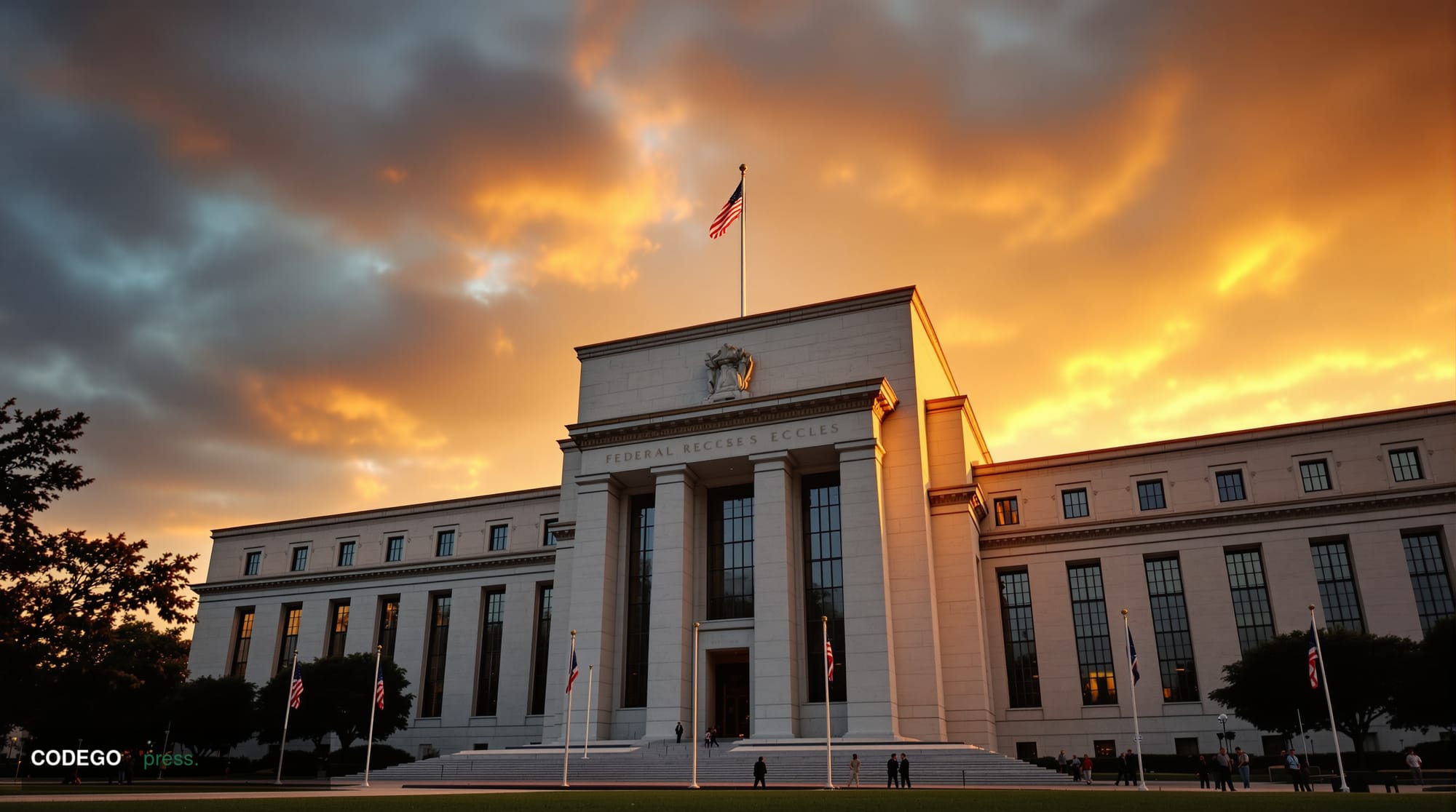
Federal Reserve Governor Christopher Waller has signaled a fundamental shift in the central bank's monetary policy stance, declaring that the next interest rate move could go either direction while abandoning the previously held easing bias. This pivot toward policy neutrality introduces fresh uncertainty into financial markets already grappling with heightened geopolitical tensions and their cascading effects on global liquidity conditions.
Waller's comments represent a notable departure from the dovish trajectory that had characterized Fed communications in recent months. By explicitly stating that rate movements could swing either toward tightening or loosening, the Fed governor has effectively reset market expectations and eliminated the implicit guidance that had been leaning toward accommodative policy. This balanced approach reflects the central bank's recognition that economic conditions remain fluid and that policy flexibility will be paramount in navigating an increasingly complex macroeconomic landscape.
The timing of this policy recalibration carries particular significance given the current constellation of global challenges facing monetary policymakers. Geopolitical tensions have emerged as a critical variable in the Fed's decision-making calculus, introducing volatility into commodity markets, supply chains, and international capital flows. These external pressures complicate the traditional relationship between domestic economic indicators and monetary policy responses, forcing central bankers to weigh competing risks with unprecedented nuance.
Market Liquidity Under Pressure
Financial markets are already experiencing the ripple effects of Waller's more cautious stance, with implications extending far beyond traditional fixed-income securities. The introduction of policy uncertainty threatens to constrain liquidity across asset classes, as investors grapple with the absence of clear directional signals from the nation's most influential monetary authority. This environment of heightened ambiguity particularly impacts risk assets, which have historically benefited from predictable easing cycles and forward guidance that provided clarity on the policy trajectory.
The cryptocurrency ecosystem, despite its decentralized nature, remains sensitive to Federal Reserve policy shifts through their influence on broader market liquidity and risk appetite. Digital assets, having matured into a legitimate component of institutional portfolios, now face the same headwinds as traditional risk assets when monetary policy uncertainty increases. The correlation between crypto valuations and traditional market sentiment has strengthened considerably, making Fed communications increasingly relevant for blockchain-based financial instruments.
Banking institutions face their own set of challenges as policy uncertainty complicates asset-liability management and lending strategies. The prospect of rates moving in either direction requires financial institutions to maintain greater balance sheet flexibility while preparing for scenarios ranging from continued accommodation to renewed tightening. This operational complexity translates into potential margin compression and more conservative risk management approaches across the banking sector.
Strategic Implications for Financial Markets
Waller's balanced approach reflects the Federal Reserve's acknowledgment that rigid policy frameworks may prove inadequate in addressing the multifaceted challenges confronting the global economy. By maintaining optionality in both directions, the central bank preserves its ability to respond dynamically to evolving conditions while avoiding the constraints imposed by overly specific forward guidance. This flexibility comes at the cost of market predictability, creating an environment where asset prices may experience greater volatility as investors adjust to reduced policy clarity.
The abandonment of easing bias also signals the Fed's recognition that inflationary pressures and economic resilience may prove more persistent than previously anticipated. Rather than committing to a predetermined path of policy accommodation, central bank officials appear increasingly willing to let data dependencies guide their decisions on a meeting-by-meeting basis. This approach aligns with historical precedents during periods of economic transition, when rigid policy frameworks have proven counterproductive.
For institutional investors and financial planners, Waller's comments necessitate a fundamental reassessment of portfolio construction and risk management strategies. The era of relying on predictable monetary policy trajectories appears to be giving way to one requiring greater tactical flexibility and scenario-based planning. Asset allocation models built on assumptions of continued easing may require significant recalibration to account for the possibility of policy tightening or extended periods of uncertainty.
Governor Waller's strategic pivot toward policy neutrality marks a watershed moment in Federal Reserve communications, introducing a new paradigm where market participants must navigate without the safety net of clear directional guidance. As geopolitical tensions continue to shape global economic conditions, this balanced approach may prove essential for maintaining central bank credibility while preserving the flexibility needed to address unforeseen challenges. The financial system's adaptation to this environment of enhanced uncertainty will likely define market dynamics in the months ahead.
Written by the editorial team — independent journalism powered by Codego Press.