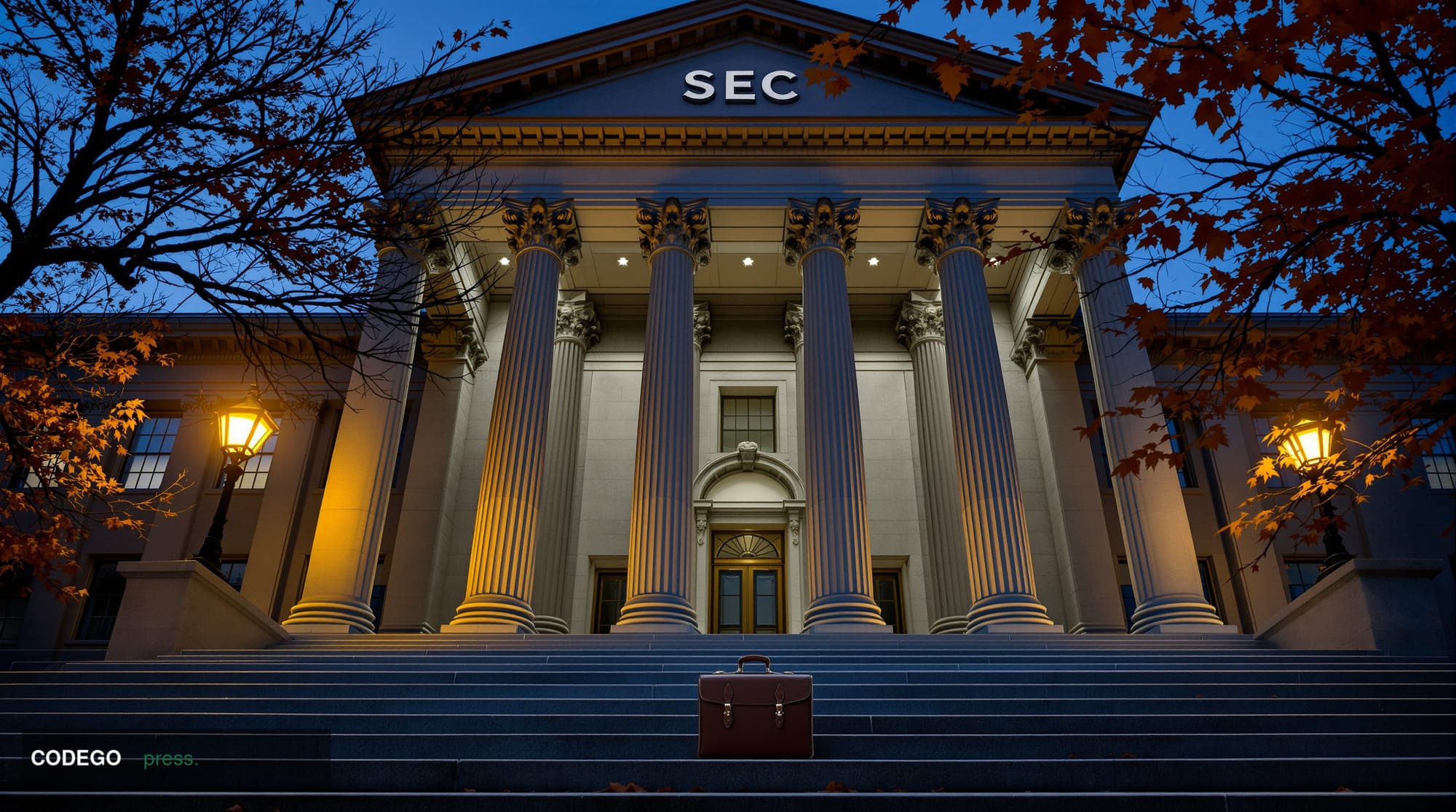
After eight years as the Securities and Exchange Commission's most outspoken advocate for sensible digital asset oversight, Commissioner Hester Peirce has resigned from her post — a departure that lands at a pivotal moment for an industry still fighting for regulatory clarity in the United States. Her exit closes a chapter that, for many in the cryptocurrency sector, represented the clearest proof that principled, market-aware voices could exist within the machinery of federal financial regulation.
Peirce, who earned the affectionate nickname "Crypto Mom" from the digital asset community over the course of her tenure, consistently distinguished herself from colleagues who viewed decentralized finance and blockchain-based instruments through an almost exclusively adversarial lens. Where enforcement actions and ambiguity frequently defined the SEC's posture toward crypto markets, Peirce argued — often in formal dissent — that the Commission owed market participants workable rules rather than regulation by litigation. That consistency over eight years made her departure something more than a routine personnel change; it marks the loss of an institutional counterweight.
The timing intensifies the concern. The digital asset industry has spent the better part of a decade navigating a regulatory environment defined by what critics describe as deliberate vagueness. The SEC's ability to produce swift, coherent guidelines on questions such as token classification, exchange registration, and custody requirements has already been contested — internally and in federal court. With Peirce no longer at the table, observers and market participants alike are warning that the Commission's capacity to move decisively toward implementable digital asset frameworks may be materially diminished.
What Peirce represented institutionally was rare: a commissioner willing to engage seriously with the technical architecture of blockchain systems before rendering judgment on them. Her dissents were notable not merely as political counterpoints but as substantive policy documents. She challenged her colleagues to confront the gap between securities law written in an era of centralized financial infrastructure and a technology that, by design, distributes authority across networks. That kind of regulatory literacy, cultivated over nearly a decade, is not easily replaced.
Her departure will now test the SEC's institutional depth on digital asset matters. The Commission has faced persistent criticism that its approach to crypto regulation — heavy on enforcement actions, light on prospective rulemaking — has pushed innovation offshore and left domestic investors with fewer protections, not more. Peirce was among the loudest internal voices making precisely that case. Whether incoming leadership or a potential replacement commissioner will adopt a similar stance remains an open and consequential question for the industry.
The broader regulatory landscape provides some context. Legislative efforts in Congress to establish a comprehensive digital asset framework have advanced fitfully, with jurisdictional disputes between the SEC and the Commodity Futures Trading Commission continuing to complicate clarity on which assets fall under which agency's purview. Peirce's ability to serve as a credible interlocutor — someone the industry trusted to argue in good faith within the Commission — arguably gave those legislative conversations a useful counterpart at the agency level. That informal bridge now requires rebuilding.
For crypto firms, asset managers, and institutional investors who have spent years calibrating their United States strategies around the expectation of eventual regulatory normalisation, the signal from Peirce's exit is unsettling. It does not foreclose progress, but it removes one of its most reliable internal engines. The SEC's next moves on spot cryptocurrency products, broker-dealer rules for digital assets, and disclosure requirements for token issuers will be the most immediate indicators of whether the Commission can sustain momentum without her.
What This Means for Digital Asset Regulation
Peirce's eight-year tenure illustrated that regulatory transformation in financial services is fundamentally a function of personnel as much as policy. Frameworks are shaped by the individuals willing to fight for them through dissents, public comment processes, and internal deliberation. Her exit creates a tangible gap in the SEC's capacity to implement clear digital asset guidelines with the speed the market demands. The industry will be watching closely to see whether her successor — whenever one is named — arrives with equivalent conviction, or whether the Commission's internal debate on crypto simply becomes less contested and, by extension, less productive. For a sector that has long depended on a single sympathetic voice inside its primary regulator, the loss of Hester Peirce is not symbolic. It is structural.
Written by the editorial team — independent journalism powered by Codego Press.