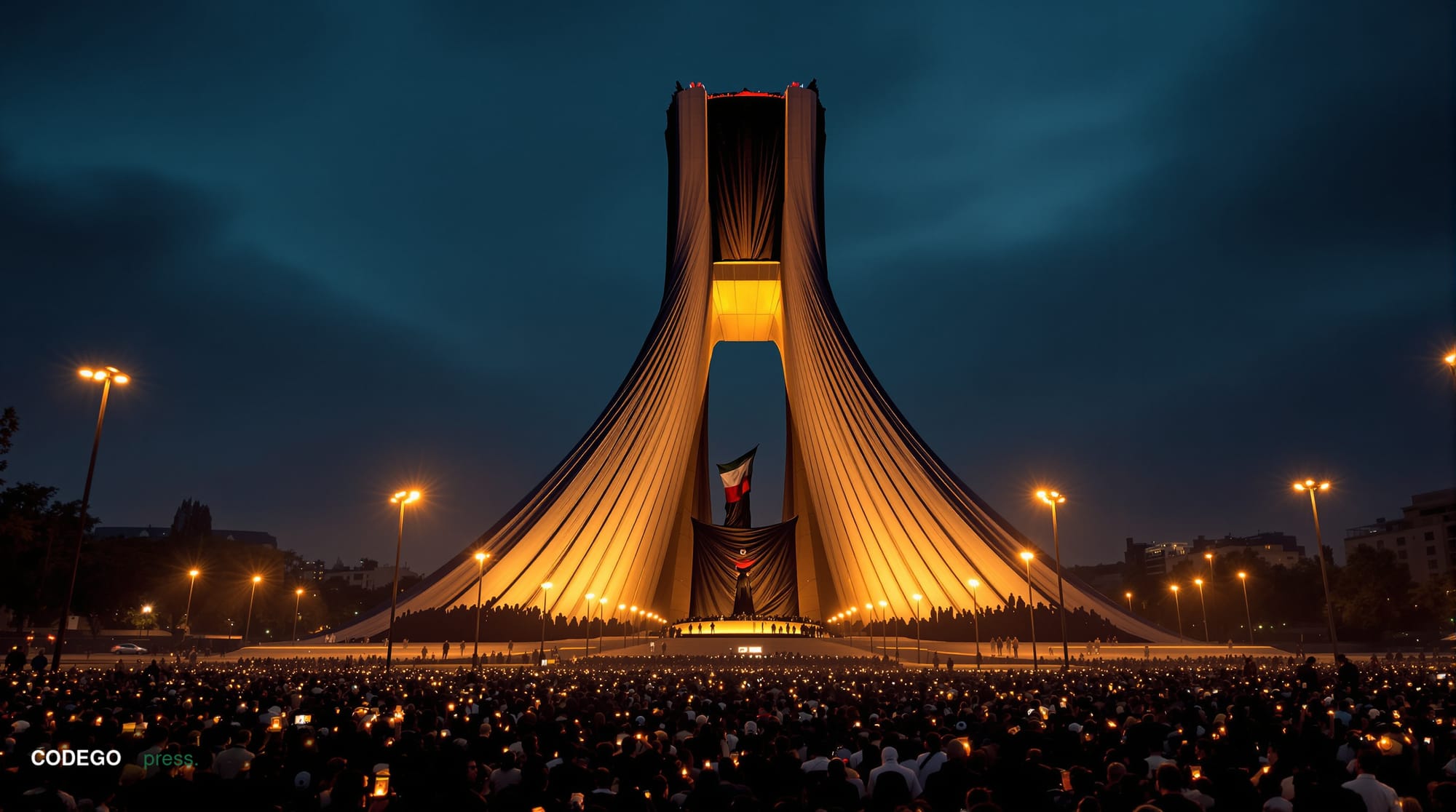
The coffin of Ayatollah Ali Khamenei has arrived in Tehran, marking the formal beginning of a week-long period of national mourning in Iran and setting in motion what analysts expect to be one of the most consequential leadership transitions in the Islamic Republic's history. The death of the Supreme Leader — the paramount authority in Iran's theocratic system — opens a period of deep institutional uncertainty that carries significant implications for regional geopolitics, global energy markets, and the broader landscape of sanctions-driven financial risk.
Khamenei held power for more than three decades, serving as the ultimate arbiter of Iran's foreign policy, nuclear strategy, and economic direction. His authority superseded that of the elected presidency and touched every lever of state power. The vacuum his passing creates is therefore not merely political theater — it is a structural rupture within a regime that has long used centralized clerical authority as its primary stabilizing mechanism. Whether the Islamic Republic can manage an orderly succession or whether factional tensions spill into open political unrest remains the defining question of the coming weeks.
The week-long mourning period, while a formal ritual of state, also functions as a window of political vulnerability. Historical precedent — including Iran's own experience following the death of Ayatollah Khomeini in 1989 — suggests that such transitions, even when managed carefully, create fertile conditions for internal power struggles, public demonstrations, and shifts in the balance between hardline and reformist factions. In the current environment, with Iran's economy already under severe strain from decades of international sanctions and a population that has periodically taken to the streets to challenge the regime's legitimacy, the risks are arguably more acute than they were in 1989.
Market participants are watching closely. Bank for International Settlements research has long established that geopolitical shocks tied to major state transitions in oil-producing nations generate measurable spikes in commodity price volatility. Iran, despite sanctions-related constraints on its official export capacity, remains a significant actor in global oil markets through informal channels and through its influence over proxies and allies across the Middle East. Any perception that internal instability could alter Iran's posture toward the Strait of Hormuz — through which roughly 20 percent of global oil trade passes — would immediately register in crude pricing and broader energy sector equities.
For the financial community, the question of regime stability also intersects directly with the sanctions architecture that Western governments, led by the United States and the European Union, have constructed around Iran over many years. A leadership transition that produces a more hardline successor could entrench existing sanctions indefinitely. Conversely, should reformist or pragmatic factions gain ground during the succession process, markets may begin to price in — however tentatively — the possibility of a longer-term diplomatic recalibration and the economic normalization that would follow. Either scenario introduces a new layer of uncertainty into risk models that compliance and treasury teams have spent years calibrating.
The cryptocurrency sector is not immune to these dynamics. In recent years, Iran has been documented as a significant user of crypto mining and digital asset transfers as tools to circumvent financial sanctions, with the U.S. Treasury Department issuing multiple advisories on the matter. A period of domestic political turbulence could either disrupt those informal financial networks or, in a scenario where central authority weakens temporarily, accelerate their use as regime-adjacent actors seek to move value outside formal channels. Compliance officers at global financial institutions and digital asset platforms will need to treat this transition period as a heightened-risk environment requiring closer monitoring of transaction flows with Iranian nexus.
Beyond the immediate horizon, the leadership transition will test whether Iran's institutional structures — including the Assembly of Experts, tasked with selecting a new Supreme Leader — can function with sufficient coherence to prevent the kind of factional fragmentation that historically precedes broader instability. The outcome of that process will shape not only Iran's domestic trajectory but also the risk calculus for every market participant with exposure to Middle Eastern geopolitics, energy supply chains, or sanctions compliance obligations.
What This Means for Financial Institutions and Markets
The arrival of Khamenei's coffin in Tehran is not merely a news event confined to political desks — it is a material geopolitical development with a direct bearing on energy price risk, sanctions exposure, and emerging market volatility. Risk and compliance teams should reassess their Iran-related exposure frameworks immediately, while market strategists update their geopolitical risk premium assumptions for oil and regional assets. The week-long mourning period represents only the opening chapter of a transition that could define the region's political economy for a generation.
Written by the editorial team — independent journalism powered by Codego Press.