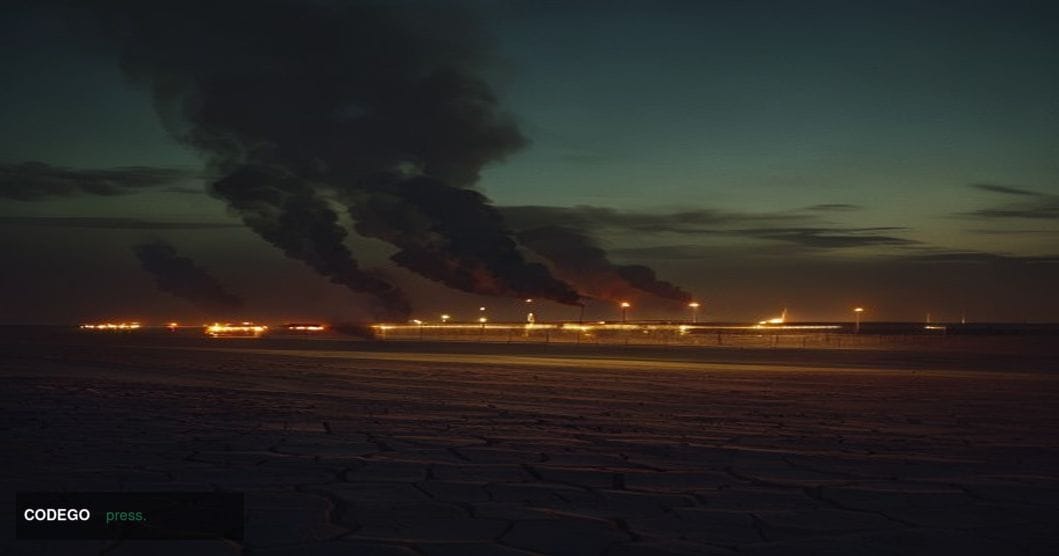
A direct Iranian military strike on Prince Hassan Air Base in Jordan has sent shockwaves through regional capitals and financial markets alike, representing one of the most significant escalations in Middle Eastern geopolitics seen in the 2026 conflict cycle. The attack, which targeted a facility of considerable strategic importance in Jordan's northwestern military infrastructure, signals a dangerous new threshold in Iran's willingness to project force beyond its immediate neighborhood — and raises urgent questions about the stability of one of Washington's most reliable Arab allies.
The implications of this strike extend far beyond the immediate theatre of conflict. Jordan has long served as a buffer state and diplomatic corridor in a region defined by competing power blocs. An Iranian attack on Jordanian sovereign military territory fundamentally alters the calculus of every government — and every institutional investor — with exposure to the broader Middle East. The attack signals what analysts had warned was a potential regional destabilization, one capable of redrawing alliance maps and triggering cascading security responses from NATO, the United States, and Gulf Cooperation Council member states simultaneously.
From a financial markets perspective, strikes of this nature historically compress risk appetite with speed and severity. Crude oil pricing, sovereign debt spreads across emerging market economies in the region, and safe-haven asset flows — into gold, the Swiss franc, and United States Treasuries — are all subject to sharp dislocation when a previously stable actor like Jordan becomes a direct target. Market participants had already been pricing elevated geopolitical risk into their 2026 portfolios, but an Iranian move against Prince Hassan Air Base forces a meaningful repricing of conflict scenario probabilities that few institutional models had weighted this heavily.
The geopolitical dynamics at play here are layered and consequential. Iran's decision to strike a Jordanian military installation rather than limiting operations to proxy engagements through allied non-state actors marks a qualitative shift in Iranian strategic doctrine. Whether this represents a deliberate escalation ladder or a miscalculation with unintended consequences, the effect on regional diplomacy is the same: every moderate Arab government in the Gulf and Levant must now recalibrate its security posture and its dependence on Iranian restraint as an operating assumption.
For the banking and fintech sectors operating across the Middle East and North Africa region, the strike introduces a new layer of operational and compliance risk. Financial institutions with correspondent banking relationships, trade finance portfolios, or cross-border payment infrastructure tied to Jordanian counterparties will need to assess business continuity exposure with urgency. Sanctions desks and geopolitical risk teams at major financial groups will be monitoring the United States and European Union response closely, as any broadening of the sanctions perimeter around Iranian-linked entities could affect transaction flows across the region within days.
It is also worth examining what this event portends for the digital asset markets, given that conflict escalation in the Middle East has historically produced bifurcated responses in cryptocurrency pricing. In some prior episodes, Bitcoin and other major digital assets have attracted capital as perceived neutral stores of value outside the reach of geopolitically constrained financial systems. In others, a broad risk-off sentiment has dragged cryptocurrency valuations alongside equities. The market perception of future conflict scenarios — explicitly identified as affected by this attack — will likely determine which dynamic dominates in the near term, and that uncertainty itself represents a material risk factor for portfolio managers with digital asset allocations.
What This Means for Financial Decision-Makers
The Iranian attack on Prince Hassan Air Base is not a peripheral news event for the financial community — it is a systemic risk signal. Regional destabilization of this character has historically preceded extended periods of elevated volatility in energy prices, emerging market currencies, and sovereign credit ratings across the Middle East. Institutions that had modeled 2026 conflict scenarios with Jordan as a stable non-combatant must now revise those assumptions entirely. The speed with which governments and multilateral bodies respond — whether through diplomatic de-escalation, expanded sanctions, or military repositioning — will determine how quickly markets can re-anchor to a new equilibrium. Until that clarity emerges, the prudent posture across banking, investment, and fintech operations with regional exposure is heightened vigilance, accelerated contingency planning, and close coordination with geopolitical risk advisors who understand the specific fault lines this strike has exposed.
Written by the editorial team — independent journalism powered by Codego Press.