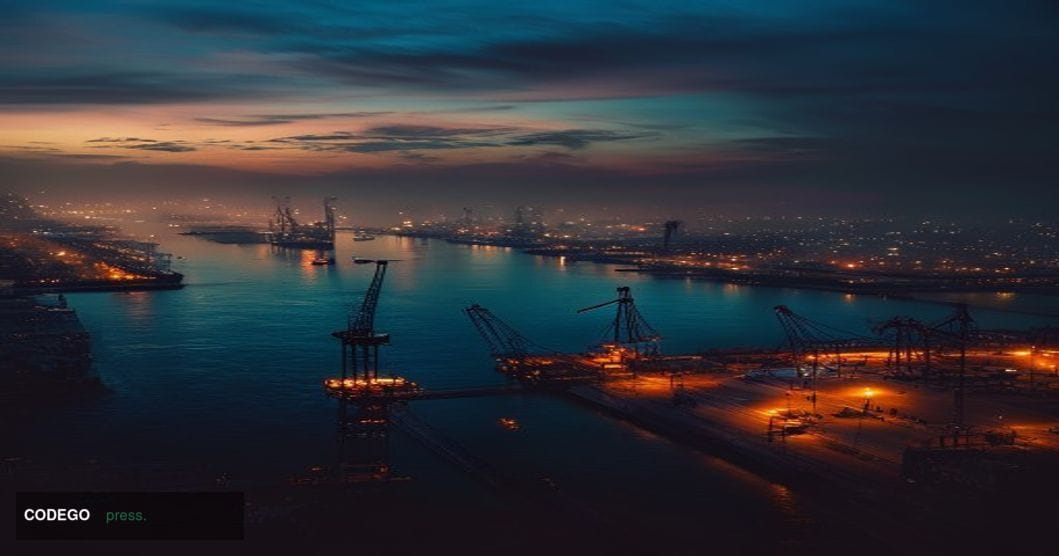
An unverified claim by Iranian authorities that they have destroyed United States carrier support centers at Oman's Port of Duqm has sent a fresh wave of anxiety through regional security circles and global financial markets alike. The assertion, which has not been independently confirmed by American, Omani, or neutral international sources, nonetheless carries sufficient geopolitical weight to demand serious scrutiny from investors, policymakers, and market participants worldwide.
Port of Duqm occupies a position of extraordinary strategic importance. Located along Oman's southeastern coastline on the Arabian Sea, the deep-water port has in recent years become a critical node in the United States Navy's regional logistics architecture. Its distance from the more volatile Strait of Hormuz made it an attractive alternative base of operations — offering reach into the Indian Ocean and the broader Indo-Pacific theater without the chokepoint vulnerability that has long defined Persian Gulf naval access. Any credible disruption to infrastructure at Duqm would therefore represent not merely a tactical blow, but a significant reconfiguration of American military posture in the region.
The Iranian claim has not been substantiated, and that distinction matters enormously. In an era of information warfare, unverified assertions can function as instruments of pressure in their own right — designed to unsettle adversaries, signal resolve to domestic audiences, and probe the international community's response thresholds without the legal and diplomatic consequences of a confirmed act of aggression. Whether or not physical destruction actually occurred at the port, the claim itself reshapes the psychological and strategic calculus for every actor operating in the region.
For financial markets, the ramifications are immediate and multidimensional. Energy commodity prices are acutely sensitive to any escalation involving Iran, given the country's position as a significant oil producer and its historical capacity to threaten shipping lanes through the Strait of Hormuz and the broader Gulf of Oman. A confirmed or even partially validated Iranian strike on Omani port infrastructure would almost certainly trigger a sharp repricing of oil futures, with cascading effects across inflation expectations, central bank policy deliberations, and sovereign credit ratings for Gulf Cooperation Council member states.
Beyond energy, airspace policies across the Arabian Peninsula could be materially affected. Commercial aviation routes threading through the Gulf region already carry contingency protocols following past episodes of Iran-linked tensions, including the 2019 tanker attacks and drone incidents over Saudi Arabian oil facilities. Airlines, insurers, and logistics operators will be watching the Duqm situation closely. Any credible evidence of escalating hostilities — even at the level of contested claims — raises the probability of airspace closures, rerouting costs, and elevated war-risk insurance premiums that ripple through global supply chains.
Oman's own diplomatic standing adds a particular layer of complexity. Muscat has historically served as a quiet but effective back-channel between Washington and Tehran, maintaining formal diplomatic relations with Iran while simultaneously hosting US and allied military assets. Any direct Iranian action against infrastructure on Omani soil — if substantiated — would represent a profound rupture in that delicate equilibrium, potentially stripping the region of one of its last functional diplomatic buffers at a moment when official dialogue between Washington and Tehran is already severely constrained.
Cryptocurrency markets, which have increasingly demonstrated sensitivity to geopolitical shock events, are also likely to register the turbulence. During prior episodes of Middle Eastern escalation, Bitcoin and other major digital assets have exhibited both flight-to-safety inflows and sharp volatility-driven selloffs depending on the perceived severity and duration of the threat. Traders operating in digital asset markets should treat the Duqm development as an active risk variable, even in its current unverified state.
What This Means for Markets and Policy
The Iranian claim regarding Port of Duqm, verified or not, illustrates precisely the kind of geopolitical flash point that modern financial risk frameworks are increasingly required to absorb. The potential impact on market dynamics — from oil futures and currency volatility to airspace policy and regional sovereign risk — is real regardless of whether the underlying military assertion is ultimately proven. Investors with exposure to Gulf region assets, global energy commodities, shipping, aviation, and emerging market equities should treat this development with heightened vigilance. In geopolitics as in markets, perception often precedes reality in determining price action, and in this instance, the perception of heightened conflict is already, demonstrably, in play.
Written by the editorial team — independent journalism powered by Codego Press.