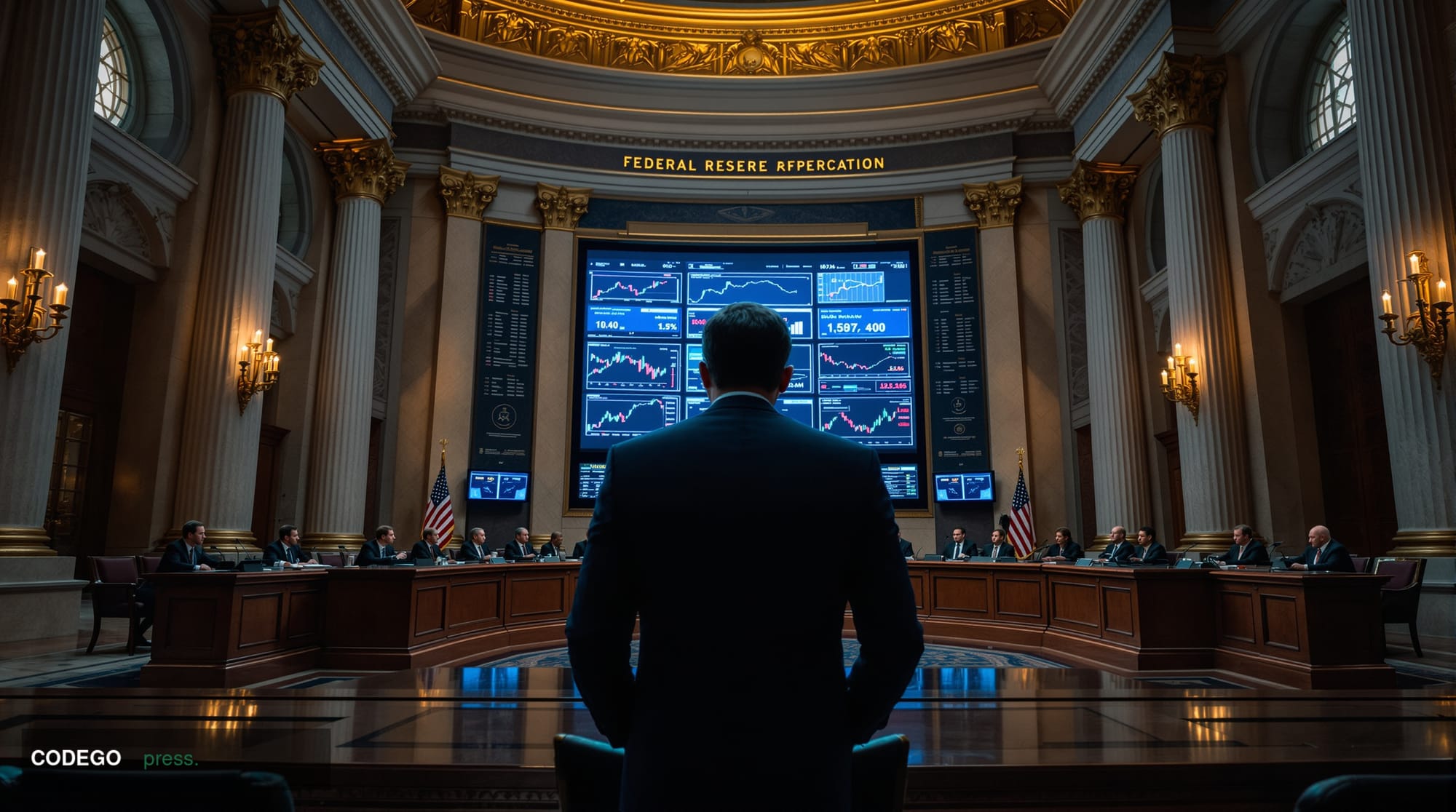
Kevin Warsh has assumed one of the most consequential positions in global finance — the chairmanship of the Federal Reserve — yet the early weeks of his tenure are already defined less by monetary policy pronouncements than by a thickening cloud of political pressure and ethical questions tied to his exposure to the cryptocurrency sector. For financial markets and digital-asset participants alike, the manner in which Warsh navigates these conflicts will determine whether his leadership ushers in a coherent new era of central-bank thinking or becomes mired in credibility challenges before it properly begins.
The scrutiny surrounding Warsh is multidimensional. On the political front, the new chairman arrives at the Fed at a moment of acute tension between the central bank's institutional independence and an executive branch that has demonstrated an unusually direct interest in the direction of interest-rate policy. That pressure is not merely atmospheric: it shapes the operational environment within which the Federal Open Market Committee deliberates, and markets are acutely sensitive to any signal that the Fed's decisions could be influenced by considerations beyond its dual mandate of price stability and maximum employment. Warsh's ability to project independence — credibly and consistently — will be tested from the outset.
Equally significant, and in some respects more novel, are the conflicts of interest observers have raised regarding Warsh's relationship with the cryptocurrency industry. The digital-asset sector has grown from a speculative fringe into a systemically relevant segment of global finance, and regulatory decisions emanating from Washington — including those shaped or influenced by Fed leadership on matters of bank supervision, stablecoin oversight, and financial stability assessments — carry enormous commercial consequences. A Fed chairman with perceived entanglements in that sector faces an inherent tension: the appearance of impartiality, long considered the bedrock of central-bank authority, becomes difficult to sustain when personal or professional interests may intersect with regulatory outcomes.
The historical parallel most readily invoked is that of the revolving door between Wall Street and Washington, a dynamic that has long generated public and legislative unease. But the crypto dimension adds a layer of complexity that is distinctly contemporary. Unlike traditional financial institutions whose regulatory relationships with the Fed are well-mapped and governed by decades of legal precedent, the cryptocurrency industry remains in a state of regulatory flux. Stablecoin legislation, the treatment of digital assets under bank capital frameworks, and the Fed's own exploration of a central bank digital currency all remain contested terrain. A chairman whose independence on these questions is doubted — fairly or otherwise — enters that contested terrain at a structural disadvantage.
Warsh is not without institutional resources to manage these pressures. He is a former Fed governor with substantive experience in crisis management, having served during the 2008 financial crisis, and commands respect among a segment of the financial establishment as a serious economist and policy thinker. Proponents argue that his background equips him to make hard decisions under political duress and that his familiarity with market dynamics, including emerging digital-asset markets, could prove an asset rather than a liability if properly disclosed and managed through robust recusal protocols.
The question of recusal, in fact, may become one of the defining procedural issues of his early chairmanship. Institutional credibility at the Fed is not merely a matter of the decisions made but of the architecture of accountability surrounding those decisions. If Warsh moves quickly and transparently to establish clear ethical guardrails — removing himself from deliberations where conflicts are plausible, publishing comprehensive disclosure documentation, and empowering the Board's ethics infrastructure — the political and crypto-related noise may recede as markets focus on the substance of his monetary-policy decisions. If he does not, the scrutiny will intensify with each Fed action touching the digital-asset or broader financial regulatory space.
Meanwhile, financial markets will be watching Warsh's signals on the trajectory of interest rates with the same intensity they direct at any incoming Fed chair. The macro environment he inherits — shaped by persistent inflation dynamics, uneven labor market signals, and the residual uncertainty of global trade policy — demands clear and consistent communication. Any perception that policy signals are colored by external political demands or personal financial interests risks an unwelcome volatility premium being priced into rate-sensitive assets across fixed income, equities, and digital markets simultaneously.
What This Means
For banking executives, asset managers, and the cryptocurrency industry's institutional participants, the central takeaway from Warsh's early period at the Fed is that uncertainty — about independence, about regulatory intent, and about the ethical architecture governing the new leadership — is itself a market variable. His chairmanship has the genuine potential to reshape Federal Reserve policies in ways that redefine the relationship between traditional monetary authority and the digital financial ecosystem. Whether that reshaping is orderly and credibility-preserving, or disruptive and contested, depends in large part on how decisively Warsh confronts the political and ethical pressures now arrayed before him. The institution he leads has survived crises of policy and crises of confidence before, but it has done so by making transparency and independence non-negotiable — a standard his tenure will be measured against from day one.
Written by the editorial team — independent journalism powered by Codego Press.