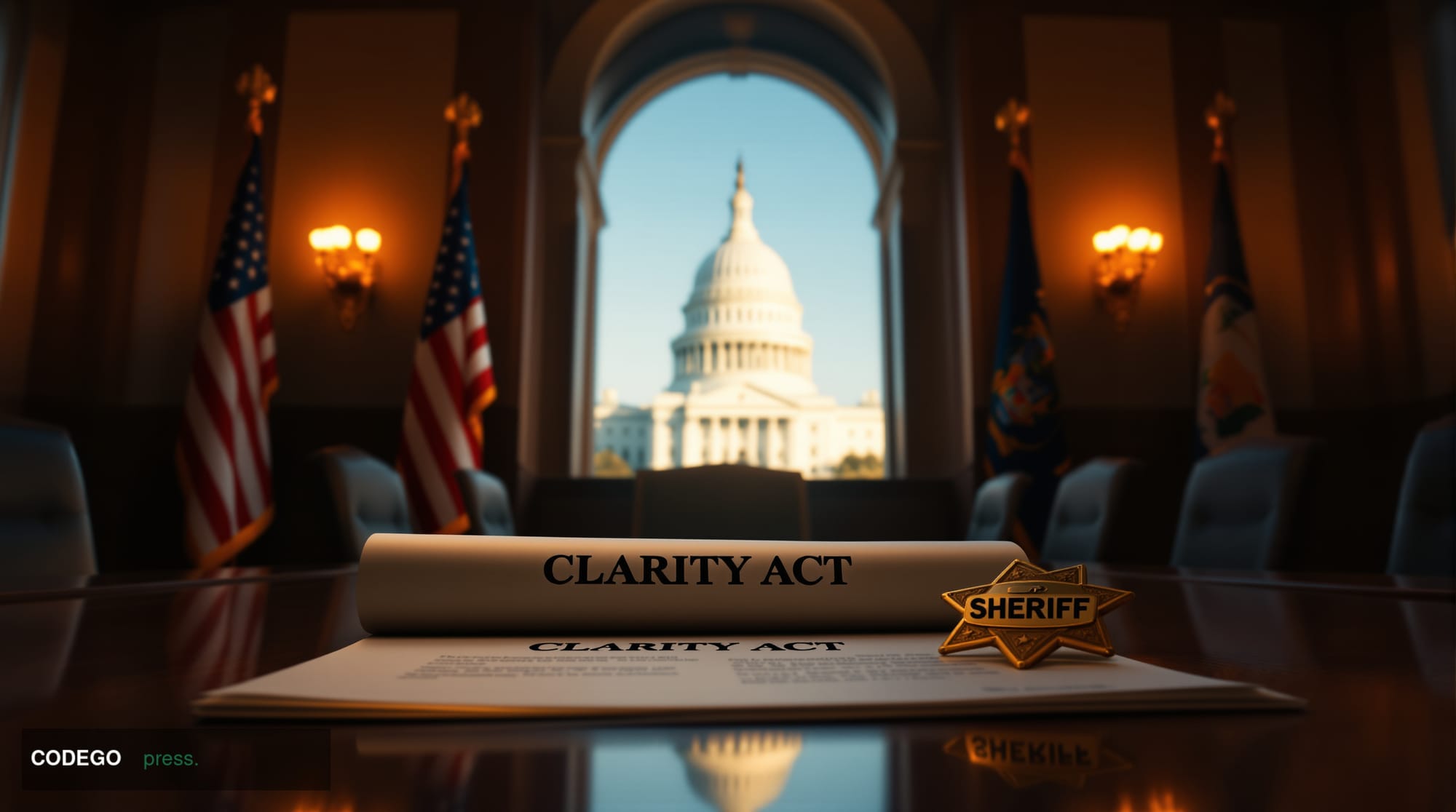
A meaningful obstacle in the legislative journey of the CLARITY Act has been removed, as the Major County Sheriffs of America formally dropped their opposition to the bill, shifting to a neutral stance following targeted negotiations around one of its more contentious provisions. The move is a notable development in the broader effort to establish a comprehensive federal framework governing digital assets in the United States, and it meaningfully improves the bill's prospects as it advances toward the Senate floor.
The Major County Sheriffs of America, an influential body representing the chief law enforcement officers of the nation's largest counties, had previously stood as an active opponent of the CLARITY Act. Law enforcement organizations of this stature rarely engage with financial legislation, which underscored the depth of concern that certain provisions of the bill had raised within policing and public safety circles. Their objection carried institutional weight — the kind that can stall or reshape legislative momentum in committee and beyond.
The critical turning point came through discussions specifically centered on Section 604 of the CLARITY Act. While the source does not detail the precise nature of those talks or enumerate the concessions made, the fact that a formal opposition from a major law enforcement coalition was converted into neutrality signals that negotiators addressed the sheriffs' core concerns with sufficient seriousness. In legislative terms, neutrality from a previously hostile stakeholder is functionally a concession of ground — it removes an organized voice of dissent from the debate without requiring that voice to endorse the legislation outright.
The CLARITY Act itself is among the most consequential pieces of proposed digital asset legislation currently moving through Congress. Broadly, it seeks to define the regulatory perimeter between the U.S. Securities and Exchange Commission and the Commodity Futures Trading Commission when it comes to cryptocurrency oversight, a jurisdictional ambiguity that has long frustrated both industry participants and regulators alike. Establishing clear lines of authority is widely considered a prerequisite for any durable federal crypto regulatory regime.
The involvement of the Major County Sheriffs of America in the CLARITY Act debate reflects a growing recognition that digital asset legislation is no longer purely a matter of financial market architecture. Cryptocurrencies and blockchain-based financial systems intersect with law enforcement priorities in meaningful ways — from the tracing of illicit transactions and money laundering to the seizure and custody of digital assets as evidence or recovered proceeds of crime. When sheriffs' organizations flag provisions in a crypto bill, it typically signals concerns about investigative authority, asset forfeiture procedures, or inter-agency cooperation frameworks. Section 604, whichever of those dimensions it touches, was evidently the focal point of productive dialogue.
For proponents of the CLARITY Act in the Senate, this development is strategically significant. Legislation of this complexity routinely accumulates opposition from multiple directions simultaneously — industry lobbyists, consumer advocates, state regulators, and, as demonstrated here, law enforcement bodies. Each bloc of opposition represents a potential procedural delay, an amendment fight, or a floor vote complication. Converting even one such bloc from active opposition to neutrality reduces the friction coefficient on the bill's Senate trajectory without requiring the kind of substantive compromise that might alienate other supporters.
The timing of this development is also noteworthy. Congressional appetite for digital asset legislation has intensified considerably in 2025 and into 2026, with stablecoin legislation and broader market structure bills competing for floor time. The CLARITY Act's ability to shed institutional opposition at this stage positions it more favorably within a crowded legislative calendar, where bipartisan goodwill and a relatively clean stakeholder environment can determine whether a bill reaches a vote before a session closes.
What This Means for Digital Asset Regulation
The Major County Sheriffs of America's shift from opposition to neutrality on the CLARITY Act is a modest but meaningful data point in the long effort to pass landmark crypto market structure legislation in the United States. It demonstrates that cross-sector negotiation — in this case, between legislative staff and law enforcement leadership — can resolve concerns that might otherwise metastasize into sustained political opposition. For the digital asset industry, which has spent years lobbying for regulatory clarity, every removed obstacle brings the prospect of a defined federal framework one step closer to reality. The Senate path remains complex, but it is measurably less obstructed than it was before the Section 604 discussions concluded.
Written by the editorial team — independent journalism powered by Codego Press.