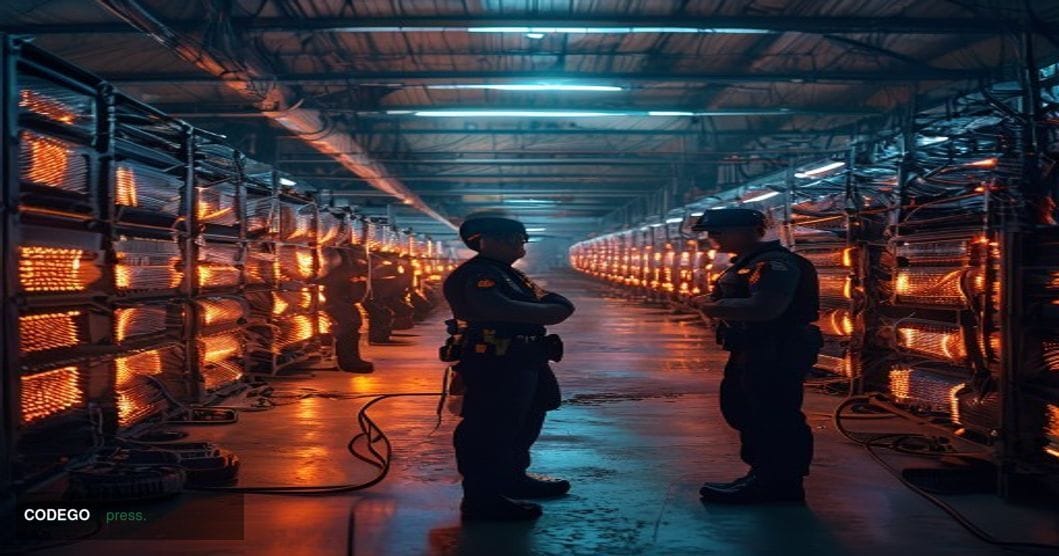
Malaysian authorities have escalated one of Southeast Asia's most aggressive campaigns against illicit cryptocurrency mining, seizing more than 75,000 mining rigs and conducting over 3,000 raids since 2022 in a sustained effort to stop operators from illegally tapping the country's national electricity grid. With 629 individuals arrested over the course of the crackdown, the operation stands as a stark signal that governments in the region are no longer willing to absorb the hidden costs of unregulated digital-asset infrastructure.
The scale of the enforcement is difficult to overstate. More than 75,000 pieces of specialized hardware — application-specific integrated circuits (ASICs) and graphics processing unit (GPU) rigs alike — represent not only a vast pool of computing power but an equally vast drain on subsidized electricity that was never paid for. Each confiscated machine is evidence of a calculated economic decision by miners: in markets where electricity is heavily subsidized, the arbitrage between power costs and Bitcoin or altcoin mining rewards can be extraordinarily attractive, provided someone else foots the energy bill.
Malaysia has long been a flashpoint for this tension. The country's relatively low industrial electricity tariffs — historically among the more affordable in the Asia-Pacific region — combined with its proximity to major hardware supply chains made it a natural destination for mining operations both legitimate and otherwise. Legal, grid-connected mining facilities do operate in Malaysia, but the 3,000-plus raids suggest that a substantial parallel economy of illegal operations flourished alongside them, burrowing into residential properties, warehouses, and commercial premises to steal power at scale.
The method of theft is not subtle. Illegal miners typically bypass utility meters using direct wire connections to distribution infrastructure, sometimes corrupting or bribing local supply officials to look the other way. The cumulative effect on Tenaga Nasional Berhad, Malaysia's national utility, and by extension the Malaysian taxpayer, runs into hundreds of millions of ringgit in unrecovered revenue annually, according to prior enforcement communications from the utility and government bodies. Grid stability and fire risk at clandestine mining sites compound the public-safety dimension of the problem.
The enforcement trajectory since 2022 reveals a deliberate, multi-agency commitment rather than a series of isolated operations. Averaging more than 750 raids per year over four years, Malaysian law enforcement — coordinating between the national utility's own enforcement arm, local police, and in some cases federal agencies — has maintained sustained pressure rather than executing a single high-profile sweep and declaring victory. The 629 arrests, while representing a fraction of the total individuals who may have been involved in operating 75,000 machines, indicate that prosecutors are pursuing criminal charges rather than merely confiscating equipment.
The broader regulatory context across Southeast Asia matters here. Neighboring countries including Thailand and Indonesia have periodically confronted similar issues, and China's blanket prohibition on cryptocurrency mining in 2021 displaced enormous hashing capacity that partly migrated into the region. Some of that displaced capacity landed in legitimately licensed facilities; a non-trivial portion appears to have flowed into the grey and black markets that Malaysian authorities are now systematically dismantling. The 75,000-rig seizure total effectively quantifies the downstream consequence of that displacement.
For the legitimate cryptocurrency mining industry, the Malaysian crackdown carries an important secondary message. Jurisdictions that offer competitively priced energy and stable infrastructure — the very characteristics that attract industrial-scale miners — are increasingly demonstrating that tolerance for illegal operations does not come bundled with those advantages. Governments are investing in enforcement capabilities, metering audits, and inter-agency coordination precisely because the economic losses from grid theft have become impossible to ignore. Operators who cut corners on power procurement face not only asset seizure but criminal prosecution, reputational damage, and the permanent loss of hardware that, in aggregate, can represent tens or hundreds of millions of dollars in capital.
What This Means for the Industry
The Malaysian enforcement record — 75,000 rigs seized, 3,000 raids executed, 629 arrested over four years — will increasingly serve as a reference benchmark for other emerging-market governments assessing how to respond to unauthorized mining activity. It demonstrates that incremental, operationally sustained enforcement is viable and produces measurable results without requiring blanket legislative prohibition of the asset class. For institutional investors and publicly listed mining companies evaluating Southeast Asian expansion, the lesson is unambiguous: energy compliance is not optional, and jurisdictions previously perceived as enforcement-light are rapidly recalibrating. The arbitrage opportunity that illegal miners exploited is closing, one seized machine at a time.
Written by the editorial team — independent journalism powered by Codego Press.