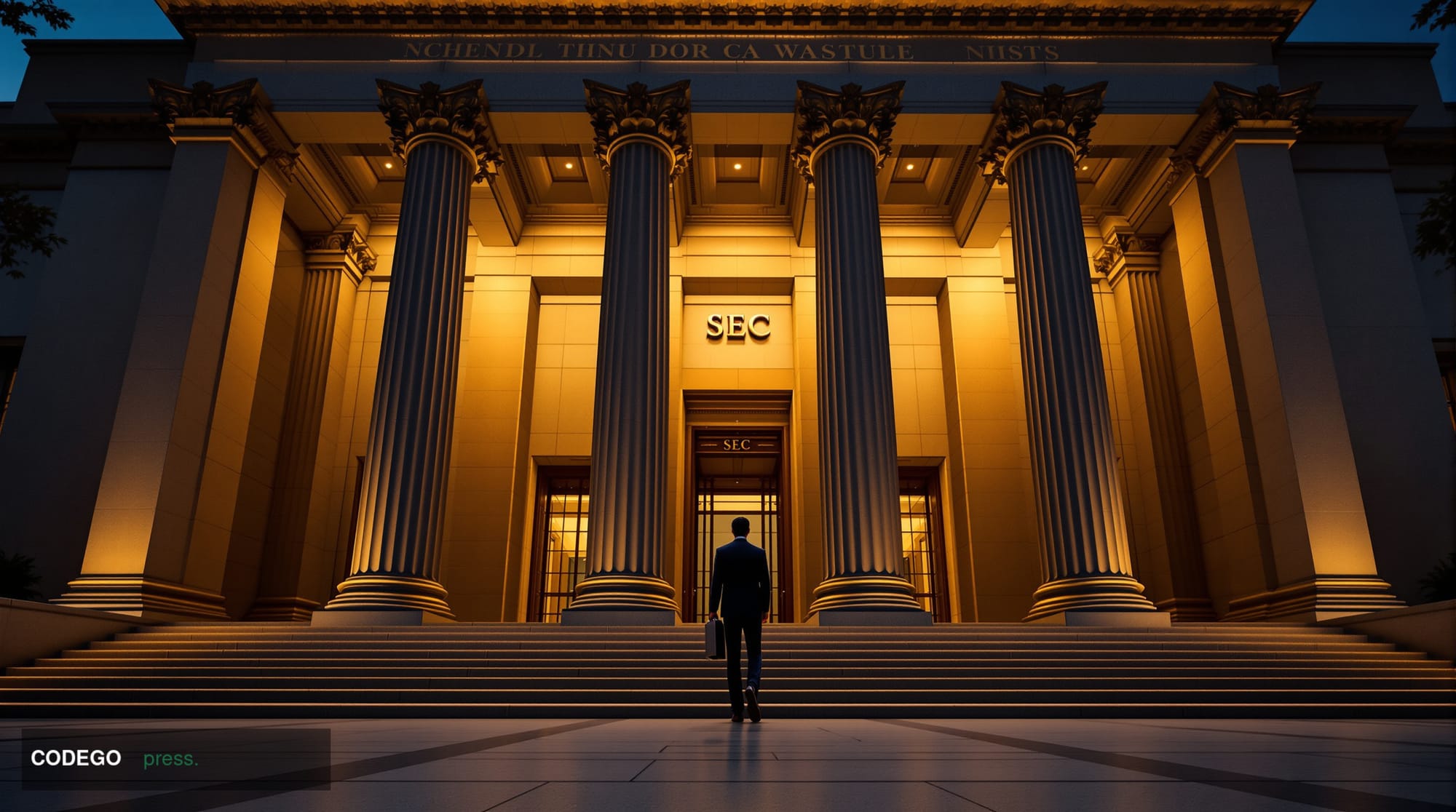
Nvidia shares cratered roughly 13% on Friday, touching a fresh 52-week low, after reports emerged that enforcement staff at the U.S. Securities and Exchange Commission are scrutinizing potential accounting irregularities at the chipmaking giant — a blow that arrives at an already precarious moment, following the high-profile resignation of longtime chief executive Jensen Huang.
The convergence of two seismic events in a single news cycle is precisely the kind of compounding pressure that sends institutional investors reaching for the exit. A 13% single-session decline to a 52-week low is not a routine pullback; it represents a fundamental reassessment of risk by the market. When a company's founder and visionary CEO departs, analysts begin repricing leadership continuity. When regulators simultaneously open an accounting examination, the discount applied deepens sharply — because the two uncertainties do not simply add together; they multiply.
It is critical to underscore what the reports do and do not say. The SEC examination currently involves enforcement staff reviewing potential accounting issues. That is meaningfully different from a formal enforcement action, a Wells Notice, or a filed complaint. Regulatory examinations at this stage can resolve without formal charges, can expand into full investigations, or can result in settlements. What they cannot do — in terms of market psychology — is remain neutral once disclosed. The mere confirmation that enforcement staff are asking questions is sufficient to reprice risk across the shareholder base, particularly given Nvidia's elevated valuation multiple heading into this period.
Nvidia's ascent over the past several years has been among the most closely watched in modern technology markets, driven by extraordinary demand for its graphics processing units in artificial intelligence infrastructure. That story thrust Jensen Huang — with his trademark leather jacket and evangelist's confidence — to the center of the AI investment narrative. His departure therefore strips the company of more than an executive; it removes a primary architect of the market's confidence in Nvidia's strategic direction. For a stock that traded at premium valuations built partly on the credibility of its leadership, the resignation alone warranted a significant repricing.
The SEC accounting examination compounds that leadership vacuum in the most damaging possible way. Investors who might otherwise have waited to assess a post-Huang Nvidia now face a second, potentially more structurally serious question: whether the financial results that underpinned the company's historic run accurately reflected the underlying business. It is worth emphasizing that an examination does not answer that question in the negative — but it places the question itself onto the table, and markets hate unanswered questions more than they hate bad answers.
From a governance standpoint, the timing will inevitably attract scrutiny. Boards and audit committees at publicly traded companies of Nvidia's scale maintain extensive internal controls, and the relationship between a chief executive's departure and a subsequent regulatory accounting review will generate pointed questions from analysts, institutional shareholders, and governance watchdogs alike. Whether any connection exists between those two events, or whether they are genuinely coincidental, remains entirely unknown at this stage — but the optics demand that Nvidia's board communicate clearly and rapidly with the market.
For the broader semiconductor and AI infrastructure investment thesis, the developments carry a cautionary dimension. Nvidia has functioned as a bellwether for the AI capital expenditure cycle — when Nvidia rises, it signals that hyperscalers are still pouring money into compute infrastructure; when it falls sharply, questions arise about the durability of that spending wave. A 13% single-session decline triggered by governance and regulatory concerns, rather than by any demand-side data, injects a different kind of uncertainty: not whether AI infrastructure spending will continue, but whether investors can trust the reported financials of the companies at the center of that spending.
What This Means
Until Nvidia's incoming leadership addresses the market directly — and until the scope of the SEC enforcement staff's accounting examination becomes clearer — the stock is operating in a regime of compounded uncertainty that few large-cap technology companies have navigated in recent memory. Investors will need concrete guidance on the accounting questions being examined, a credible succession narrative, and evidence of board-level accountability before the valuation discount applied on Friday begins to recede. The 52-week low registered this week may prove to be the floor, or it may prove to be a waypoint. The difference between those two outcomes rests almost entirely on what Nvidia and its regulators disclose next.
Written by the editorial team — independent journalism powered by Codego Press.