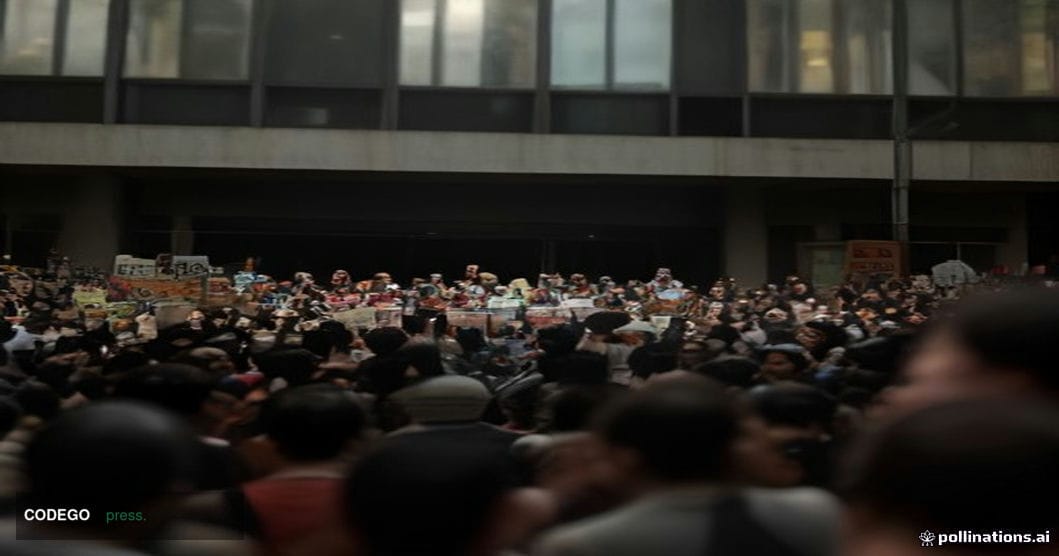
A banking crisis that began with frozen accounts has escalated into one of Paraguay's most significant political confrontations in years, as savers locked out of Ueno Bank took to the streets and the country's Congress moved formally toward impeaching President Santiago Peña. The convergence of financial desperation and institutional breakdown has produced scenes of raw public fury — depositors burning their bank cards on the pavement — that signal a crisis far beyond the balance sheet of a single financial institution.
The protests, which have intensified as an impeachment vote draws near, represent something that financial regulators across Latin America should study with considerable urgency. When ordinary savers lose access to their deposits and perceive that the state has either enabled or ignored that loss, the resulting anger does not remain confined to the financial sector. It migrates rapidly and unpredictably into the political arena, destabilising governments and eroding the institutional trust that functioning banking systems depend upon absolutely.
The symbolic act of burning bank cards is not merely theatrical. It is an expression of total repudiation — not just of Ueno Bank specifically, but of the entire framework of trust that underpins retail banking. Depositors place their savings with an institution on the fundamental assumption that those funds remain accessible. When that access is severed, the psychological and financial damage is acute and immediate. Households cannot pay bills, businesses cannot meet payroll, and the compact between citizen and financial institution collapses. What Paraguay's streets are showing the world is what that collapse looks like in human terms.
The political dimension of the crisis deepened further when a former presidential candidate attempted to address the crowd and was booed forcefully off the scene. That detail is telling. It suggests that the protesters are not aligned with a particular opposition figure or partisan agenda — they are expressing a broader, more corrosive disillusionment with the entire political class. When even opposition politicians cannot find purchase in a crowd of aggrieved citizens, it indicates that the institutional deficit runs deeper than any single party or administration can easily repair.
Congress's move toward removing President Peña adds a constitutional dimension to what began as a consumer-finance dispute. Impeachment proceedings are among the most destabilising instruments in a democratic system, and their deployment signals that the Ueno Bank lockout has become a proxy for wider grievances about governance, accountability, and the relationship between financial institutions and political power in Paraguay. Whether those proceedings ultimately succeed or fail, the reputational and institutional damage to Paraguay's banking sector will outlast any single political outcome.
For observers of Bank for International Settlements-aligned regulatory frameworks and emerging-market financial stability, Paraguay's crisis illustrates a structural vulnerability that is by no means unique to that country. Smaller markets with concentrated banking sectors, limited deposit insurance frameworks, and underdeveloped supervisory infrastructure are perpetually exposed to the kind of confidence shock that Ueno Bank's lockout has produced. The speed with which a retail banking failure can translate into street protests and constitutional crisis should inform how regulators in comparable jurisdictions calibrate their early-warning systems and depositor-protection mechanisms.
Latin America has witnessed banking crises before — Argentina's corralito of 2001, which froze deposit withdrawals and triggered the fall of multiple governments in rapid succession, remains the paradigmatic example of how financial contagion and political collapse can feed each other in a devastating loop. Paraguay's current situation carries echoes of that episode, even if the scale is different. The pattern — institutional failure, depositor fury, political implosion — is disturbingly familiar.
The role of digital financial infrastructure in this crisis also merits attention. Ueno Bank, as a digital-first institution serving a population that has increasingly moved toward cashless transactions, represents the kind of fintech-adjacent banking model that has expanded rapidly across emerging markets. When such institutions fail or restrict access, customers often have fewer fallback options than those served by traditional branch-based banks. The card-burning imagery on Paraguay's streets may well be a preview of what digital-banking failures look like in an era when the plastic card or the mobile wallet is the sole gateway to one's savings.
What This Means
The Ueno Bank lockout and its extraordinary political aftershocks carry a direct message for the fintech and banking industry globally: depositor protection is not a secondary regulatory concern to be addressed after growth targets are met — it is the foundational prerequisite for public legitimacy. Regulators in emerging markets must move aggressively to ensure that digital-first banks maintain adequate liquidity buffers and that depositors have genuine, enforceable recourse when institutions restrict access to funds. Paraguay's crisis, playing out in real time between burning bank cards and congressional impeachment votes, is a case study that no serious financial policymaker can afford to ignore.
Written by the editorial team — independent journalism powered by Codego Press.