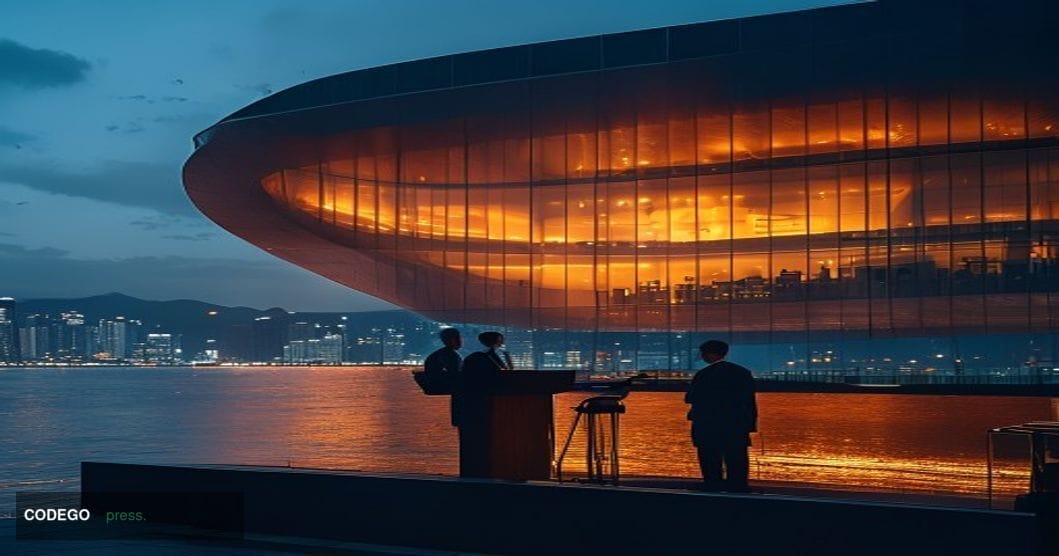
At a landmark gathering of fixed income and currency market participants in Hong Kong on 7 July 2026, People's Bank of China Governor Pan Gongsheng took the stage at the Hong Kong FIC & Bond Connect Summit to unveil a suite of new measures — and the financial world listened closely. The announcement, delivered before an audience convened by four of Hong Kong's most consequential financial institutions, underscored Beijing's continued commitment to deepening cross-border market connectivity through the city's unique intermediary role.
Hong Kong Monetary Authority (HKMA) Chief Executive Eddie Yue subsequently addressed the media in response to Governor Pan's announcements, positioning the new measures within the broader arc of Hong Kong's development as an international financial centre with privileged access to mainland Chinese capital markets. Yue's remarks came at the close of a summit jointly organized by the HKMA, the Securities and Futures Commission (SFC), Hong Kong Exchanges and Clearing Limited (HKEX), and Bond Connect Company Limited — a coalition of regulatory and market infrastructure bodies whose co-hosting of the event signals a coordinated institutional push to advance the Fixed Income and Currency (FIC) agenda.
A Summit Architecture Built for Strategic Weight
The choice of co-hosts is itself a statement of intent. Rarely does a single financial summit draw simultaneous institutional sponsorship from Hong Kong's monetary authority, its securities regulator, its primary exchange operator, and the dedicated infrastructure company governing northbound and southbound bond flows. That architecture reflects how seriously both Hong Kong and mainland authorities regard the ongoing maturation of Bond Connect — the scheme that since its 2017 launch has gradually opened China's vast onshore bond market to international investors via Hong Kong as a conduit.
Bond Connect has grown from an experimental channel into a systemically significant pathway. International investors have steadily accumulated Chinese government bonds and policy bank bonds through the programme, drawn by yield differentials, diversification value, and improving settlement infrastructure. Each successive policy announcement at forums such as this one tends to expand eligibility criteria, improve operational mechanics, or remove friction in areas such as foreign exchange hedging and tax treatment — the kind of incremental but compounding liberalization that transforms a niche access route into a mainstream allocation for global fixed income portfolios.
Pan Gongsheng's Announcement and Its Institutional Framing
Governor Pan's decision to deliver these new measures personally at a Hong Kong-hosted summit, rather than through a Beijing press release, carries deliberate diplomatic and market signalling weight. It affirms Hong Kong's status as the preferred offshore stage for announcements concerning China's capital account opening — a role that has faced questions in recent years given shifting geopolitical currents. By appearing at an event jointly convened with the SFC and HKEX, Pan aligned the PBoC's policy signal with the operational credibility of Hong Kong's market infrastructure, lending the announcement immediate institutional context.
Eddie Yue's media response served a complementary function: translating the governor's policy language into the register of international investors and market practitioners who look to the HKMA for guidance on the practical implications of mainland regulatory shifts. In this respect, Yue occupies a structurally important interpretive role — the HKMA sits at the intersection of Hong Kong's currency board arrangements, its function as a global financial hub, and its deepening integration with mainland financial market development. His ability to speak credibly to both the international investment community and Beijing's policy apparatus makes him a crucial interlocutor at moments like this.
What This Means for Global Fixed Income Investors
The symbolism of the 7 July summit extends beyond any single policy measure. It reflects a deliberate and joint effort by mainland and Hong Kong authorities to sustain momentum around FIC market development at a time when global investors are recalibrating their China exposure strategies. For international asset managers, the signal from a PBoC Governor speaking in Hong Kong flanked by HKMA, SFC, HKEX, and Bond Connect institutional partners is that the access infrastructure is stable, the policy direction is expansionary, and the political will to maintain Hong Kong's intermediary role remains firm.
The FIC & Bond Connect Summit now stands as one of the primary annual forums where China's capital market opening narrative is actively shaped. The involvement of Governor Pan at the 2026 edition raises the summit's profile considerably and ensures that whatever measures were announced will be watched closely by sovereign wealth funds, central banks, and institutional fixed income managers across Asia, Europe, and North America who hold or are considering Chinese renminbi-denominated assets. The HKMA's stewardship of this event — and Yue's role as its public face — reinforces Hong Kong's indispensable position in the architecture of global capital flows into China.
Written by the editorial team — independent journalism powered by Codego Press.