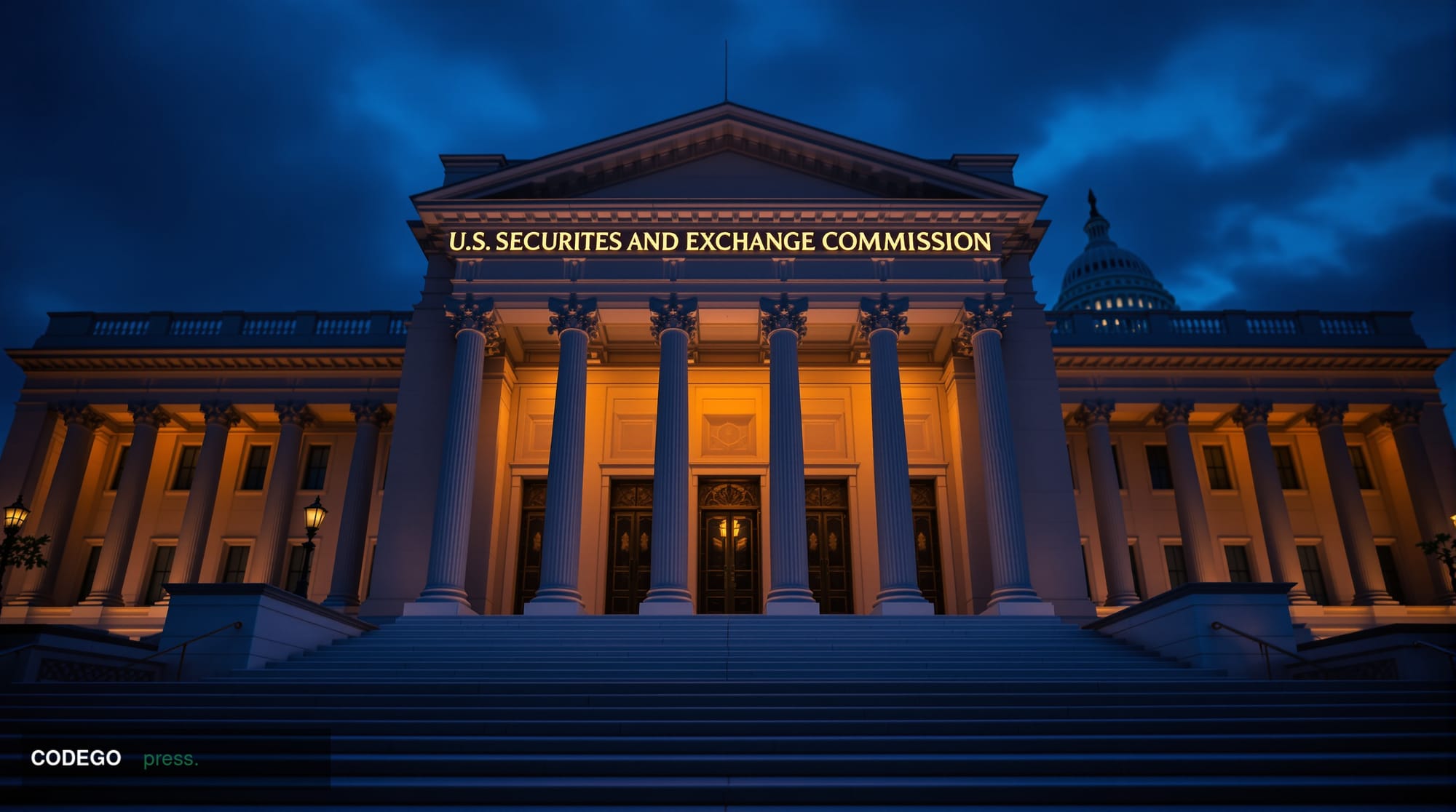
The U.S. Securities and Exchange Commission has canceled a scheduled meeting devoted to proposed rules governing crypto asset offerings, a development that underscores the fragile and deeply interdependent relationship between the country's two principal pillars of financial rulemaking: regulatory agencies and the legislature. The abrupt cancellation, triggered by the U.S. Senate's departure for recess without casting a vote on the CLARITY Act, represents one of the more consequential procedural setbacks the digital asset industry has faced in its ongoing effort to secure a workable regulatory framework in the United States.
The SEC's now-canceled meeting had been widely anticipated by industry participants, legal practitioners, and institutional investors who have long waited for clearer rules of engagement around how crypto asset offerings should be structured, disclosed, and supervised under American securities law. The Commission's decision to call off the session — rather than proceed independently — signals that senior officials viewed the legislative trajectory of the CLARITY Act as a prerequisite, or at minimum a meaningful input, into the shape of any proposed rulemaking. That the Senate failed to vote on the Act before leaving for recess has effectively stalled both tracks simultaneously.
What the CLARITY Act Represents
The CLARITY Act has been positioned as a landmark piece of legislation intended to establish definitive jurisdictional boundaries between the SEC and the Commodity Futures Trading Commission with respect to digital assets — a demarcation that has been the source of prolonged legal uncertainty, overlapping enforcement actions, and chilling effects on domestic crypto market development. By leaving Washington without advancing the bill to a floor vote, the Senate has allowed that foundational ambiguity to persist, leaving both regulators and market participants without the statutory clarity they require to operate with confidence.
For the SEC, proceeding with a formal rulemaking session in the absence of legislative guidance would have carried its own risks. Crafting detailed offering rules for crypto assets without a settled statutory definition of what constitutes a security versus a commodity in the digital context risks producing regulations that are either legally vulnerable to challenge or rapidly rendered obsolete the moment Congress does act. The Commission's decision to stand down, while frustrating to many in the industry, reflects a degree of institutional caution that is arguably appropriate given the scale and complexity of what is at stake.
An Industry Left in Limbo
The practical consequences of this dual stall — a canceled regulatory meeting compounded by a Senate recess — are significant and immediate. Crypto firms seeking to launch token offerings in the United States must continue to navigate an environment defined by enforcement-led guidance rather than transparent, prospective rulemaking. Legal teams across the industry will continue to rely on a patchwork of no-action letters, enforcement settlements, and court decisions to infer what the SEC will and will not tolerate. That is a poor substitute for codified rules, and it continues to push activity — and capital — toward jurisdictions with more settled frameworks.
Institutional investors, meanwhile, face their own dilemma. Many fund managers and allocators who are structurally willing to engage with digital assets remain constrained by compliance mandates that require a level of regulatory certainty the U.S. market still cannot provide. Each month that the CLARITY Act languishes and the SEC's rulemaking calendar slips is another month in which American markets cede competitive ground to European regulators who have already enacted comprehensive digital asset market legislation, and to jurisdictions in Asia and the Gulf that are actively courting crypto businesses with stable legal environments.
What This Means for the Road Ahead
When the Senate returns from recess, the CLARITY Act will need to be re-prioritized on a legislative calendar that is perennially crowded and subject to political headwinds. There is no guarantee that the bill advances to a vote in the near term, and even if it does, the timeline for the SEC to reconvene its rulemaking process, digest the legislative outcome, and produce actionable proposed rules extends the horizon for regulatory resolution further into the future. For an industry that has been promised clarity — figuratively and literally — for several years, the cancellation of this meeting is a painful reminder of how easily progress can be undone by the rhythms of the American political calendar.
The SEC's cancellation is not, in isolation, a catastrophic event. Regulatory meetings are rescheduled, legislative sessions restart, and rulemaking processes resume. But the pattern it represents — of interdependent processes that stall one another in sequence — is the more serious concern. Until the CLARITY Act or equivalent legislation achieves a legislative resolution, the SEC will remain in a difficult position: too exposed to legal risk to regulate comprehensively, and too significant an institution to be ignored by any serious market participant. The industry's patience, already tested, will be tested further still.
Written by the editorial team — independent journalism powered by Codego Press.