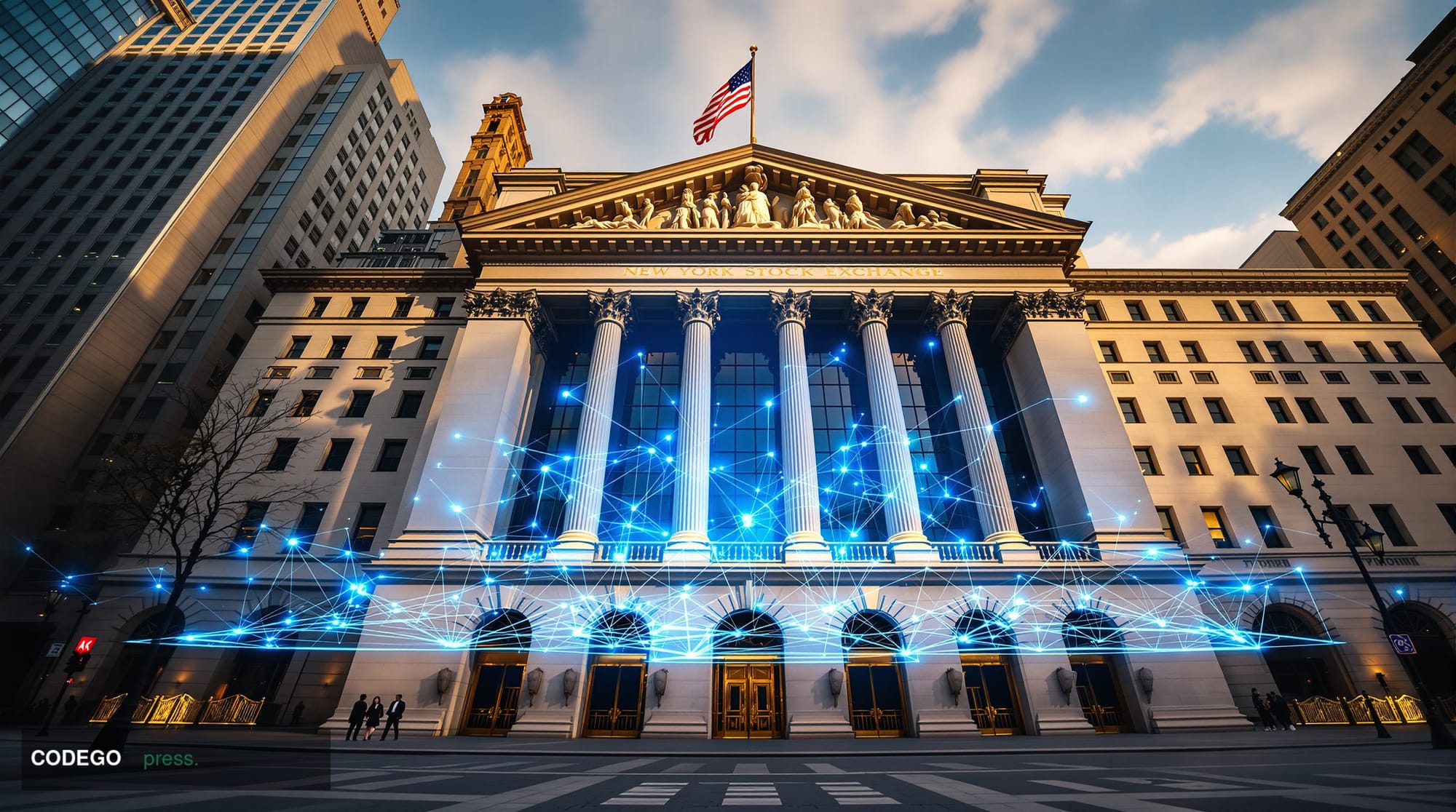
In a milestone that underscores how rapidly the boundaries between traditional capital markets and blockchain infrastructure are dissolving, Securitize — the tokenization firm backed by BlackRock — has commenced trading on the New York Stock Exchange. What makes this listing categorically different from a conventional initial public offering is the simultaneous availability of tokenized Securitize shares on two major public blockchains: Solana and Avalanche. The firm has effectively bridged the analog and digital worlds of equity ownership in a single corporate action — and the implications for capital markets are far-reaching.
A Dual-Rail Equity Market Becomes Reality
For years, advocates of blockchain-based finance argued that tokenized equities would eventually trade alongside their traditional counterparts, offering investors a choice of rails rather than forcing a binary decision between old-world brokerage accounts and crypto-native wallets. Securitize's listing makes that theoretical framework operational. Investors can access the company's shares through a conventional NYSE brokerage account or, alternatively, hold and transact in tokenized form on either the Solana or Avalanche networks. This dual-rail structure is not a pilot or a proof of concept — it is a live, regulated market event executed by a publicly traded company whose core business is, precisely, the tokenization of real-world assets.
The symbolism is difficult to overstate. Securitize does not merely use blockchain technology as a back-office efficiency tool; it sells tokenization as a service to some of the most consequential institutional names in global finance. Having BlackRock as a backer is not incidental background color — it is a direct signal that the asset management industry's largest player has made a strategic bet on the firm's model. When BlackRock commits capital and credibility to a tokenization infrastructure company, and that company then lists its own shares in tokenized form on public blockchains, the message to the broader financial services industry is unambiguous: this is a direction of travel, not a detour.
Why Solana and Avalanche?
The choice of Solana and Avalanche as the blockchain rails for tokenized share issuance reflects deliberate infrastructure reasoning rather than speculative enthusiasm. Solana has established itself as one of the highest-throughput public blockchains in operation, capable of processing thousands of transactions per second at fractional cost — characteristics that matter enormously when the goal is to replicate or exceed the settlement efficiency of centralized exchanges. Avalanche, for its part, has distinguished itself through its subnet architecture, which allows enterprises to create application-specific blockchain environments with customizable compliance and permissioning layers. For a regulated securities issuer, that flexibility is not a luxury; it is a compliance necessity.
Together, these two networks offer Securitize a combination of speed, cost efficiency, and institutional-grade configurability that neither chain alone nor legacy settlement infrastructure could deliver as completely. The selection also signals that Securitize is not building toward a single-chain future — a positioning that hedges against network-level risk and broadens the addressable investor base across distinct crypto-native communities.
Tokenization at an Institutional Inflection Point
Securitize's NYSE debut arrives at a moment when institutional interest in real-world asset tokenization has moved well beyond exploratory conversations. Major banks, sovereign wealth funds, and asset managers have spent the past two years building or acquiring tokenization capabilities, driven by the prospect of unlocking liquidity in traditionally illiquid asset classes, reducing settlement times from days to seconds, and enabling fractional ownership structures that democratize access to institutional-grade investments. Securitize has been at the operational center of this shift, having already facilitated the tokenization of fund products for BlackRock and other blue-chip clients.
The firm's own listing therefore functions as both a corporate milestone and a live demonstration of its product. Every trade executed in tokenized Securitize shares on Solana or Avalanche is simultaneously a proof of concept for the services the company sells to its clients. It is a rare instance of a financial infrastructure provider using its own equity as a testbed for the technology it commercializes — and doing so in full view of regulators, institutional investors, and the broader market.
What This Means for Capital Markets
The convergence of NYSE listing and multi-chain tokenized share availability marks a qualitative shift in how equity markets may function over the next decade. If Securitize's dual-rail model demonstrates reliable price discovery, adequate liquidity, and compliant settlement across both traditional and blockchain venues, it creates a template that other issuers — and potentially regulators — will study closely. The U.S. Securities and Exchange Commission's evolving posture toward tokenized securities will inevitably be shaped, in part, by real-world data generated by live listings such as this one.
For institutional investors, the practical question is no longer whether tokenized equities are theoretically viable, but whether the infrastructure surrounding them — custody, compliance, market-making, and cross-chain interoperability — is mature enough to support meaningful allocation. Securitize's listing does not answer all of those questions, but it advances the conversation from hypothetical to empirical in a way that no white paper or pilot program can replicate. BlackRock's continued involvement ensures that the weight behind this experiment is institutional, not merely entrepreneurial.
Written by the editorial team — independent journalism powered by Codego Press.