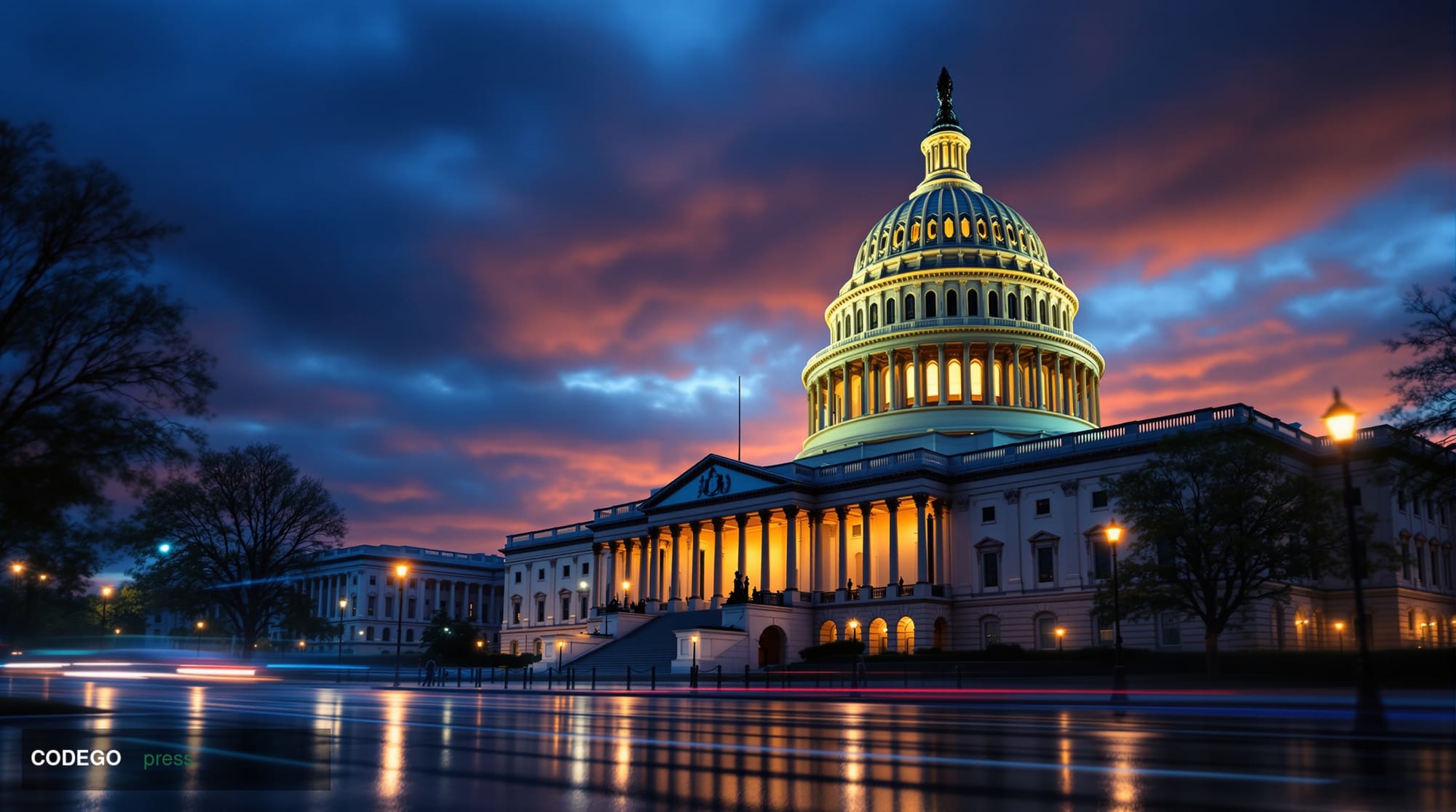
The United States Senate's rejection of the CLARITY Act on September 16, 2026 struck the digital asset industry with swift and measurable force. Coinbase, the largest publicly traded crypto exchange in the United States, saw its share price slide nearly 9% in the immediate aftermath, as broader crypto-linked equities sold off sharply across the board. The vote was not merely a procedural setback — it was a definitive signal that the U.S. Congress remains unable to deliver the comprehensive regulatory framework that the digital asset sector has spent years lobbying to obtain.
The CLARITY Act had been positioned by its supporters as the long-awaited legislative architecture that would resolve one of the most debilitating ambiguities in American financial markets: whether digital assets are securities, commodities, or an entirely distinct class of instrument. For an industry repeatedly hammered by enforcement actions from the Securities and Exchange Commission and the Commodity Futures Trading Commission, the bill represented the possibility of a defined legal perimeter — a foundation on which exchanges, token issuers, and institutional investors could build with confidence. The Senate's failure to clear the key procedural vote dismantled that possibility, at least for now.
The market response was immediate and rational. Crypto stocks sank across the sector following the Senate's rejection, with Coinbase's near-9% decline serving as the sharpest barometer of investor disappointment. The sell-off reflected not just the loss of a single bill, but the erosion of the regulatory optimism that had quietly buoyed valuations throughout 2026 as the legislation advanced through earlier stages. When that optimism evaporated on the Senate floor, so did a meaningful portion of the sector's market capitalization.
Ripple, whose years-long legal battle with the Securities and Exchange Commission made it one of the most prominent symbols of the cost of regulatory uncertainty, weighed in directly on the CLARITY Act's failure. Ripple's position — shaped by its own experience navigating enforcement actions in the absence of clear statutory guidance — carries particular credibility in this debate. The company has consistently argued that the lack of legislative clarity forces crypto businesses to operate in legal gray zones, stifling innovation and driving capital and talent offshore to jurisdictions with more defined rules.
The questions now confronting the industry are stark: will crypto prices face sustained downward pressure as regulatory uncertainty reasserts itself, and when — if ever — will the Senate find the political will to revisit comprehensive digital asset legislation? Historical precedent offers limited comfort. Major financial regulation in the United States rarely moves quickly, and the CLARITY Act's failure suggests that the coalition required to advance it through the upper chamber remains incomplete. Competing regulatory philosophies between Senate factions, combined with broader political pressures, have once again proven sufficient to block consensus.
For institutional investors who had begun positioning for a post-CLARITY regulatory environment, the Senate's vote forces a strategic reassessment. Custody providers, asset managers, and banks that had been quietly building digital asset infrastructure on the assumption that clarity was approaching must now recalibrate their timelines. The compliance burden of operating without statutory certainty remains elevated, and the risk of enforcement actions — historically wielded by regulators in lieu of clear legislative mandates — has not diminished.
Meanwhile, on the industry's formation side, a notable development emerged alongside the legislative turbulence. Alumni of Revolut and N26, two of Europe's most prominent neobanks, launched a new fintech venture called Quartz. The timing is instructive: while U.S. regulatory stalemate persists, experienced operators from the European digital banking ecosystem continue to bring new companies to market, underscoring where entrepreneurial energy is flowing in the absence of American legislative certainty. Quartz's founders carry significant institutional pedigree from two institutions that collectively reshaped retail banking across the European Union — a foundation that will attract close scrutiny as the startup's proposition becomes clearer.
What This Means for the Industry
The Senate's rejection of the CLARITY Act is more than a legislative failure — it is a stress test of the crypto industry's resilience to political disappointment. Coinbase's nearly 9% single-session decline quantifies the market's belief that regulatory clarity had real, priced-in value. That value has now been unwound. For the broader sector, the path forward likely runs through either a revised and renegotiated bill, a change in Senate composition, or continued reliance on agency-level guidance — none of which offers the certainty that exchanges, token issuers, and institutional capital require. The emergence of ventures like Quartz, built by veterans of Europe's digital banking revolution, serves as a reminder that talent and capital will continue to find productive outlets regardless of Washington's pace. The question is whether those outlets will be built in the United States or beyond its borders.
Written by the editorial team — independent journalism powered by Codego Press.