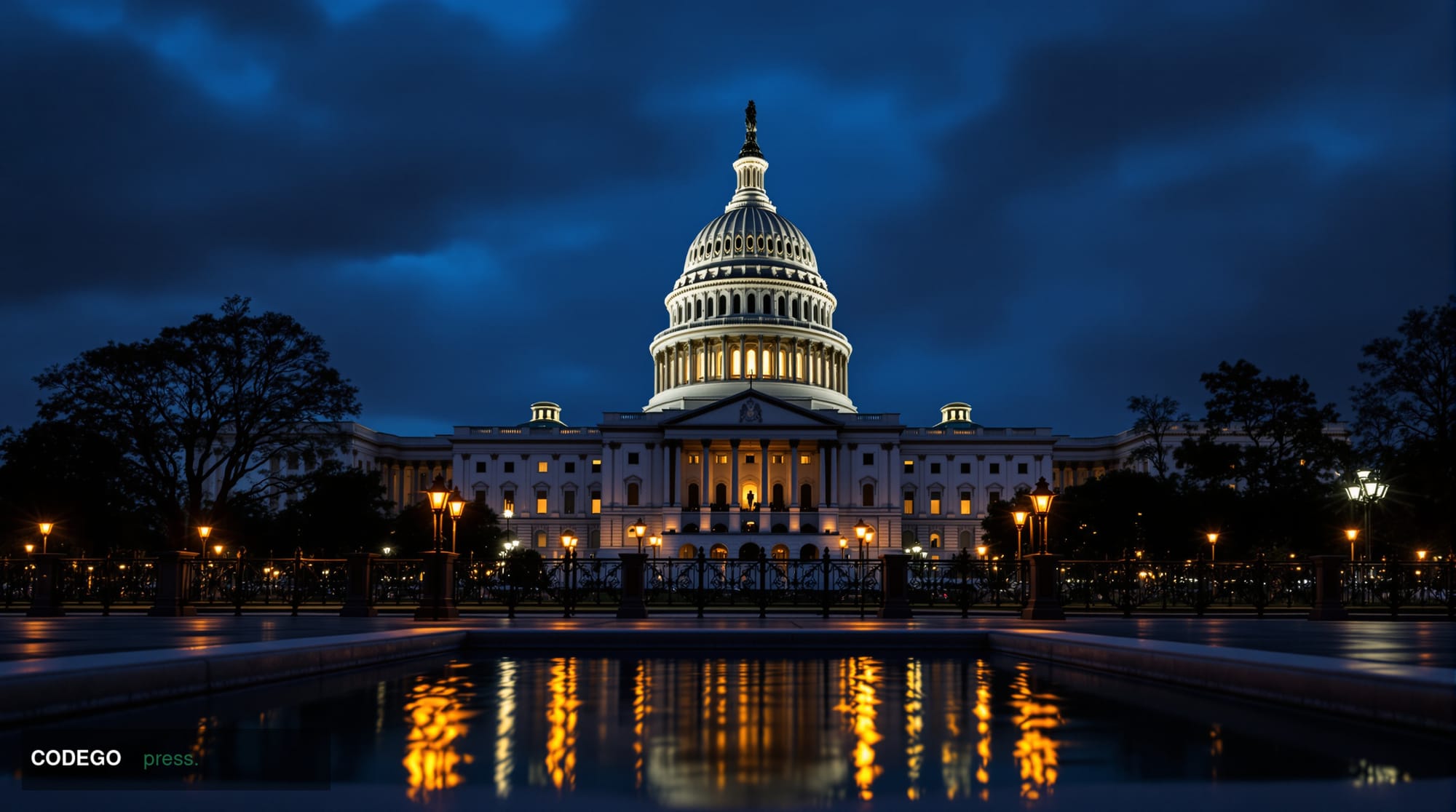
A bill that could have delivered the United States its first comprehensive framework for cryptocurrency regulation has collapsed on the Senate floor, undone not by technical disagreement over digital assets but by the intensely political question of whether a sitting president can profit from an industry he is simultaneously trying to legislate. Senate Democrats, pointing directly at Donald Trump's documented personal investments in crypto markets, blocked the legislation from advancing — with Nevada's senators among those casting decisive votes against the bill. The episode has sent a stark signal to markets and policymakers alike: in Washington, the line between financial regulation and political self-dealing has never been harder to separate.
The defeat of the crypto bill represents one of the most consequential regulatory failures in the short history of digital asset governance. For years, the industry lobbied aggressively for legal clarity — on custody rules, on stablecoin issuance, on exchange oversight — and had every reason to believe 2026 would finally be its year. Republican leadership in the Senate had signaled willingness to move, and there was, at least on paper, a viable bipartisan coalition available. What those projections did not account for was the degree to which Trump's flagrant self-enrichment in crypto would harden Democratic opposition into something non-negotiable.
The argument Democrats made was straightforward, if politically explosive: a president with material financial interests in cryptocurrency should not be the one signing cryptocurrency regulation into law. The conflict of interest, they argued, was not theoretical. Trump's involvement in the crypto space has been publicly visible, and critics contend that any regulatory framework enacted under these conditions would be shaped, at least in part, by the president's personal profit motive rather than the public interest. Nevada's senators, representing a state with considerable tech and financial services exposure, aligned with that position — a notable signal given the economic stakes involved for their constituents.
For the crypto industry, the consequences are both immediate and structural. Without federal legislation, the existing patchwork of Securities and Exchange Commission enforcement actions, state-level money transmission rules, and ad hoc guidance from the Commodity Futures Trading Commission continues to serve as a de facto regulatory regime — one that satisfies almost nobody. Institutional investors seeking certainty before committing large allocations to digital assets will remain cautious. International competitors, particularly in Europe where the Markets in Crypto-Assets regulation has provided a functioning framework since 2023, will press their first-mover advantage further.
The Senate drama unfolded against a broader backdrop of transformation in global banking that the week's financial reading made plain. The World's Best Digital Banks 2026 rankings — Round 1 of the annual exercise — landed with considerable fanfare, their central thesis being that a genuinely next generation of digital banking has arrived. The rankings, closely watched by investors and incumbents alike, reflect a competitive landscape in which pure digital challengers have matured from disruption-phase experiments into fully scaled financial institutions capable of challenging traditional lenders on core products, not just on user experience at the margin.
Simultaneously, a serious strategic conversation is gathering momentum in Europe around the creation of the next cohort of European banking champions. The logic is not hard to follow: as Revolut, Wise, and a cluster of regional neobanks demonstrate the capacity to scale across borders within the single market, the question of whether legacy institutions can consolidate fast enough to compete — with American megabanks and with nimble digital-first rivals — is no longer academic. European Central Bank policymakers and finance ministers have watched American and Asian financial giants extend their balance sheet advantages for over a decade; the political will for consolidation appears to be hardening.
What This Means for Markets and Policy
The failure of U.S. crypto legislation in September 2026 does not simply delay regulation — it reframes the entire political economy of the debate. Future attempts to pass a framework will need to resolve, explicitly, the question of presidential and congressional financial conflicts of interest in digital assets before any bipartisan coalition can hold together. That is a harder problem than drafting custody rules or defining a security. Until it is solved, regulatory uncertainty in the world's largest capital market persists, and the competitive gap between U.S. regulatory clarity and that of European Banking Authority-supervised markets will continue to widen. For digital banks watching the global rankings shift and for European institutions contemplating consolidation, the message from Washington is unambiguous: the rules of the game remain unwritten, and the political will to write them cleanly has not yet arrived.
Written by the editorial team — independent journalism powered by Codego Press.