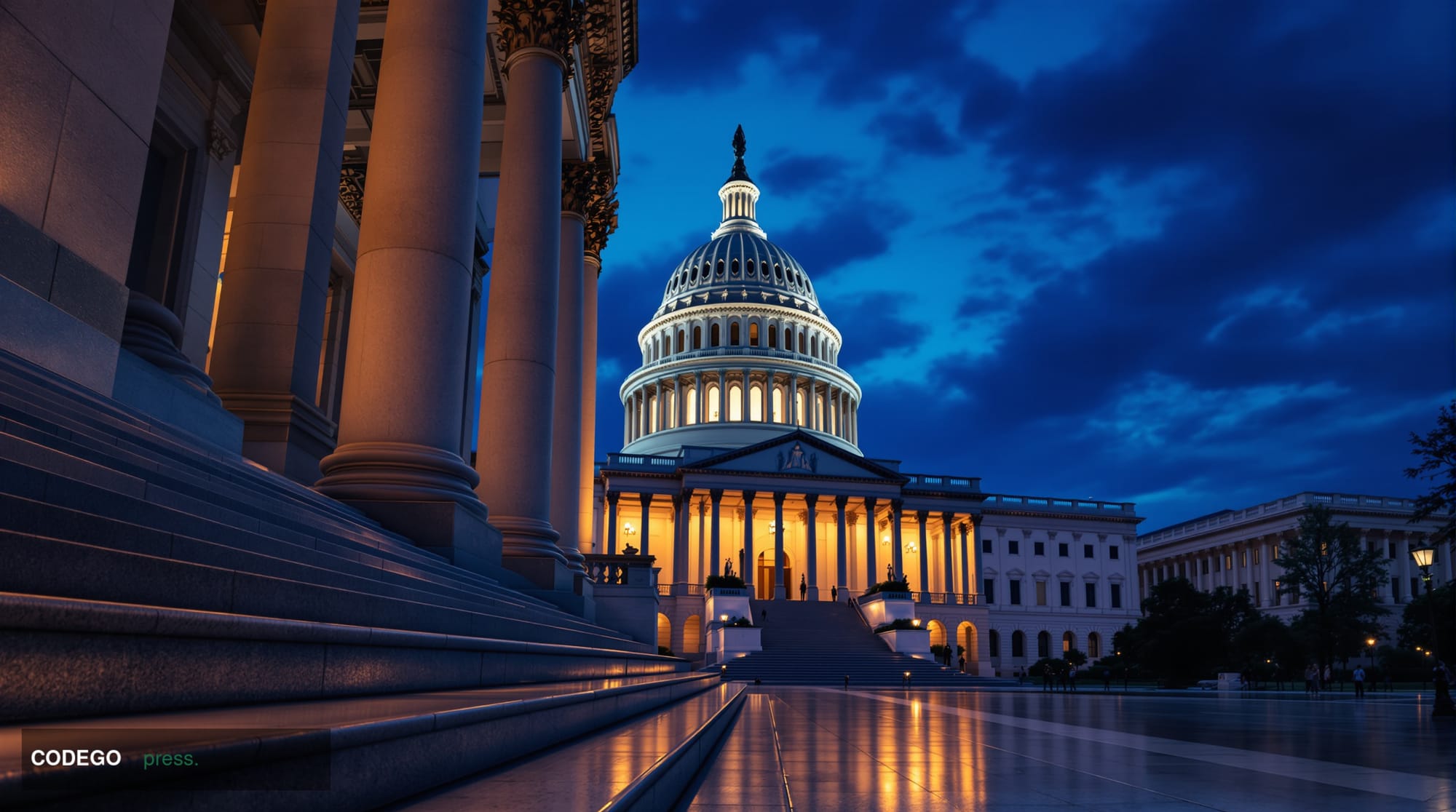
A United States Senate investigation has formally placed Binance, Tether, and a collection of crypto firms with ties to former President Donald Trump under direct congressional scrutiny, ordering all named entities to produce records by January 4 or face the prospect of further, unspecified measures. The move marks one of the most sweeping legislative interventions into the digital-asset sector in recent memory, drawing three of the industry's most prominent and politically charged names into a single congressional crosshairs at a moment when crypto's relationship with Washington is already under intense negotiation.
The January 4 deadline imposed by the Senate carries unmistakable weight. Congressional document demands of this nature, when unmet, can escalate to formal subpoenas, contempt referrals, or coordinated action with executive-branch regulators including the Department of Justice and the Securities and Exchange Commission. The phrase "other measures," used to describe what may follow non-compliance, is deliberately broad — a legislative tool designed to signal maximum flexibility for investigators while applying maximum pressure on recipients. For companies operating in a sector already navigating overlapping domestic and international regulatory frameworks, the ambiguity is as consequential as the deadline itself.
Binance, the world's largest cryptocurrency exchange by trading volume, enters this investigation carrying the weight of a prior legal reckoning. The exchange reached a landmark settlement with U.S. authorities in 2023, pleading guilty to federal charges including violations of the Bank Secrecy Act and anti-money laundering statutes, and agreeing to pay approximately $4.3 billion in penalties — one of the largest corporate financial penalties in U.S. history. Its founder, Changpeng Zhao, stepped down as chief executive as part of that resolution. A renewed Senate inquiry therefore raises immediate questions about whether Binance's post-settlement compliance posture has satisfied congressional investigators, or whether new concerns have emerged that the 2023 agreement did not address.
Tether, the issuer of the world's most widely circulated stablecoin, USDT, presents a distinct set of investigative angles. The company has faced persistent questions from regulators, lawmakers, and journalists over the precise composition of the reserves backing its dollar-pegged token, as well as over the use of USDT in jurisdictions subject to U.S. sanctions. Tether has repeatedly asserted the legitimacy and soundness of its reserves, but it has never undergone a full independent audit of the kind that U.S. lawmakers and banking regulators have demanded of stablecoin issuers. A Senate records demand could force a level of documentary transparency that years of voluntary disclosure have failed to produce.
The inclusion of Trump-linked crypto firms adds a politically explosive dimension to the investigation that separates this probe from more routine regulatory inquiries. While the source reporting does not name the specific entities classified as Trump-linked, the former president and members of his family have in recent years become materially involved in the digital-asset space through various ventures and licensing arrangements. Congressional scrutiny of those connections, particularly from a Senate body, risks colliding directly with the broader political debate over crypto regulation — a debate in which Trump himself has positioned as an industry ally. The Senate probe, by lumping these firms alongside Binance and Tether, signals that investigators are unwilling to treat political association as a shield against accountability.
The timing is significant in ways that extend beyond the January 4 deadline itself. The U.S. crypto regulatory environment has been in a state of contested flux, with ongoing disagreements between the SEC, the Commodity Futures Trading Commission, and Congress over jurisdictional authority and the appropriate legislative framework for digital assets. Senate-level intervention of this magnitude can reshape those dynamics, lending urgency to stalled legislative efforts while simultaneously creating litigation and compliance uncertainty for the named firms. Industry lobbyists who had anticipated a more permissive posture from Congress following election-cycle crypto advocacy will now need to reassess that calculus.
For institutional participants and financial counterparties with exposure to any of the named entities — whether through custodial arrangements, liquidity provision, or treasury holdings of USDT — the Senate probe introduces a new tier of counterparty risk that compliance and risk-management teams cannot responsibly ignore. Due diligence frameworks that treat regulatory and legislative actions as binary outcomes — resolved or unresolved — are poorly suited to the graduated pressure campaign that congressional investigations represent. The period between now and January 4 is therefore not merely a waiting period; it is an active risk interval.
What This Means for the Industry
The Senate's decision to issue simultaneous demands to Binance, Tether, and Trump-linked crypto entities in a single coordinated probe signals that legislative scrutiny of the digital-asset sector has matured into something more systematic than reactive. No longer are congressional inquiries confined to singular events — exchange collapses, fraud allegations, or specific enforcement failures. This probe suggests a broader intent to map the financial, political, and operational networks connecting the most powerful players in crypto. For an industry that has long marketed decentralization as a governance virtue, the centralizing force of a Senate investigation — with its capacity to compel, to sanction, and to legislate — may prove to be the most consequential regulatory event of the year. Firms across the digital-asset ecosystem would be wise to treat the January 4 deadline not as someone else's problem, but as a signal about where congressional attention is directed and where it is likely to travel next.
Written by the editorial team — independent journalism powered by Codego Press.