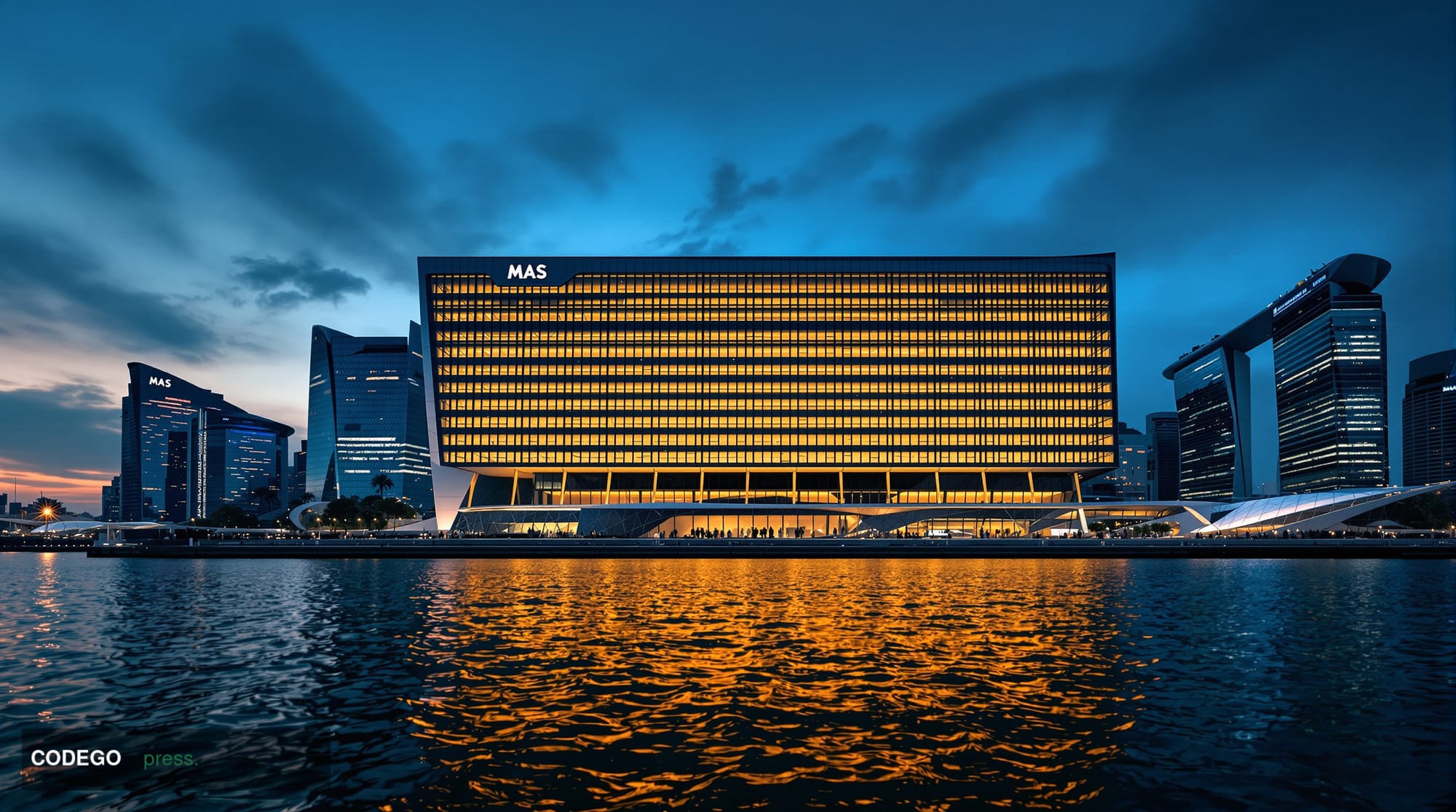
Singapore's Parliament passed the Financial Services and Markets (Amendment) Bill on 6 October 2026, handing the Monetary Authority of Singapore sweeping new authority to impose loss-absorption requirements on the city-state's most systemically critical lenders. The legislation marks one of the most consequential shifts in Singapore's bank-resolution framework in years, formalising a regulatory architecture that aligns the island nation with post-crisis global standards long adopted by larger financial jurisdictions.
At the heart of the new law is the empowerment of MAS to mandate that banks classified as Domestic Systemically Important Banks — commonly referred to as D-SIBs — hold sufficient resources capable of absorbing losses without triggering a disorderly collapse. During the bill's second reading speech in Parliament, MAS outlined its concrete plans to apply the Total Loss Absorbing Capacity, or TLAC, framework to these institutions. TLAC, a standard developed in the aftermath of the 2008 global financial crisis under the auspices of the Financial Stability Board, requires that systemically important banks maintain a minimum quantum of capital and long-term debt that can be written down or converted into equity during resolution — keeping taxpayers out of the firing line when a major institution falters.
The significance of this legislation lies not merely in its technical provisions, but in what it signals about Singapore's regulatory ambitions. MAS has long been regarded as one of Asia's most sophisticated and proactive financial supervisors. By legislating explicit TLAC powers rather than relying on softer supervisory guidance, the authority is cementing its ability to act swiftly and decisively if a D-SIB faces distress. The move places Singapore alongside jurisdictions such as the European Union — which enforces the Minimum Requirement for Own Funds and Eligible Liabilities (MREL) under its Bank Recovery and Resolution Directive — and the United States, where the Federal Reserve has long applied TLAC rules to global systemically important banks.
For the banks directly in scope, the implications are material. D-SIBs in Singapore — a designation that typically encompasses the country's three major local banking groups — will need to structure their balance sheets to satisfy whatever TLAC thresholds MAS ultimately prescribes. That means maintaining a defined stack of eligible liabilities and regulatory capital that sits above and beyond existing Basel III requirements. Depending on the calibration MAS adopts, affected institutions could face pressure to issue additional qualifying instruments, such as bail-in debt, to ensure compliance. This is not a trivial exercise: the pricing and issuance of bail-in-eligible instruments requires careful liability management and investor relations work, and the market's appetite for such paper in Southeast Asia, while growing, remains shallower than in Europe or North America.
The timing of the legislation is instructive. Global regulators have spent much of the past two years revisiting resolution frameworks in the wake of high-profile bank failures in the United States and Switzerland — episodes that exposed continuing vulnerabilities even within well-capitalised institutions. Singapore's Parliament moving to close potential gaps in its own statutory toolkit reflects a broader international mood of regulatory tightening, and MAS appears intent on ensuring that no legislative ambiguity could impede its resolution toolkit in a future stress event. The ability to impose TLAC requirements through a clear legal mandate, rather than through ad hoc supervisory letters or informal expectations, meaningfully strengthens the regulator's hand.
There is also a macroprudential dimension worth examining. Singapore's banking sector punches well above its weight relative to the size of the domestic economy. The three local banks are significant regional players, with substantial cross-border exposures across Southeast and East Asia. A disorderly failure of any one of them would reverberate far beyond Singapore's shores, with knock-on effects for trade finance, foreign exchange markets, and regional credit flows. Legislators and regulators are evidently cognisant of this outsized systemic footprint, and the TLAC framework is specifically designed to make resolution of such institutions orderly and internationally coordinated.
What This Means for Singapore's Financial Sector
The passage of the Financial Services and Markets (Amendment) Bill is a decisive step in Singapore's journey toward a fully Basel III-plus resolution regime. For D-SIBs, the near-term priority will be engaging with MAS to understand the precise calibration of TLAC requirements — thresholds, eligible instrument definitions, phase-in timelines — that the authority intends to publish as it translates its second reading commitments into binding rules. Investors holding subordinated debt or hybrid capital instruments issued by Singapore's major banks should similarly monitor forthcoming MAS consultation papers closely, as the rules will define which securities qualify as TLAC-eligible and at what haircut. More broadly, the legislation reinforces Singapore's standing as a jurisdiction that takes financial stability seriously at the institutional level, a reputational asset that remains central to its continued role as Asia's premier international financial centre.
Written by the editorial team — independent journalism powered by Codego Press.