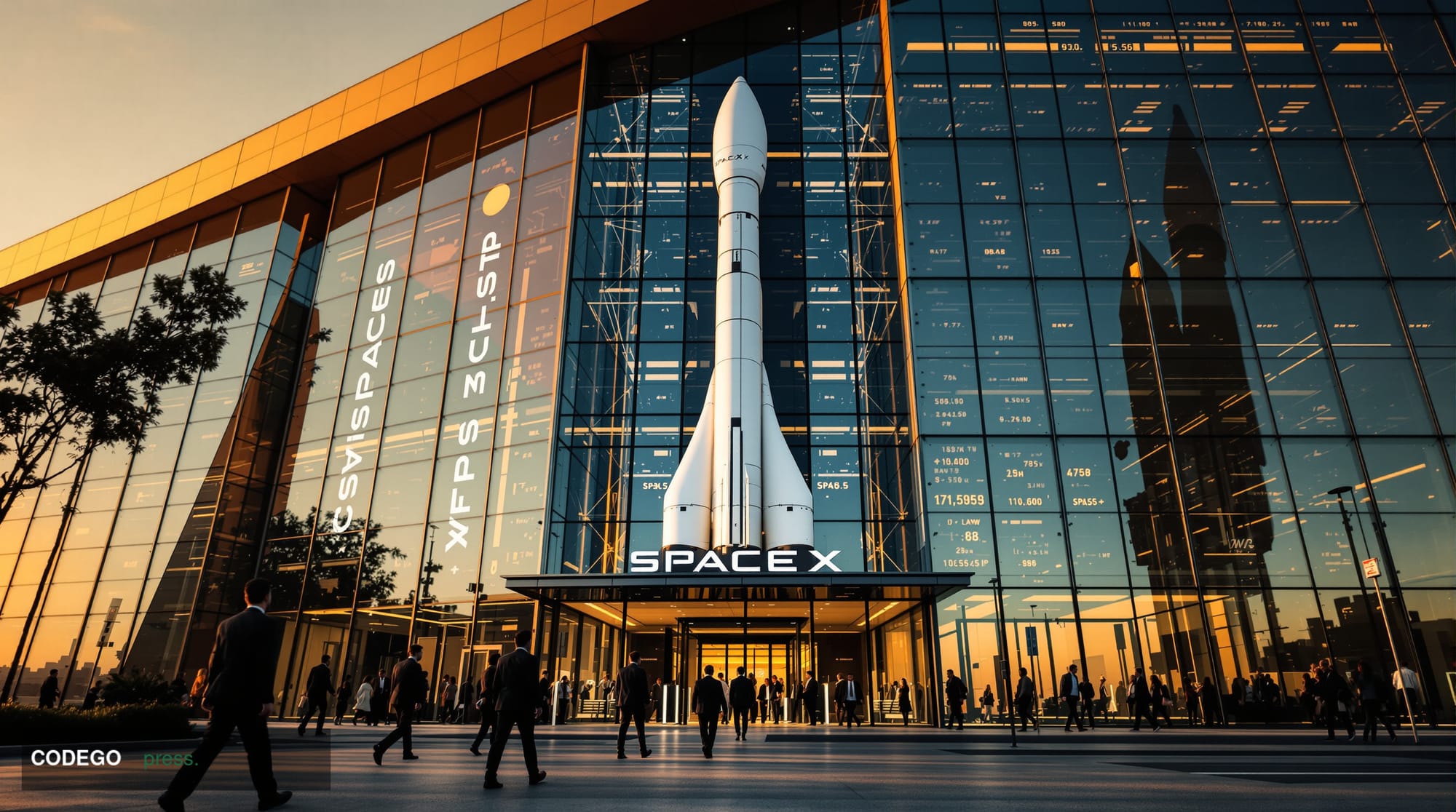
The financial markets witnessed history in the making Friday as SpaceX completed the largest initial public offering ever recorded, with shares surging immediately upon debut and pushing the aerospace manufacturer's market capitalization past the unprecedented $2 trillion threshold. Trading under the ticker SPCX, the company's public market entrance represents a seismic shift in how mega-cap companies approach Wall Street, while simultaneously elevating founder Elon Musk to trillionaire status—a financial milestone never before achieved by any individual.
The IPO's magnitude dwarfs previous record-holders, establishing new benchmarks for public market debuts that seemed inconceivable just years ago. SpaceX's valuation trajectory reflects not merely investor enthusiasm for space exploration, but a fundamental recalibration of how markets value companies operating at the intersection of advanced manufacturing, satellite communications, and interplanetary logistics. The sharp climb in share price during Friday's trading session suggests institutional and retail investors alike view the company's diversified revenue streams—from NASA contracts to Starlink satellite internet services—as sustainable foundations for long-term growth.
Musk's achievement as the world's first trillionaire marks a watershed moment for individual wealth accumulation in the modern era. His ascension to this rarefied financial territory stems largely from his retained equity stake in SpaceX, which has maintained private market valuations exceeding $180 billion in recent funding rounds before this public debut. The trillionaire milestone underscores how transformative technology companies can generate unprecedented personal wealth for their founders, particularly when those companies operate in sectors with massive addressable markets and significant barriers to entry.
The IPO's structure and execution have effectively rewritten established protocols for how mega-cap companies transition from private to public markets. Traditional IPO mechanics, designed for companies valued in the billions rather than trillions, required substantial adaptation to accommodate SpaceX's scale and complexity. The successful completion of this offering demonstrates that capital markets can absorb even the largest corporate debuts, provided investor demand aligns with the company's growth narrative and financial fundamentals.
Market analysts point to SpaceX's diversified business model as a key factor driving investor confidence. Unlike traditional aerospace contractors dependent primarily on government contracts, SpaceX has cultivated multiple revenue streams including commercial satellite launches, the rapidly expanding Starlink constellation providing global internet coverage, and ambitious plans for Mars colonization missions. This diversification strategy has created a company whose value proposition extends far beyond traditional aerospace manufacturing into telecommunications infrastructure and space tourism.
The timing of SpaceX's public debut coincides with renewed global interest in space exploration and satellite-based services, sectors experiencing unprecedented investment and technological advancement. Government agencies worldwide are increasing space-related expenditures, while private sector demand for satellite services continues expanding as businesses seek global connectivity solutions. These market dynamics position SpaceX to capitalize on multiple growth vectors simultaneously, justifying investor willingness to support the company's record-breaking valuation.
Friday's IPO success also validates the broader venture capital ecosystem that supported SpaceX through its early development phases. Initial investors who backed Musk's vision when commercial space flight seemed impossibly ambitious have realized returns that exceed even the most optimistic projections. This outcome reinforces investor appetite for supporting seemingly audacious technological ventures, potentially encouraging increased funding for other companies pursuing transformative innovations in aerospace, energy, and advanced manufacturing.
The implications of SpaceX's public market debut extend beyond immediate financial metrics to encompass broader questions about corporate scale, market concentration, and the role of visionary leadership in driving technological progress. As SpaceX begins operating as a public company subject to quarterly reporting requirements and shareholder expectations, maintaining the innovation pace and risk tolerance that enabled its private market success will test management's ability to balance public company obligations with continued technological advancement. The market's sustained confidence in this $2 trillion valuation will ultimately depend on SpaceX's ability to execute its ambitious roadmap while meeting the heightened scrutiny that accompanies public market participation.
Written by the editorial team — independent journalism powered by Codego Press.