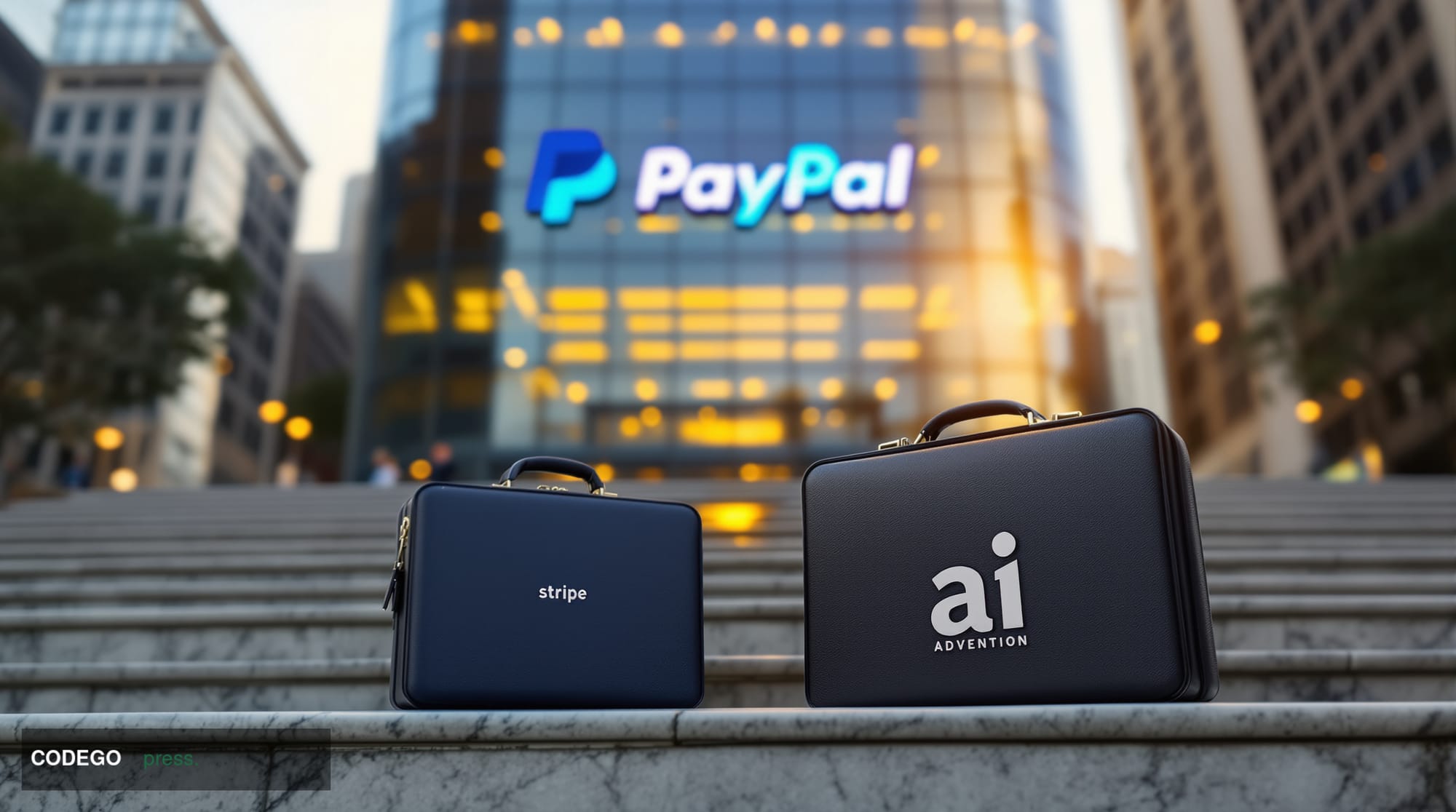
A seismic shift in the global payments landscape may be imminent. PayPal has received a joint acquisition proposal from Stripe and Advent International valuing the payments giant at more than US$53 billion, according to Reuters, which cited two people with direct knowledge of the approach. The bidders are offering US$60.50 per share — a premium of approximately 28 percent above PayPal's closing share price on Tuesday — in what would rank among the largest fintech acquisitions in history if completed.
The proposal represents a remarkable convergence of two distinct but complementary forces in the private-capital world: Stripe, the privately held payments infrastructure titan widely regarded as one of Silicon Valley's most formidable companies, and Advent International, one of the world's most experienced technology-focused private equity firms. Together, they are positioning themselves to absorb a company that, despite years of strategic turbulence and investor skepticism, still commands a user base and merchant network of extraordinary depth.
Why PayPal, and Why Now
PayPal's recent trading history tells a story of a company that has struggled to recapture its pandemic-era highs. The stock has faced persistent pressure as growth decelerated and competition from Stripe itself, Apple Pay, Google Pay, and a host of embedded-finance challengers intensified. Yet that same subdued valuation is precisely what makes the timing of this bid strategically logical. A 28 percent premium on a stock trading well below its historical peak translates into a US$53 billion price tag that — while enormous in absolute terms — may represent a compelling entry point for acquirers with a long horizon and the operational infrastructure to extract latent value.
For Stripe, the strategic rationale is particularly compelling. Despite its own meteoric growth and multi-hundred-billion-dollar private valuation trajectory in prior years, Stripe has built its dominance largely in the developer-facing, business-to-business payments stack. PayPal, by contrast, brings a consumer-facing identity, a recognized global brand, and a sprawling merchant services operation spanning small businesses to enterprise clients. Acquiring PayPal would give Stripe instant scale in consumer payments — a segment it has historically approached more cautiously — while dramatically expanding its geographic and vertical footprint.
Advent's Role: Private Equity Discipline Meets Fintech Ambition
Advent International's participation adds a dimension that pure strategic logic alone cannot supply: financial engineering, operational restructuring expertise, and the capital discipline that characterizes best-in-class private equity. Advent has a long track record of investing in financial technology and payments businesses globally, and its involvement signals that this is not merely a vanity acquisition but a structured plan with defined value-creation milestones in mind. In a deal of this magnitude — north of US$53 billion — having a private equity anchor alongside a strategic co-bidder also helps manage financing risk and governance complexity during any transitional period post-close.
The structure of a joint bid itself is worth examining. Strategic-financial buyer partnerships in mega-cap technology deals are relatively uncommon, as they require alignment on integration philosophy, exit timelines, and governance from the outset. The fact that Stripe and Advent have reportedly arrived at the table together — rather than competing against each other — suggests a carefully negotiated consortium arrangement with clearly delineated roles. Stripe likely takes the operational lead on product integration and technology roadmap, while Advent brings balance-sheet depth and post-acquisition restructuring capability.
What This Means for the Payments Industry
Should this proposal progress to a completed transaction, the consequences for the global payments ecosystem would be profound. A Stripe-controlled PayPal would combine two of the world's most recognizable payments brands under a single, privately held umbrella — insulating the merged entity from quarterly earnings pressure and enabling the kind of long-term product investment that public-market scrutiny often discourages. Competitors including Visa, Mastercard, Adyen, and Block would face a consolidated rival with an unmatched combination of infrastructure depth, brand recognition, and private-capital backing.
Regulatory scrutiny, however, will be unavoidable. Any transaction combining two of the most systemically significant actors in digital payments will attract intense review from competition authorities in the United States, the European Union, and likely the United Kingdom. Antitrust examiners will probe market concentration in merchant acquiring, peer-to-peer transfers, and online checkout — segments where PayPal and Stripe together hold substantial combined share. The bidders will need to present a credible remedies package well before any regulatory filing reaches its critical phase.
As of this writing, the proposal remains exactly that — a proposal. PayPal's board has yet to publicly respond, and the outcome of any formal review process remains uncertain. But the mere existence of a US$60.50-per-share bid, at a 28 percent premium and a headline valuation exceeding US$53 billion, reframes the conversation around PayPal's strategic future entirely. Whether or not this specific transaction closes, the signal is unambiguous: the era of consolidation in digital payments has arrived, and the industry's map is about to be redrawn.
Written by the editorial team — independent journalism powered by Codego Press.