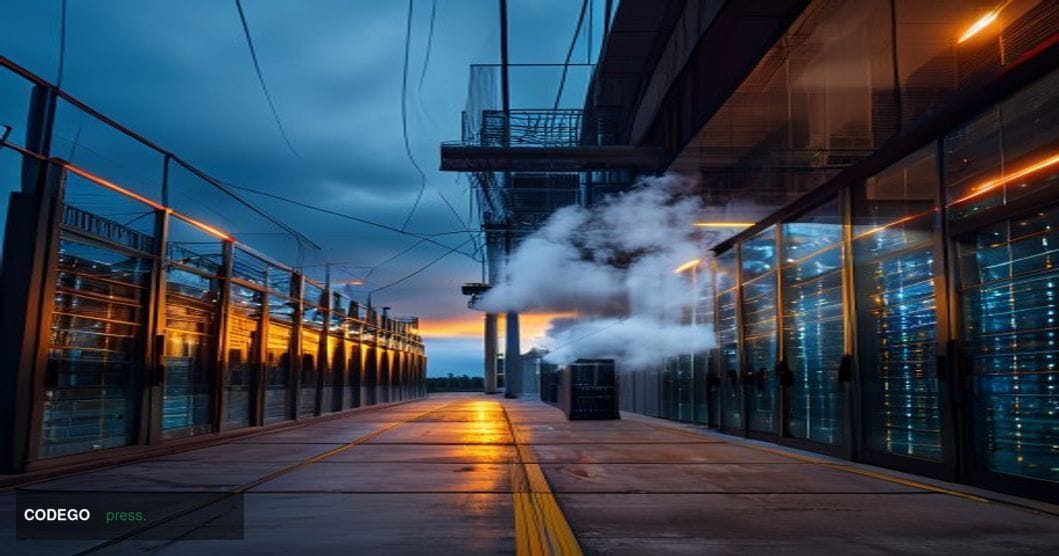
When TeraWulf announced a 20-year lease agreement with artificial intelligence heavyweight Anthropic projected to generate $19 billion in revenue, the market reaction was swift and unmistakable: Bitcoin mining stocks surged broadly, signaling that investors have snapped to attention over a fundamental shift in how the sector's future is being priced.
The deal is among the most consequential infrastructure agreements in the recent history of cryptocurrency mining, not merely because of its scale — $19 billion across two decades represents a revenue commitment that dwarfs most miners' existing market capitalizations — but because of what it says about the direction of capital in the energy-intensive compute industry. TeraWulf, which built its reputation on environmentally conscious Bitcoin mining powered substantially by nuclear and renewable energy, has effectively monetized its core asset — raw, reliable, high-density power capacity — in an entirely new direction.
Anthropic, the San Francisco-based artificial intelligence safety company and developer of the Claude family of large language models, requires prodigious quantities of compute power for model training and inference at scale. Data center capacity that can deliver consistent, high-voltage electricity with minimal carbon intensity has become the scarcest commodity in Silicon Valley's AI arms race. TeraWulf's infrastructure, purpose-built to sustain the relentless power demands of Bitcoin mining application-specific integrated circuits, translates with remarkable efficiency to the needs of graphics processing unit clusters required by frontier AI workloads.
The lease structure is particularly noteworthy. Rather than selling its facilities or entering a joint venture, TeraWulf retains ownership of its physical assets while securing what amounts to a long-duration, contracted revenue stream — a financial profile that more closely resembles a real estate investment trust or regulated utility than a speculative cryptocurrency operator. Over 20 years, $19 billion in committed revenue provides a degree of cash-flow visibility that is virtually unheard of in Bitcoin mining, a sector that has historically been hostage to the twin volatilities of Bitcoin price and network hash-rate difficulty.
The broader market response underscores a thesis that has been building quietly among institutional investors: that Bitcoin miners, by virtue of their grid-connected power infrastructure, low-cost energy contracts, and large-footprint facilities in power-rich regions, are structurally positioned as the most shovel-ready hosts for the AI data center buildout. The surge in major mining stocks following the TeraWulf announcement reflects not just enthusiasm for one deal, but a re-rating of the entire sector's optionality. Investors are beginning to price in the possibility that a meaningful portion of existing mining capacity could be repurposed or co-located with AI compute over the coming years.
This is not the first time a Bitcoin miner has attempted to pivot toward high-performance computing and AI hosting, but the scale and duration of the TeraWulf-Anthropic agreement sets a new benchmark. The $19 billion figure, spread across a 20-year term, implies average annual revenue of approximately $950 million from this single arrangement — a number that contextualizes the ambition of the deal against the backdrop of an industry that has, until recently, struggled to articulate a credible growth narrative beyond Bitcoin price appreciation.
There are, of course, material risks attached to any 20-year contractual arrangement of this magnitude. Counterparty durability, the evolution of AI compute architectures, shifting energy costs, and regulatory developments across both the cryptocurrency and AI sectors all represent variables that could affect the deal's real-world economics. Anthropic itself, despite significant backing from Amazon and other major investors, operates in a competitive and rapidly evolving market where today's frontier model provider may face entirely different infrastructure requirements a decade hence. TeraWulf's management will need to structure contractual protections accordingly.
What This Means for the Mining Sector
The TeraWulf-Anthropic lease is a watershed event for an industry long dismissed as a one-dimensional bet on Bitcoin prices. By locking in $19 billion in projected revenue over 20 years, TeraWulf has demonstrated that purpose-built power infrastructure carries value independent of what is plugged into it. The stock market surge across major Bitcoin mining equities in response to this announcement reflects a genuine, and arguably overdue, reassessment of the sector's intrinsic worth. For mining companies sitting on acres of grid-tied power capacity, the message is clear: the AI infrastructure supercycle represents an extraordinary monetization opportunity, and the race to secure anchor tenants of Anthropic's caliber has now begun in earnest. How the industry manages this transition — balancing Bitcoin mining operations against increasingly lucrative AI hosting contracts — will define its investment profile for the decade ahead.
Written by the editorial team — independent journalism powered by Codego Press.