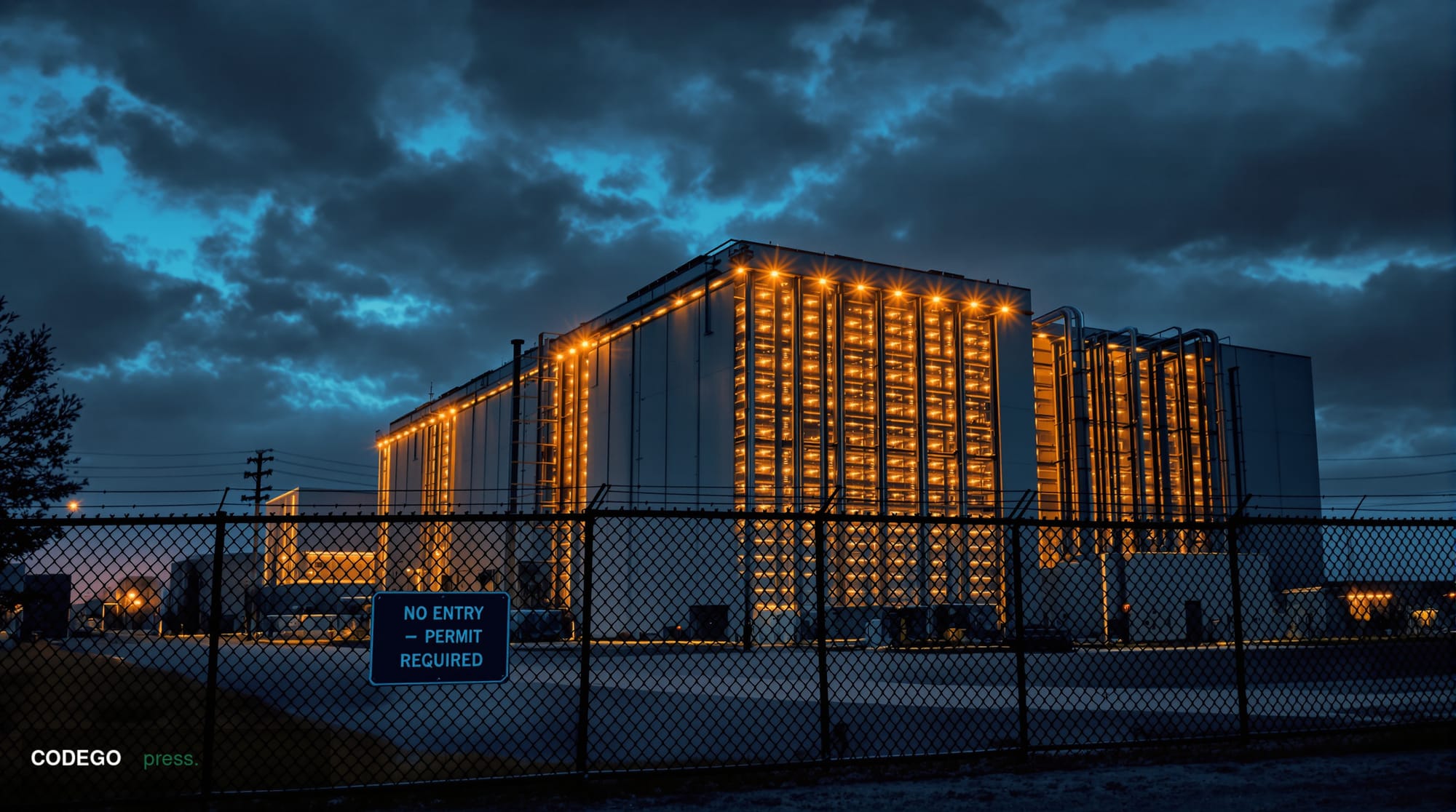
A single regulatory announcement from Albany sent shockwaves through the data center investment landscape on Tuesday, with TeraWulf Inc. (NASDAQ: WULF) bearing some of the most immediate and visible market consequences. Shares of the company fell approximately 7% after New York Governor Kathy Hochul announced a temporary statewide moratorium on permits for new hyperscale data centers — a measure that strikes at the heart of TeraWulf's strategic ambitions and signals a potentially rocky road ahead for the broader build-out of artificial intelligence (AI) and high-performance computing (HPC) infrastructure across the state.
The timing is particularly consequential for TeraWulf, which has been executing a deliberate pivot away from its origins as a Bitcoin mining company toward becoming a full-scale AI and HPC infrastructure provider. That transition — one the company has publicly championed as its path to higher-margin, more stable revenue streams — depends heavily on the ability to develop, permit, and operate large-scale computing campuses. A statewide freeze on new hyperscale data center permits, even a temporary one, directly threatens the operational and commercial timelines underpinning that strategy.
A Moratorium With Wide-Ranging Implications
Governor Hochul's moratorium does not target any single operator or project. It is a blanket, statewide pause applicable to new large-scale data center development across New York. While the precise scope, duration, and the regulatory process that will follow the pause have yet to be fully articulated in public detail, the market's reaction was swift and unambiguous. Investors interpreted the measure as a material headwind for any company whose growth plans depend on expanding physical computing infrastructure within the state — and TeraWulf, with its New York-rooted operations, was immediately in the crosshairs.
The 7% single-day decline in WULF shares reflects more than routine volatility. It represents a repricing of execution risk. When a company's strategic transformation is predicated on building and scaling data centers, a government-imposed permitting freeze injects genuine uncertainty into capital allocation decisions, construction timelines, and prospective customer commitments. Hyperscale tenants — the cloud providers, AI model developers, and enterprise computing customers that TeraWulf would need to attract — require long-term certainty from infrastructure partners. A moratorium, however temporary in stated intent, complicates that certainty considerably.
The Broader Context: Energy, Infrastructure, and the AI Boom
Governor Hochul's move reflects a tension that has been building across multiple U.S. states as the AI infrastructure boom collides with power grid constraints, environmental concerns, and community resistance. Hyperscale data centers are among the most energy-intensive facilities ever constructed, and New York's power grid — already navigating the complexities of a renewable energy transition — faces genuine stress from the prospect of dozens of large-scale compute campuses coming online simultaneously. Regulators in Albany appear to be pulling a pause lever before that stress becomes a crisis, much as several European jurisdictions have done in response to similar pressures.
For TeraWulf specifically, the pivot from Bitcoin mining to AI and HPC was a logical one on paper. Bitcoin mining, while profitable during bull markets, is subject to brutal cyclicality tied to cryptocurrency prices and network difficulty adjustments. AI and HPC infrastructure, by contrast, offers longer contract durations, more predictable revenue, and growing demand driven by the insatiable appetite of large language model developers and cloud hyperscalers for raw compute power. The company has been positioning its existing power infrastructure — a genuine competitive asset given how scarce reliable, large-scale power connections have become — as the foundation for this new chapter.
That power infrastructure thesis, however, depends on more than electrons. It requires permits, regulatory approvals, and a constructive relationship with state authorities. A moratorium imposed by the governor's office is as much a political signal as it is a legal one: it tells the market that New York's posture toward hyperscale data center development is under active review, and that the previously assumed regulatory pathway for new facilities may be longer, more conditional, or more expensive than the industry had priced in.
What This Means for TeraWulf and the Sector
For investors, the immediate question is whether the moratorium is genuinely temporary — a brief pause while Albany develops a more structured permitting framework — or the leading edge of a more sustained and restrictive regulatory posture. If it is the former, the 7% decline in WULF shares may ultimately prove to be an overreaction, with the stock recovering as clarity emerges. If it is the latter, TeraWulf and its peers will need to either develop alternative sites outside New York's jurisdiction or engage in a prolonged regulatory negotiation that could delay projects by months or years.
Either way, Tuesday's market reaction underscores a fundamental truth about infrastructure investment in the current environment: regulatory risk is no longer a secondary concern. As AI demand drives an unprecedented wave of data center development, state and local governments are increasingly asserting oversight authority — and companies whose growth strategies assume a permissive regulatory backdrop are being forced to reckon with a more complex reality. TeraWulf's 7% share drop is a data point, but it is also a warning to an entire sector that the path from Bitcoin mining to AI infrastructure runs through city halls and governors' offices, not just server rooms.
Written by the editorial team — independent journalism powered by Codego Press.