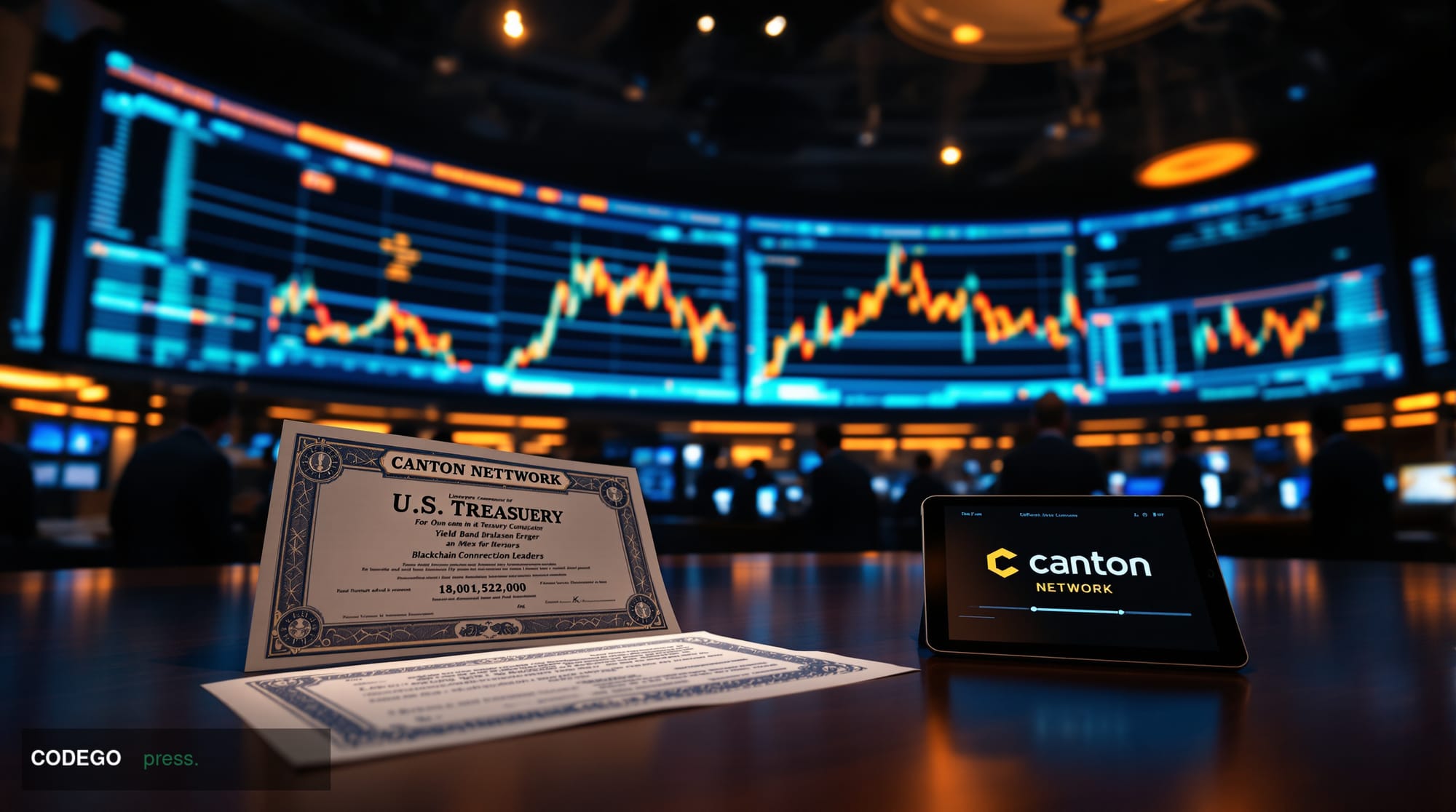
On July 1, 2026, Tradeweb executed what stands as one of the most consequential settlements in the recent history of U.S. fixed-income markets: a real-time, onchain transaction in which a tokenized U.S. Treasury security was transferred and settled against USDCx — a tokenized form of cash — on the Canton Network. The milestone brings together two of the most closely watched trends in institutional finance — the tokenization of sovereign debt and the deployment of regulated digital cash — and demonstrates, for the first time in this configuration, that atomic delivery-versus-payment settlement for Treasuries is operationally viable at the institutional level.
The mechanics of the transaction were straightforward in concept but remarkable in execution. Franklin Templeton, one of the asset management industry's most active participants in blockchain-native securities infrastructure, transferred a tokenized U.S. Treasury security to Virtu Financial, the electronic market-making firm, in exchange for USDCx. Tradeweb served as the execution venue, providing the trading platform infrastructure through which the transaction was initiated and completed. The trade size was not disclosed by any of the parties involved.
What makes this transaction architecturally significant is the simultaneous, onchain exchange of both legs of the trade. In conventional Treasury markets, settlement occurs through a layered infrastructure that involves custodians, clearing agents, and the Depository Trust & Clearing Corporation, with standard settlement cycles introducing counterparty risk and operational friction across the two-day window. The Canton Network's blockchain infrastructure collapses that window entirely, enabling the asset leg and the cash leg to settle in real time with finality — an outcome that removes the temporal mismatch that has long been treated as an accepted cost of doing business in government securities markets.
The choice of USDCx as the cash instrument deserves particular attention. Unlike settlement in fiat currency passed through traditional correspondent banking rails, USDCx represents tokenized cash native to the Canton Network, designed specifically to function as the liquidity counterpart in onchain institutional transactions. Its use here signals that the participants are not merely experimenting with tokenized assets while leaving the payment leg in legacy infrastructure; rather, the entire transaction — both sides — lived and settled onchain. This full-stack approach is precisely what market structure reformers have argued is necessary to realize the genuine efficiency gains that blockchain-based settlement promises.
The institutional pedigree of the parties involved adds considerable weight to the transaction's significance. Franklin Templeton has been building tokenized fund infrastructure for several years, most notably through its OnChain U.S. Government Money Fund, which operates on public blockchain rails. Virtu Financial brings the perspective of a high-frequency, electronically oriented market maker accustomed to demanding precision in execution and settlement mechanics. Tradeweb, as the intermediating platform, represents the established institutional bond market — a venue that handles trillions of dollars in fixed-income trading annually. That these three firms chose the Canton Network for this execution underscores the network's growing credibility as enterprise-grade financial market infrastructure.
The Canton Network itself, built on the Digital Asset Daml smart contract platform, has been designed from the ground up with the privacy, permissioning, and interoperability requirements of regulated financial institutions in mind. Unlike permissionless public blockchains, Canton allows participants to share only the data relevant to their specific transactions while still benefiting from network-wide atomic settlement guarantees. This architectural choice addresses one of the most persistent objections institutional participants have raised about deploying blockchain infrastructure in markets where confidentiality of position and counterparty information is a legal and competitive necessity.
The broader context amplifies the importance of this single trade. The tokenized Treasury market has grown substantially over the past two years, with aggregate onchain Treasury holdings across major platforms now measured in the tens of billions of dollars. Regulatory frameworks in the United States are gradually evolving to accommodate blockchain-native settlement, and the Securities and Exchange Commission has engaged with several pilot programs testing alternative settlement models. A completed, production-grade transaction between a major asset manager, a prominent market maker, and one of the world's largest electronic bond trading platforms — executed in real time with full onchain settlement — moves the conversation decisively from proof-of-concept to production reality.
What This Means for Fixed-Income Market Structure
The Tradeweb-Franklin Templeton-Virtu transaction on the Canton Network is not a headline curiosity — it is a structural data point. When the participants in a transaction include institutions that collectively handle a material fraction of daily U.S. Treasury volume, and when those institutions choose to settle onchain against tokenized cash rather than through legacy infrastructure, the market is receiving a clear signal about where institutional fixed-income settlement is heading. The operational questions are not resolved — scalability, regulatory recognition of onchain settlement finality, and the liquidity depth of tokenized cash instruments all require further development. But the directional evidence is now harder to dismiss. Real-time, atomic, onchain Treasury settlement has moved from whitepaper aspiration to executed trade, and the implications for custody, clearing, and liquidity management in government securities markets will be felt for years.
Written by the editorial team — independent journalism powered by Codego Press.