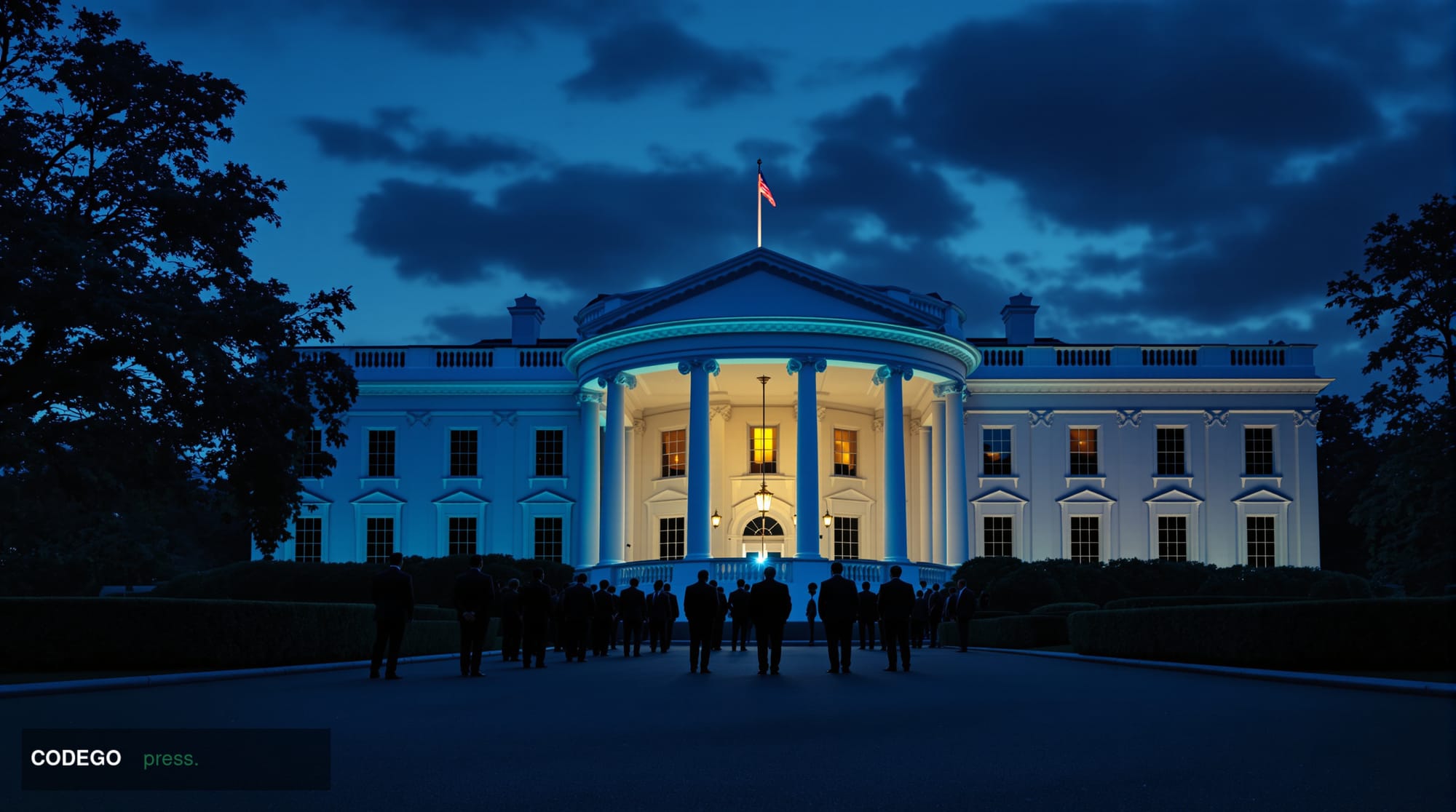
President Donald Trump took to the White House podium on Wednesday to deliver an unambiguous directive to the United States Senate: pass the CLARITY Act, the landmark crypto market structure bill that has been advancing through Congress, or risk surrendering the digital-asset landscape to China. Speaking alongside a gathering of prominent cryptocurrency industry leaders, Trump elevated what has long been a legislative back-room debate into a direct presidential call to action — one freighted with both geopolitical urgency and significant implications for the future of financial regulation in America.
The CLARITY Act represents the most consequential attempt yet to establish a comprehensive legal and regulatory framework for digital-asset markets in the United States. Unlike narrower legislative efforts focused solely on stablecoins or specific token classifications, the bill addresses the broader architecture of crypto market structure — questions of jurisdiction between the Securities and Exchange Commission and the Commodity Futures Trading Commission, disclosure requirements, trading platform obligations, and the treatment of decentralized protocols. For an industry that has operated under a patchwork of enforcement actions and regulatory ambiguity for more than a decade, the passage of such a bill would represent a foundational shift.
Trump's decision to frame the bill's passage explicitly as a matter of competition with China is a politically calculated move that reflects a broader pattern in his administration's approach to technology policy. The invocation of Beijing is designed to appeal not merely to crypto advocates, but to a wider coalition of legislators who may be skeptical of digital assets yet deeply committed to American technological supremacy. By positioning the CLARITY Act as a national security and economic competitiveness measure rather than simply a financial regulation bill, the White House is attempting to broaden its Senate coalition beyond those members already sympathetic to the crypto industry.
The presence of crypto industry leaders at Wednesday's White House event is itself a signal of how dramatically the relationship between the digital-asset sector and federal executive power has shifted. Where previous administrations maintained an arm's-length — and often adversarial — relationship with Coinbase, Binance, and the broader crypto ecosystem, the Trump White House has cultivated direct lines of communication with the sector's most influential figures. Their appearance alongside the president lends visible industry endorsement to a bill that many in the space have lobbied for intensively, while also placing corporate reputations behind the legislative push — a form of accountability that cuts both ways.
The Senate remains the decisive arena. While the House has demonstrated greater appetite for crypto-specific legislation in recent sessions, the upper chamber has historically moved more cautiously on digital-asset regulation, with committee chairs and ranking members wary of the jurisdictional disputes between regulatory agencies that any market structure bill inevitably stirs. Trump's direct engagement — bypassing traditional legislative lobbying channels to make a public, presidential demand — is an attempt to collapse that caution through political pressure and the force of executive attention.
The geopolitical dimension Trump emphasized deserves serious analytical weight. China has spent years developing its own digital financial infrastructure, most visibly through the digital yuan, or Bank for International Settlements-recognized central bank digital currency program, while simultaneously suppressing private crypto markets domestically. The strategic logic Trump is advancing is that American regulatory clarity — rather than prohibition or indefinite ambiguity — is the mechanism by which the United States preserves its dominance in financial innovation. If firms and capital continue to migrate to jurisdictions with established rule sets, the argument goes, the United States loses not just tax revenue and employment but strategic positioning in the infrastructure of global finance.
Critics of the administration's approach will note the compressed timeline and the risk of legislation passed under political urgency rather than deliberative rigor. A market structure bill of this scope touches virtually every corner of the digital-asset ecosystem — spot markets, derivatives, lending protocols, decentralized exchanges — and the cost of regulatory design errors at this level is not merely inconvenience but systemic fragility. The Senate's traditional deliberativeness, whatever its frustrations for industry advocates, exists precisely to catch the unintended consequences that speed tends to obscure.
What This Means for Markets and Regulation
For financial institutions, asset managers, and fintech operators currently navigating the U.S. digital-asset landscape, Wednesday's White House event marks a meaningful escalation in legislative momentum. A presidential stamp on the CLARITY Act's urgency materially increases the probability of Senate floor consideration in the near term. Firms that have been deferring strategic decisions on crypto product development or custody infrastructure pending regulatory certainty now have a clearer signal that the window for that clarity may be narrowing. Whether the Senate responds to Trump's pressure with the speed the White House demands, or whether the bill enters the familiar gravitational field of amendment, committee wrangling, and procedural delay, the direction of travel is now unmistakable: comprehensive crypto market structure regulation in the United States is no longer a matter of if, but when — and the president has made plain that he intends "when" to be now.
Written by the editorial team — independent journalism powered by Codego Press.