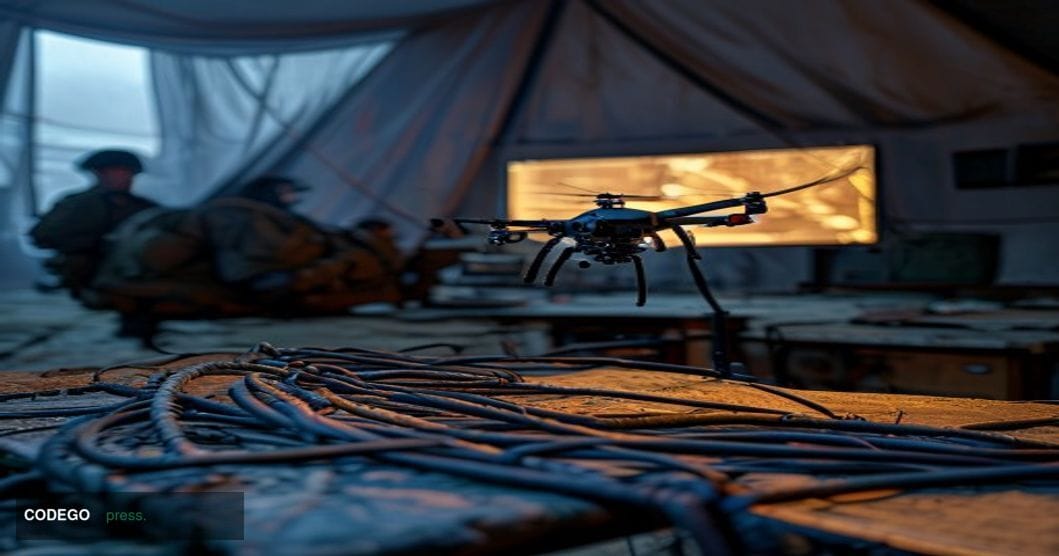
At a moment when the front lines of the Russia-Ukraine conflict have hardened into something resembling a grinding stalemate, Kyiv is betting that a spool of fiber-optic cable could rewrite the calculus of modern drone warfare. Ukraine has begun deploying fiber-optic guided drones as a deliberate technological countermeasure, a development that carries significant implications not only for battlefield outcomes but for the broader geopolitical and economic stakes of the conflict.
The strategic logic is straightforward, even if the engineering behind it is anything but. Conventional drone systems rely on radio-frequency signals for command and control, making them vulnerable to the sophisticated electronic warfare suites that Russian forces have progressively deployed along the contact line. Fiber-optic tethered drones sidestep this vulnerability entirely: the cable carries the operator's commands and video feed through light pulses rather than radio waves, rendering standard jamming equipment effectively useless against them. In a theater where electronic warfare has become one of the defining asymmetries, this is not a marginal upgrade — it is a potential category shift.
Ukraine's territorial ambitions have been under mounting pressure. With the conflict widely characterized as a stalemate, the pace of territorial exchange has slowed dramatically, and the war of attrition has imposed severe costs on both sides in personnel, materiel, and economic capacity. For Kyiv's leadership, technological innovation has repeatedly served as a force multiplier when numerical and industrial disadvantages might otherwise prove decisive. The deployment of fiber-optic drone systems fits squarely within that strategic tradition — an attempt to regain tactical initiative at a moment when conventional momentum has stalled.
The financial and industrial dimensions of this shift deserve careful attention. Fiber-optic guided munitions are not a novel concept in defense procurement circles; several NATO member states have explored the technology for decades in the context of anti-tank guided missiles. What distinguishes the current Ukrainian application is the adaptation of the principle to low-cost, rapidly producible drone platforms — a fusion of commercial-off-the-shelf drone manufacturing with military-grade signal integrity. This approach reflects a broader industrial logic that has characterized Ukrainian defense innovation throughout the conflict: iterate quickly, keep unit costs manageable, and field systems at scale rather than waiting for technically perfect but expensive solutions.
For defense analysts and investors tracking the global defense technology sector, the implications extend well beyond the Ukrainian front. The demonstrated effectiveness — or failure — of fiber-optic drone systems in live combat conditions will feed directly into procurement decisions across NATO, the Indo-Pacific, and beyond. Defense contractors and dual-use technology firms with exposure to fiber-optic communications hardware, miniaturized gimbal systems, and real-time image processing stand to benefit from heightened institutional interest in the technology, regardless of the conflict's ultimate territorial resolution.
There is also a sanctions and trade-policy dimension that bears scrutiny. Ukraine's capacity to manufacture and field advanced drone systems at operational scale depends in part on access to critical components — optical fiber, microcontrollers, imaging sensors — many of which flow through global supply chains subject to ongoing export-control regimes. The European Commission and allied governments have worked to tighten controls on dual-use goods reaching Russia while simultaneously facilitating defense-related exports to Ukraine, but supply chain integrity remains a live concern. Any disruption to the components pipeline could blunt the operational impact of what is otherwise a promising tactical innovation.
What This Means for the Conflict and Beyond
The deployment of fiber-optic guided drones represents one of the more consequential technological inflection points in a conflict that has already accelerated the militarization of commercial drone technology globally. If Ukraine can demonstrate that fiber-optic systems meaningfully degrade Russian electronic warfare advantages along the contact line, the strategic balance — frozen for months by the logic of attritional stalemate — could shift in ways that affect not only battlefield geography but the diplomatic and economic negotiations that will eventually frame any resolution to the conflict.
For readers in the fintech and banking sector, the relevance may not be immediately obvious, but the connective tissue is real. Conflict duration, territorial control, and the pace of reconstruction financing are all variables that directly influence sovereign risk assessments for Ukraine, the pricing of war-risk insurance across the Black Sea region, and the pipeline of multilateral development bank lending that European institutions including the European Investment Bank have committed to Ukraine's eventual rebuilding. A technological breakthrough that meaningfully shortens the conflict, or conversely one that prolongs it by raising the cost of Russian offensive operations, carries measurable consequences for the financial architecture being assembled around Ukraine's future.
Technology, as this conflict has repeatedly demonstrated, does not stay on the battlefield. The innovations forged under operational pressure in Ukraine have a history of migrating rapidly into commercial and regulatory conversations worldwide — and fiber-optic drone guidance is unlikely to be an exception.
Written by the editorial team — independent journalism powered by Codego Press.