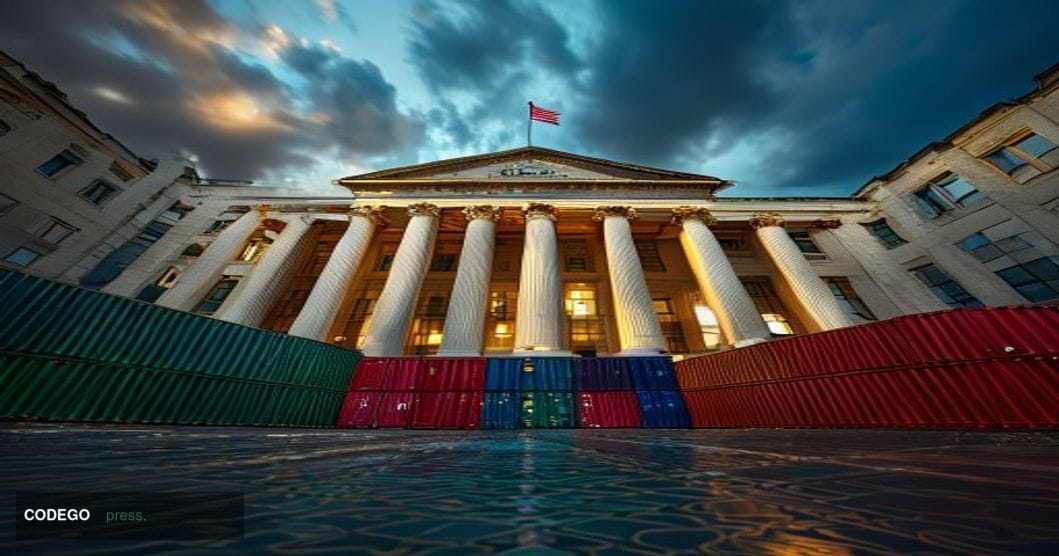
On July 24, 2026, Washington moved the global trade war into uncharted territory, activating new tariffs on 60 trading partners simultaneously — a sweeping action that, by the US government's own accounting, captures 99.4% of all American imports. Executed under Section 301 of US trade law, the measures lift effective import rates to a uniform band of 10% to 12.5%, reshaping the cost architecture of global commerce in a single regulatory stroke. For financial institutions, corporate treasuries, and emerging-market economies that depend on access to the American consumer, the implications are immediate and structural.
The Mechanics of Section 301 and Why Scale Matters
Section 301 grants the United States Trade Representative broad authority to impose trade restrictions when foreign governments are found to engage in unfair, unreasonable, or discriminatory practices that burden US commerce. Historically, the tool has been deployed selectively — against single nations or narrow product categories. The activation of Section 301 tariffs against 60 countries simultaneously, covering virtually the entirety of the US import ledger, represents a departure from that surgical approach. This is not targeted economic diplomacy; it is comprehensive reconfiguration of American trade terms.
The breadth of the 99.4% import coverage figure deserves particular scrutiny. In practical terms, it means that almost no category of good entering the United States — from industrial components and agricultural produce to consumer electronics and financial services-adjacent software products — escapes the new rate schedule. The 10% to 12.5% tariff band may appear modest in isolation, but applied uniformly across virtually all import sources and product categories, the cumulative pass-through effect on input costs, supply chains, and ultimately consumer prices is considerable. For banks and lenders financing trade flows, this repricing of risk is not peripheral — it is foundational.
Sixty Partners: The Geography of Economic Pressure
The selection of 60 trading partners as simultaneous targets is itself a strategic signal. The United States conducts meaningful trade with roughly 200 jurisdictions, meaning the July 24 action specifically covers the most commercially significant three-tenths of that universe — precisely the countries whose goods flow in the highest volumes and whose industries are most integrated into American supply chains. The list almost certainly encompasses key World Trade Organization members across Asia, Europe, Latin America, and Africa, though the precise country-by-country breakdown was not fully disclosed in initial government communications.
For financial markets, the geography matters enormously. Emerging-market currencies tied to export-dependent economies now face potential depreciation pressure as their largest customer market becomes materially more expensive to access. Export credit agencies, development finance institutions, and multilateral lenders such as the World Bank and the International Monetary Fund will be watching closely for stress signals in balance-of-payments data across the affected nations. Trade finance desks at global banks should equally be reassessing country-level exposure with some urgency.
A New Phase — and What That Framing Signals
Officials and analysts describing July 24 as the trade war entering a "new phase" are making a deliberate rhetorical choice. The phrase acknowledges that what began as a series of bilateral disputes — most visibly with China — has now become something qualitatively different: a standing, multilateral assertion of American trade sovereignty applied at near-universal scale. This is no longer a negotiating tactic deployed against a single rival; it is a redefinition of the baseline terms under which the United States participates in global commerce.
The financial sector will need to internalize this distinction quickly. A targeted tariff on one counterpart can be hedged, routed around, or absorbed through supply-chain restructuring. A 10% to 12.5% floor applied to 99.4% of all imports offers far fewer escape routes. Corporate hedging desks face a structurally altered environment. Cross-border payment volumes may shift as trading relationships are renegotiated. Digital payment networks and fintech infrastructure providers that have built cross-border corridors between the US and affected nations will be monitoring whether transaction volumes respond to the new cost pressures trickling through to end buyers and sellers.
What This Means for Banking and Financial Services
For the banking and financial services industry, the July 24 action crystallizes a risk that has been building for years: that the rules-based international trading system, which underpins the cross-border credit, payment, and investment flows that banks monetize, is now subject to rapid, large-scale revision by executive action. Institutions with significant trade-finance books, correspondent banking networks spanning the 60 affected countries, or meaningful exposure to emerging-market sovereigns that rely on US export access will need to revisit their risk frameworks. The tariff rate of 10% to 12.5% may prove to be a floor rather than a ceiling if retaliatory measures from affected partners trigger further rounds of escalation — a dynamic that has characterized every previous phase of the current trade conflict. Treasurers, compliance officers, and credit committees across the industry should treat July 24 not as a discrete event, but as a durable structural shift in the global trade environment they are being asked to finance.
Written by the editorial team — independent journalism powered by Codego Press.