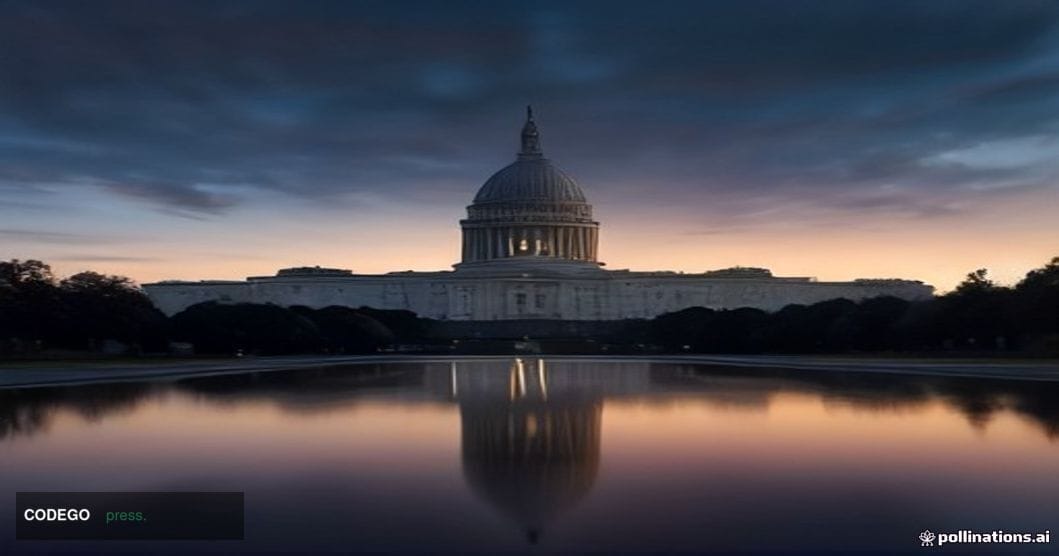
The United States Senate dealt a significant blow to the future of federal cryptocurrency regulation on Tuesday when it failed to advance the CLARITY Act through a procedural vote, leaving the landmark legislation stranded after months of painstaking negotiation and leaving an already fractious digital-asset policy landscape without a clear path forward.
The procedural stumble — the kind of parliamentary hurdle that determines whether a bill even reaches the Senate floor for debate — is more than a bureaucratic footnote. In Washington's legislative arithmetic, failing to clear a procedural threshold often signals that the underlying coalition needed to pass a bill simply does not exist in sufficient strength. For the United States Congress, the CLARITY Act represented one of the most ambitious attempts yet to impose a coherent regulatory framework on the digital-asset sector, addressing both crypto market oversight and the ethics provisions that have become an increasingly contentious subplot in the broader crypto-regulation drama.
The bill's collapse at this stage is particularly striking given the investment of political capital that preceded it. Negotiations over the CLARITY Act stretched across several months, involving lawmakers, industry representatives, and regulatory stakeholders who were attempting to reconcile fundamentally different visions of how the federal government should supervise cryptocurrencies. Proponents argued that the bill would provide the legal clarity that markets have demanded for years — a settled framework that would define which digital assets fall under the jurisdiction of the Securities and Exchange Commission and which fall under the Commodity Futures Trading Commission. That jurisdictional ambiguity has long been cited by institutional investors and crypto firms alike as one of the primary barriers to broader market participation and responsible innovation in the United States.
The ethics provisions embedded in the CLARITY Act added another layer of complexity to the negotiations. Lawmakers sought to address conflicts of interest and disclosure requirements surrounding elected officials who hold or trade digital assets — a provision that gained urgency amid public scrutiny over politicians with direct financial stakes in the very sector they are tasked with regulating. These ethics clauses proved as divisive as the regulatory substance of the bill itself, with some legislators viewing them as essential accountability measures and others regarding them as politically motivated additions designed to complicate passage.
The failure arrives at a moment when the global regulatory landscape is shifting rapidly around the United States. The European Securities and Markets Authority has been actively implementing the Markets in Crypto-Assets regulation — known as MiCA — which has given European Union-based firms a degree of regulatory predictability that American counterparts currently lack. Meanwhile, jurisdictions across Asia and the Gulf Cooperation Council have been aggressively courting crypto businesses with defined licensing frameworks. Every month that Washington remains deadlocked on foundational crypto legislation is a month in which market participants weigh the cost of regulatory uncertainty against the prospect of relocating operations to friendlier jurisdictions.
For the crypto industry, which has deployed hundreds of millions of dollars in lobbying efforts and political donations over the past several election cycles, the Senate's failure to even bring the CLARITY Act to the floor represents a sobering reminder that legislative momentum, no matter how hard-won, can evaporate quickly. The bill's uncertain future now depends on whether its sponsors and supporters can renegotiate the most contentious provisions, rebuild the necessary supermajority coalition, and find a procedural window before the Senate's calendar becomes dominated by other legislative priorities.
The road back for the CLARITY Act is narrow but not necessarily closed. Senate sponsors have options: they can attempt to strip out the provisions that lost them votes, seek a revised procedural motion, or pursue the bill's core elements through an alternative legislative vehicle. None of these paths is straightforward, and all of them require a degree of bipartisan cooperation that has proved elusive throughout this debate. The longer the bill lingers without resolution, the more its negotiating dynamics will be shaped by approaching electoral cycles and shifting political incentives.
What This Means for Markets and the Industry
The immediate consequence of the Senate's procedural failure is prolonged uncertainty — for exchanges, custodians, decentralized finance protocols, and institutional investors who were watching the CLARITY Act as a potential inflection point for United States market structure. Without a settled federal framework, enforcement actions by the Securities and Exchange Commission and the Commodity Futures Trading Commission will remain the de facto regulatory reality, a posture that critics argue prioritizes punishment over policy and chills legitimate innovation. The CLARITY Act's stalled momentum also raises the stakes for any successor legislation: the longer Congress waits, the more entrenched competing interests become, and the harder it grows to thread the needle between robust investor protection and a permissive enough environment to keep American crypto firms competitive on the global stage. Tuesday's vote was a procedural defeat, but its consequences will be felt across boardrooms, trading desks, and policy forums for months to come.
Written by the editorial team — independent journalism powered by Codego Press.