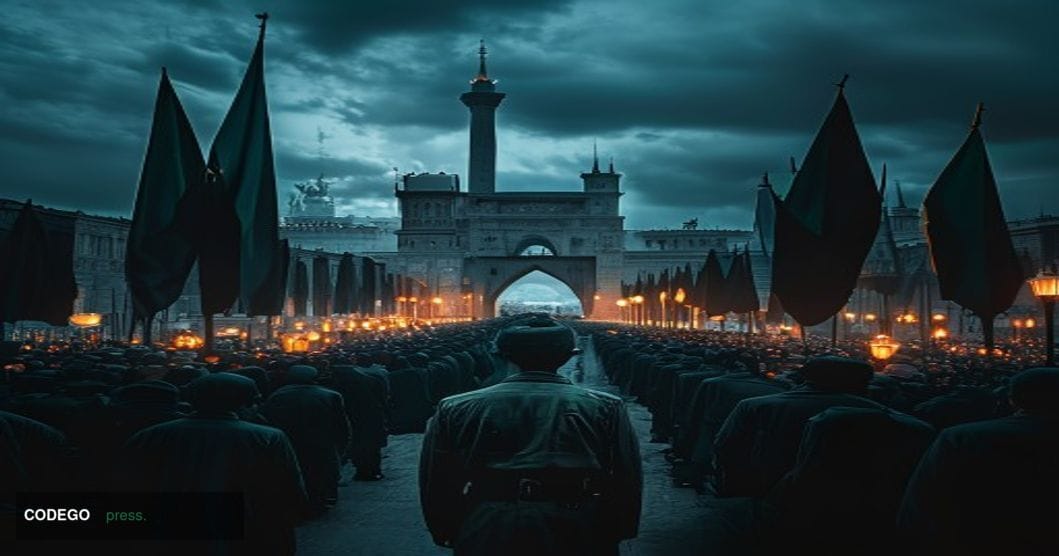
The reported appearance of Ahmad Vahidi — an Interpol-wanted commander within Iran's Islamic Revolutionary Guard Corps (IRGC) — at the state funeral of Supreme Leader Ali Khamenei has sent an immediate tremor through geopolitical risk assessments and, notably, across the prediction markets that increasingly serve as real-time barometers of global political uncertainty. The sighting, reported amid the extraordinary circumstances of one of the Islamic Republic's most consequential moments of transition, raises pointed questions about who holds genuine power in Tehran — and what that means for regional stability, international sanctions enforcement, and the financial instruments tied to Iranian political outcomes.
Khamenei's death represents a generational rupture in Iranian governance. For decades, the Supreme Leader served as the singular axis around which the Islamic Republic's fractious power centers rotated — the IRGC, the clerical establishment, the elected presidency, and the opaque network of revolutionary foundations known as bonyads. His passing does not simply open a succession question; it reorders the entire architecture of institutional authority in a country that sits at the intersection of major global energy corridors, sanctions regimes, and proxy conflict networks spanning from Lebanon to Yemen.
Against that backdrop, Vahidi's presence at the funeral carries a significance that extends well beyond symbolic attendance. Vahidi is a figure with an extraordinary international legal profile: he carries an Interpol red notice in connection with the 1994 bombing of the AMIA Jewish community center in Buenos Aires, an attack that killed 85 people and remains one of the deadliest terrorist incidents in Latin American history. Argentina issued the arrest warrant, and Interpol subsequently circulated it internationally. Despite that status, Vahidi has held senior positions within the Iranian state apparatus — including serving as Defense Minister from 2009 to 2013 — a persistent demonstration of the gap between international legal mechanisms and actual enforcement when sovereign political will is absent.
His visible presence at the highest ceremonial occasion in contemporary Iranian history is therefore not a minor detail. It signals that figures with deep IRGC roots and international legal exposure continue to operate at the heart of Iranian state power, unconcerned by external warrant status. For governments and multilateral bodies attempting to calibrate post-Khamenei engagement with Tehran, this is a meaningful data point about the institutional character of whoever will inherit or contest the Supreme Leader's authority.
Prediction markets — decentralized and centralized platforms that allow participants to stake capital on the probability of real-world political outcomes — have registered the uncertainty almost immediately. These markets, which have grown substantially in prominence following their accurate tracking of several major electoral outcomes globally, are now pricing the probability of various Iranian succession scenarios, degrees of internal power consolidation by IRGC-aligned factions, and the likelihood of escalation or de-escalation in Iran's regional posture. The Vahidi sighting, insofar as it suggests IRGC-hardliner continuity rather than a reformist or moderate opening, has direct implications for how those probabilities are assigned.
For participants in crypto-native prediction platforms and decentralized finance (DeFi) protocols with exposure to geopolitically sensitive assets, these are not abstract concerns. Oil price volatility linked to Iranian political instability has historically transmitted rapidly into broader risk-off sentiment in digital asset markets. Sanctions designations, enforcement actions targeting Iranian crypto channels — a well-documented method of sanctions evasion — and potential conflict escalation in the Strait of Hormuz all represent tangible risk vectors. The confluence of Khamenei's death and the visible prominence of IRGC-linked figures in the immediate aftermath is precisely the kind of compound uncertainty that prediction markets are designed to price, however imperfectly.
The broader financial stability question hinges on what form Iran's leadership transition ultimately takes. A consolidation of power around IRGC-aligned hardliners — an outcome that Vahidi's prominent funeral attendance arguably foreshadows — would likely entrench the current sanctions architecture, diminish the prospect of a renewed nuclear agreement, and sustain the geopolitical risk premium that affects energy markets from the Persian Gulf to European futures exchanges. A more contested succession, or one that elevates figures with greater institutional distance from the IRGC's most internationally exposed commanders, could open different trajectories — none of them simple, but some more amenable to negotiated engagement.
What This Means for Markets and Policy
For financial professionals, risk analysts, and participants in politically sensitive prediction markets, the lesson from Vahidi's reported appearance is straightforward: the institutional depth of the IRGC within Iranian state power should not be underestimated during this transition period. The presence of an Interpol-wanted figure at a head-of-state funeral, without apparent concern for international legal exposure, is itself a geopolitical signal of the first order. Prediction market participants, sanctions compliance officers, and investors with exposure to Middle Eastern energy and political risk would be prudent to weight IRGC continuity scenarios more heavily in their models as Iran's succession unfolds. The funeral was not merely a ceremony — it was, in geopolitical terms, an opening statement.
Written by the editorial team — independent journalism powered by Codego Press.