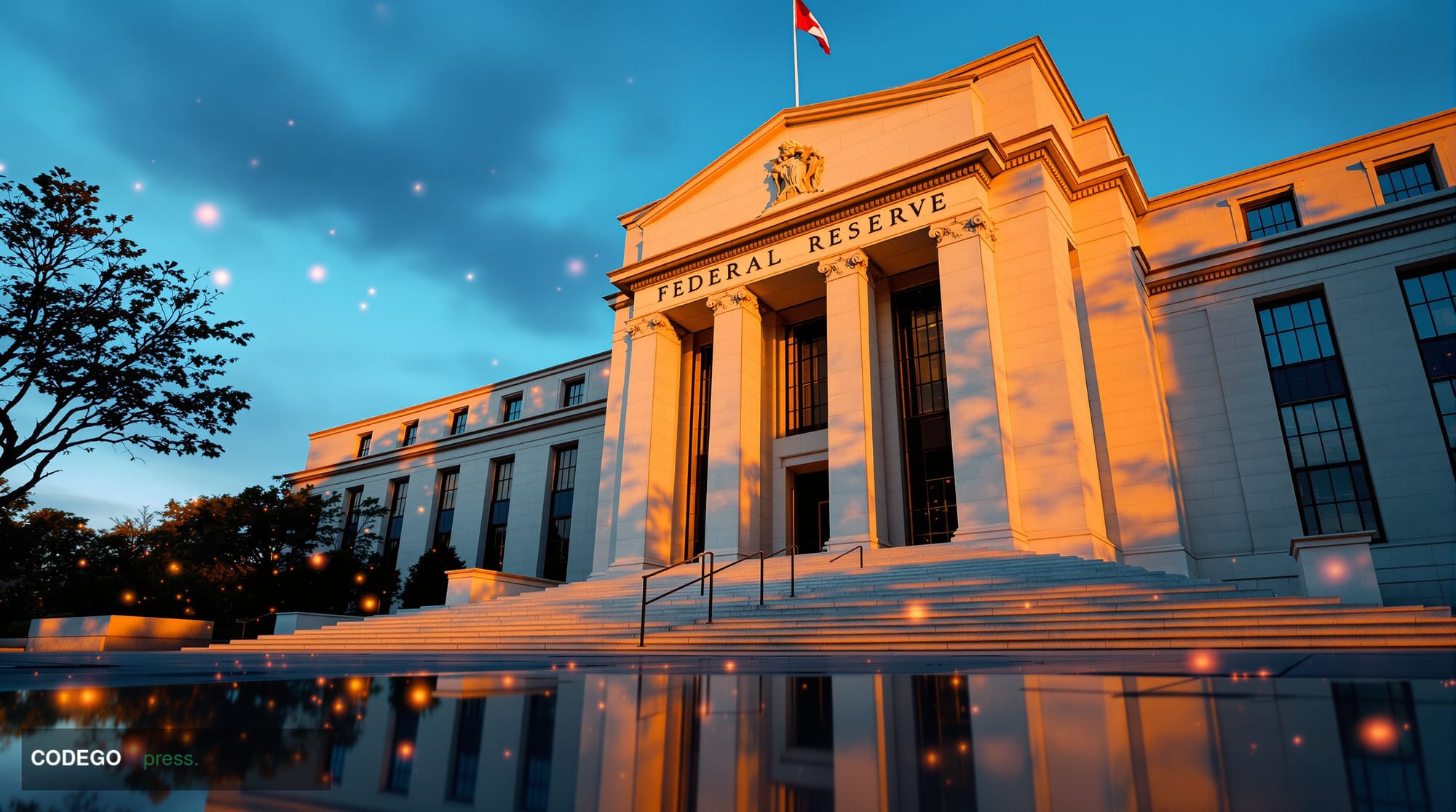
The changing of the guard at the Federal Reserve carries profound implications for financial markets, but Kevin Warsh's swearing-in as chair represents something more significant for the cryptocurrency ecosystem. His appointment to replace Jerome Powell arrives at a critical juncture when Bitcoin and digital assets have evolved from peripheral curiosities to instruments intimately connected to the Fed's policy decisions on interest rates, market liquidity, and institutional risk appetite.
Warsh's elevation to the Fed's top post signals a departure from conventional central banking orthodoxy, positioning him as a chair who arrives with a fundamentally different perspective on monetary policy and its intersection with emerging financial technologies. This transition occurs against a backdrop where Bitcoin has demonstrated its sensitivity to Federal Reserve actions, with digital asset prices often moving in lockstep with shifts in monetary policy expectations and liquidity conditions.
The symbolic nature of Warsh's appointment extends beyond mere personnel changes. His leadership represents the first time the Federal Reserve will be helmed by someone who recognizes the structural role that cryptocurrency has assumed within the broader financial system. Unlike previous Fed chairs who viewed digital assets as speculative instruments operating at the margins, Warsh enters his tenure acknowledging Bitcoin's established connections to traditional monetary mechanisms including interest rate cycles, dollar strength, and institutional capital flows.
This recognition carries significant implications for how the Federal Reserve approaches its dual mandate of price stability and full employment in an era where digital assets have become integral to institutional portfolios and retail investment strategies. The interconnectedness between Bitcoin and traditional financial markets means that Fed policy decisions now ripple through cryptocurrency markets with unprecedented speed and magnitude, creating feedback loops that previous central bank leadership may not have fully appreciated.
For cryptocurrency markets, Warsh's appointment suggests a potential shift toward monetary policy frameworks that explicitly consider digital asset implications rather than treating them as externalities. This evolution reflects the maturation of cryptocurrency from a niche technology experiment to a legitimate asset class that demands sophisticated policy consideration. The timing proves particularly relevant as institutional adoption of Bitcoin continues expanding through exchange-traded funds, corporate treasury allocations, and pension fund investments.
The broader implications extend to regulatory clarity and policy consistency across federal agencies overseeing digital assets. A Fed chair who understands cryptocurrency's role in modern finance could provide the institutional leadership necessary to coordinate coherent policy approaches across the Treasury Department, Securities and Exchange Commission, and Commodity Futures Trading Commission. Such coordination has been notably absent in previous administrations, creating regulatory uncertainty that has hindered broader cryptocurrency adoption.
Market participants will closely monitor Warsh's initial policy statements and Federal Open Market Committee guidance for signals about how his understanding of cryptocurrency markets might influence traditional monetary policy tools. The relationship between Fed policy and Bitcoin prices has grown increasingly sophisticated, with digital asset traders now parsing Fed communications with the same intensity previously reserved for bond and equity markets.
The appointment represents a generational shift in central banking philosophy, acknowledging that monetary policy in the 21st century must account for digital assets that operate across traditional jurisdictional boundaries and respond to policy signals in ways that challenge conventional economic models. Warsh's leadership will test whether the Federal Reserve can adapt its policy frameworks to effectively manage an economy where cryptocurrency plays an increasingly central role without sacrificing its core mandates of price stability and employment maximization.
Written by the editorial team — independent journalism powered by Codego Press.