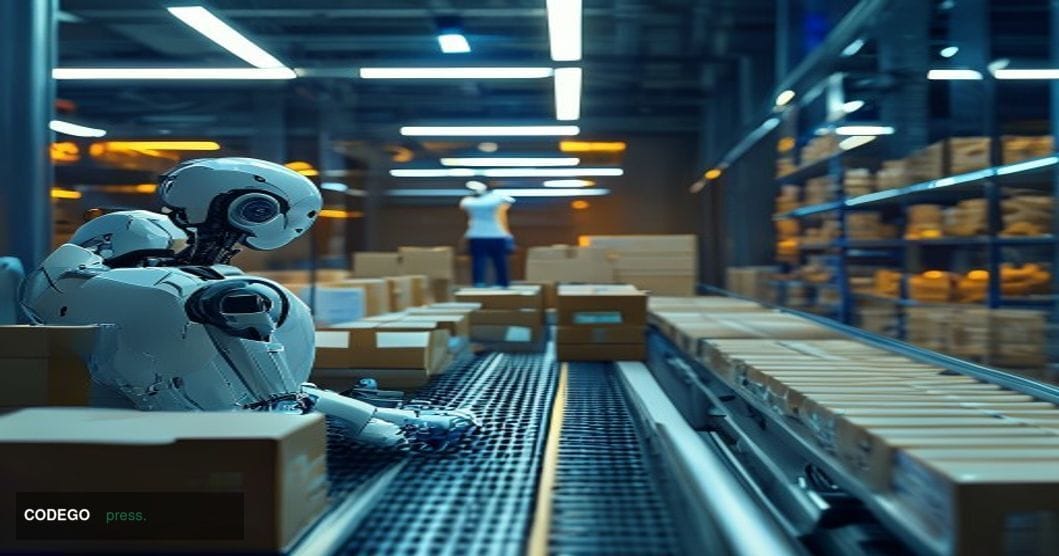
The age-old question of human versus machine efficiency received a definitive answer last week when Figure AI's most advanced humanoid robot suffered a decisive defeat in a grueling endurance test. The company's flagship F.03 robot lost a live-streamed 10-hour package sorting contest to Aime, a human intern, who managed to process 192 more packages than the machine designed to revolutionize warehouse automation.
The "Man vs. Machine" challenge, orchestrated by Figure AI itself, represents more than a publicity stunt—it exposes the current limitations of even the most sophisticated robotics technology in real-world applications. While the company positioned the contest as an exploratory exercise to benchmark AI capabilities against human performance, the results reveal significant gaps between robotics marketing promises and operational reality.
Figure AI's willingness to stage such a public test demonstrates either remarkable confidence or strategic transparency about their technology's current state. The F.03 represents the pinnacle of the company's engineering efforts, incorporating advanced machine learning algorithms and precision actuators designed specifically for repetitive industrial tasks. Yet over the course of ten hours, human adaptability, problem-solving, and stamina proved superior to artificial intelligence and mechanical precision.
The 192-package margin of victory suggests systematic advantages rather than random variation or isolated incidents. Humans possess inherent flexibility in handling irregular packages, adapting to unexpected situations, and maintaining consistent performance over extended periods. These capabilities remain challenging to replicate in robotic systems, despite significant advances in computer vision and motor control technologies.
For investors and industry observers, this outcome carries profound implications for the robotics sector's near-term commercial viability. Companies across the automation spectrum have attracted billions in venture funding based on promises of human-equivalent or superior performance in industrial applications. Figure AI itself has raised substantial capital from prominent investors betting on the transformative potential of humanoid robotics in logistics and manufacturing environments.
The live-streaming aspect adds another dimension to the results' significance. By broadcasting the competition in real-time, Figure AI subjected their technology to transparent public scrutiny—a bold move that contrasts sharply with the controlled demonstrations typically used to showcase robotic capabilities. This approach suggests either genuine confidence in their technology's competitive position or strategic preparation for more realistic market expectations.
The contest also highlights the complexity of human-robot workplace integration. Rather than simple replacement scenarios, the results suggest complementary deployment models may prove more practical in the immediate future. Humans excel in adaptability and problem-solving, while robots offer consistency and endurance advantages in specific, well-defined tasks.
Market Reality Check for Robotics Valuations
The implications extend beyond Figure AI to the broader robotics investment landscape. Companies promising imminent human replacement through robotic automation may need to recalibrate timelines and deployment strategies. The package sorting challenge represents exactly the type of repetitive, structured task where robots should theoretically excel—making the human victory particularly significant for market expectations.
This outcome arrives as the robotics sector faces increasing scrutiny over commercialization timelines and return on investment projections. While technological progress continues advancing rapidly, the gap between laboratory capabilities and real-world performance remains substantial. Aime's victory demonstrates that human workers retain competitive advantages that may persist longer than many industry forecasts anticipate, potentially reshaping investment strategies and deployment priorities across the automation sector.
Written by the editorial team — independent journalism powered by Codego Press.